Review
. 2020 Dec 31:12:13553-13566.
doi: 10.2147/CMAR.S285083. eCollection 2020.

The Dynamic Process and Its Dual Effects on Tumors of Therapy-Induced Senescence

Affiliations
Review

The Dynamic Process and Its Dual Effects on Tumors of Therapy-Induced Senescence

Chenxi Liao et al. Cancer Manag Res. .

Abstract

Cellular senescence is traditionally considered as stable cell cycle arrest state with other phenotypic alterations including the production of an array of cytokines and growth factors. Cancer cells undergo senescence in response to chemotherapeutic agents, radiotherapy and molecular targeted therapy. This form of senescence is termed therapy-induced senescence (TIS) and represents a desirable target in cancer therapy. Recent studies have shown that cellular senescence is a highly heterogeneous and dynamic process. Apart from being cleared by the immune system, the senescent cancer cells may survive for a long time and escape from senescence state. Notably, these cells even have the potential to regain stem-like state with high aggressiveness that eventually facilitates cancer recurrence. Furthermore, the senescence-associated secretory phenotype (SASP) of senescent cells is not always the same, and could establish immunosuppression and a protumor microenvironment. Given these detrimental effects, senescence-inducing chemotherapy followed by senotherapy (the "one-two punch" approach), has emerged. This combined therapy could mitigate unnecessary side effects of the persistent senescent cells, reduce the toxicity of pro-senescence therapy and prolong the survival of cancer patients, and it has a potential future in the precise treatment of cancer. Herein, we review the complex effects of therapy-induced senescence in cancer and highlight the great promise of two-step strategies in anticancer therapies.

Keywords: SASP; cancer therapy; cellular senescence; reversibility; senotherapy.


Conflict of interest statement

The authors report no conflicts of interest in this work.

Figures
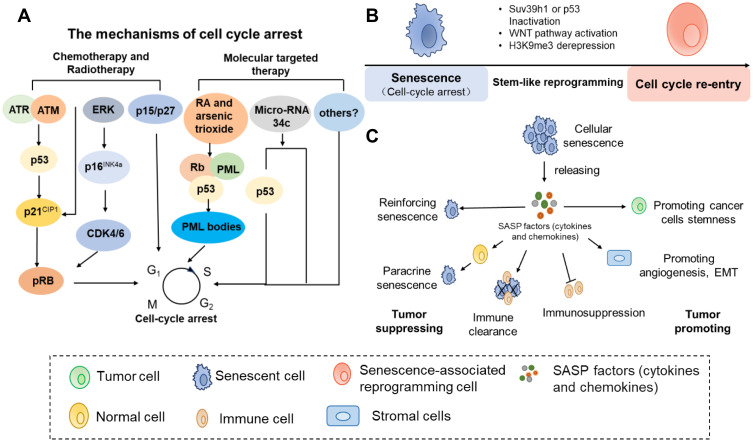
Figure 1
Figure 1
The mechanism and function of therapy-induced senescence. (A) Therapy induce senescence-associated growth arrest by generating DNA damage or targeting reinitiation of senescent pathway signaling. (B) The senescent cells could reprogram with stemness by Suv39 h1 or p53 inactivation, Wnt stem signaling activation and/or derepression of the H3K9 me3 mark. (C) The SASP is an important mediator of cross-talk between senescent cells and nonsenescent cells. Scheme summarizing some of the functions associated with the SASP.
Figure 2
Figure 2
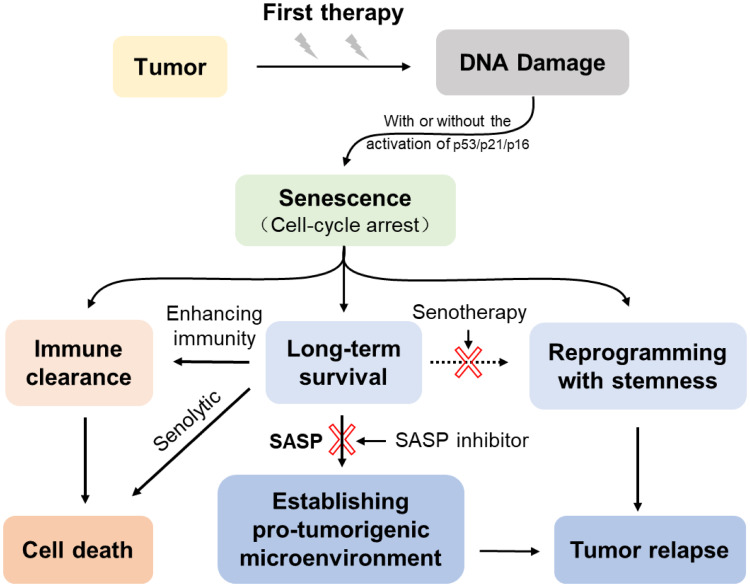
The dynamic process of chemotherapy-induced senescence. Cancer cells undergo senescence after exposure to chemotherapeutic agents in response to DNA damage, and then activate the p53/p21CIP1 and/or p16INK4a/Rb tumor suppressor networks. On the one hand, the senescent cancer cells are cleared by activating the immune system. On the other hand, failure to clear CIS cells can last in the long-term and even escape from the senescent state. The accumulating senescent cells are able to shape their surroundings toward a tumor-permissive and chronic inflammatory microenvironment by SASP. The escaping senescent cells could reprogram with stemness recovery which contributes to tumor relapse. Using senotherapy after senescence-inducing chemotherapy could mitigate unnecessary side effects of the senescent cells.

References

    1. Herranz N, Gil J. Mechanisms and functions of cellular senescence. J Clin Invest. 2018;128(4):1238–1246. doi:10.1172/JCI95148 - DOI - PMC - PubMed
    1. Lee S, Schmitt CA. The dynamic nature of senescence in cancer. Nat Cell Biol. 2019;21(1):94–101. doi:10.1038/s41556-018-0249-2 - DOI - PubMed
    1. Hayflick L, Moorhead PS. The serial cultivation of human diploid cell strains. Exp Cell Res. 1961;25:585–621. doi:10.1016/0014-4827(61)90192-6 - DOI - PubMed
    1. Prieur A, Peeper DS. Cellular senescence in vivo: a barrier to tumorigenesis. Curr Opin Cell Biol. 2008;20(2):150–155. doi:10.1016/j.ceb.2008.01.007 - DOI - PubMed
    1. Ewald JA, Desotelle JA, Wilding G, Jarrard DF. Therapy-induced senescence in cancer. J Natl Cancer Inst. 2010;102(20):1536–1546. doi:10.1093/jnci/djq364 - DOI - PMC - PubMed