Comparative Study
. 2020 Dec 21:11:615327.
doi: 10.3389/fimmu.2020.615327. eCollection 2020.

Bidirectional Action of Cenicriviroc, a CCR2/CCR5 Antagonist, Results in Alleviation of Pain-Related Behaviors and Potentiation of Opioid Analgesia in Rats With Peripheral Neuropathy

Affiliations
Comparative Study

Bidirectional Action of Cenicriviroc, a CCR2/CCR5 Antagonist, Results in Alleviation of Pain-Related Behaviors and Potentiation of Opioid Analgesia in Rats With Peripheral Neuropathy

Klaudia Kwiatkowski et al. Front Immunol. .

Abstract

Clinical management of neuropathic pain is unsatisfactory, mainly due to its resistance to the effects of available analgesics, including opioids. Converging evidence indicates the functional interactions between chemokine and opioid receptors and their influence on nociceptive processes. Recent studies highlight that the CC chemokine receptors type 2 (CCR2) and 5 (CCR5) seem to be of particular interest. Therefore, in this study, we investigated the effects of the dual CCR2/CCR5 antagonist, cenicriviroc, on pain-related behaviors, neuroimmune processes, and the efficacy of opioids in rats after chronic constriction injury (CCI) of the sciatic nerve. To define the mechanisms of action of cenicriviroc, we studied changes in the activation/influx of glial and immune cells and, simultaneously, the expression level of CCR2, CCR5, and important pronociceptive cytokines in the spinal cord and dorsal root ganglia (DRG). We demonstrated that repeated intrathecal injections of cenicriviroc, in a dose-dependent manner, alleviated hypersensitivity to mechanical and thermal stimuli in rats after sciatic nerve injury, as measured by von Frey and cold plate tests. Behavioral effects were associated with the beneficial impact of cenicriviroc on the activation/influx level of C1q/IBA-1-positive cells in the spinal cord and/or DRG and GFAP-positive cells in DRG. In parallel, administration of cenicriviroc decreased the expression of CCR2 in the spinal cord and CCR5 in DRG. Concomitantly, we observed that the level of important pronociceptive factors (e.g., IL-1beta, IL-6, IL-18, and CCL3) were increased in the lumbar spinal cord and/or DRG 7 days following injury, and cenicriviroc was able to prevent these changes. Additionally, repeated administration of this dual CCR2/CCR5 antagonist enhanced the analgesic effects of morphine and buprenorphine in neuropathic rats, which can be associated with the ability of cenicriviroc to prevent nerve injury-induced downregulation of all opioid receptors at the DRG level. Overall, our results suggest that pharmacological modulation based on the simultaneous blockade of CCR2 and CCR5 may serve as an innovative strategy for the treatment of neuropathic pain, as well as in combination with opioids.

Keywords: CCL3; IL-18; IL-1beta; IL-6; buprenorphine; microglia; morphine; opioid receptor.


Conflict of interest statement

The authors declare that the research was conducted in the absence of any commercial or financial relationships that could be construed as a potential conflict of interest.

Figures
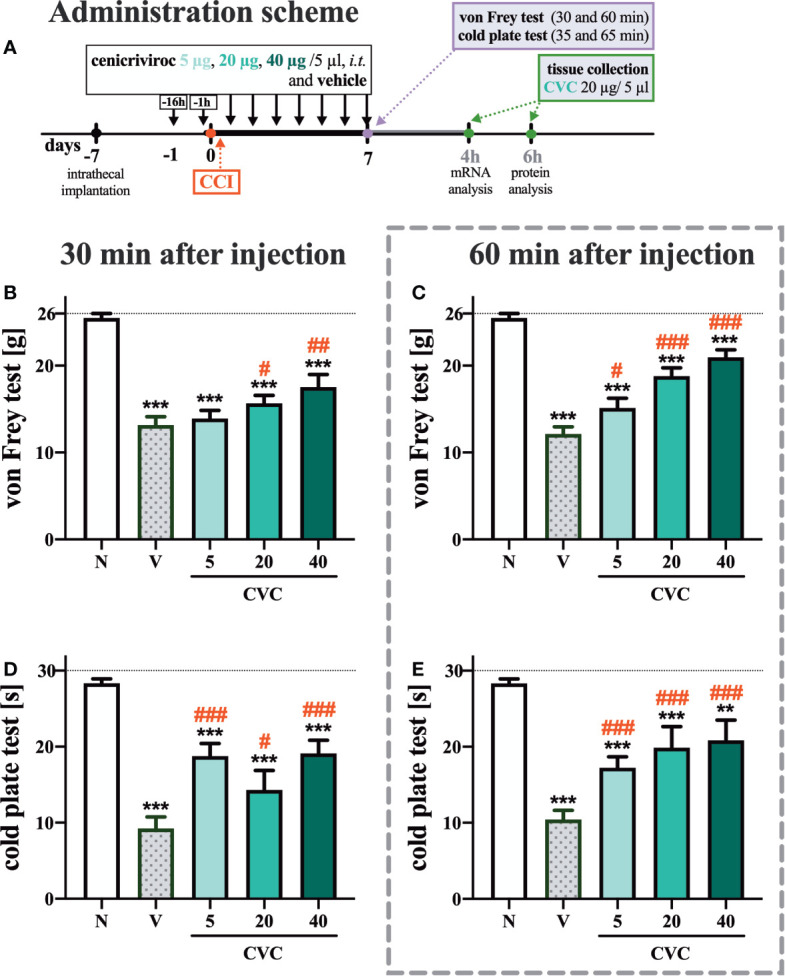
Figure 1
Figure 1
Dose-dependent changes following the preemptive (16 h and 1 h before CCI) and then repeated i.t. administration of cenicriviroc in concentrations of 5 µg, 20 µg, and 40 µg/5 µl [(A) administration scheme] on pain-related behaviors [(B, C) von Frey test; (D, E) cold plate test] on day 7 post CCI, 30 min or 60 min after cenicriviroc or vehicle injection. Data are presented as the mean ± SEM (n = 7–10 per group). Intergroup differences were analyzed by ANOVA with Bonferroni’s multiple comparisons test. ***p < 0.0001, **p < 0.01 indicates differences between naive and CCI-exposed rats; ###p < 0.001, ##p < 0.01, #p < 0.05 indicates differences between V-treated and CVC-treated CCI-exposed rats. The dotted line shows the cut-off value. CCI, chronic constriction injury; CVC, cenicriviroc; N, naive; V, vehicle.
Figure 2
Figure 2
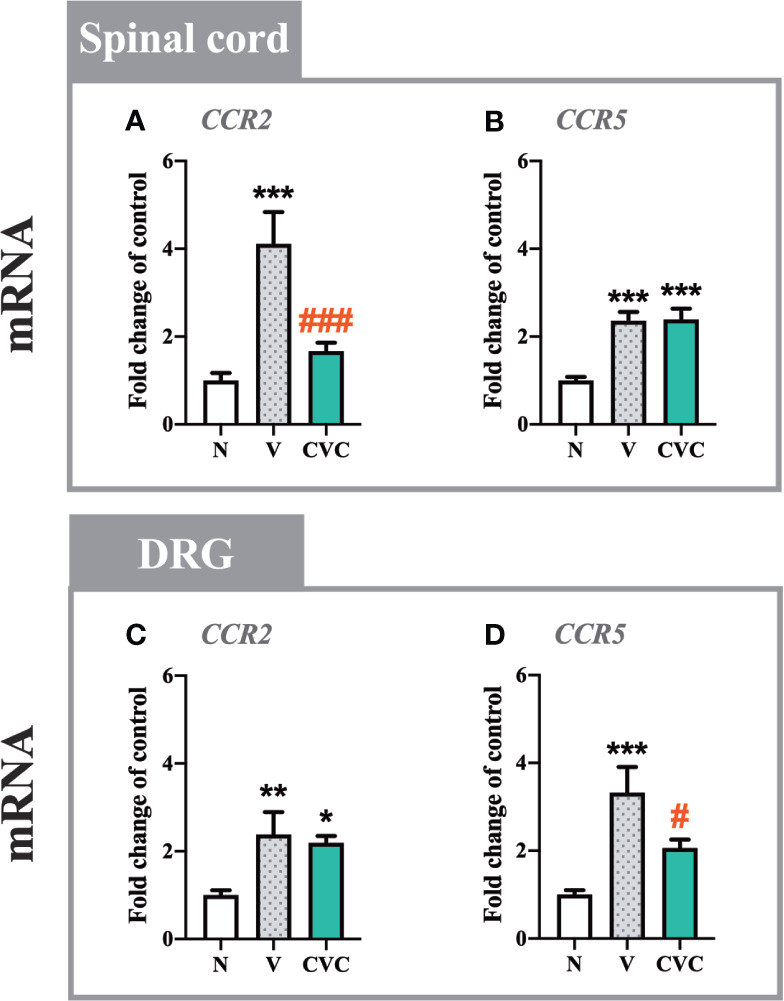
Changes in mRNA levels of CCR2 and CCR5 in the spinal cord (A, B) and DRG (C, D) on day 7 post CCI after repeated vehicle or cenicriviroc (20 µg/5 µl, i.t.) administrations, measured using RT-qPCR method. Data are presented as the mean ± SEM (n = 6–8 per group). Intergroup differences were analyzed by ANOVA with Bonferroni’s multiple comparisons test. ***p < 0.001, **p < 0.01, *p < 0.05 indicate differences between naive and V-treated/CVC-treated CCI-exposed rats; ###p < 0.001, #p < 0.05 indicate differences between V-treated and CVC-treated CCI-exposed rats. CCI, chronic constriction injury; CVC, cenicriviroc; N, naive; V, vehicle.
Figure 3
Figure 3
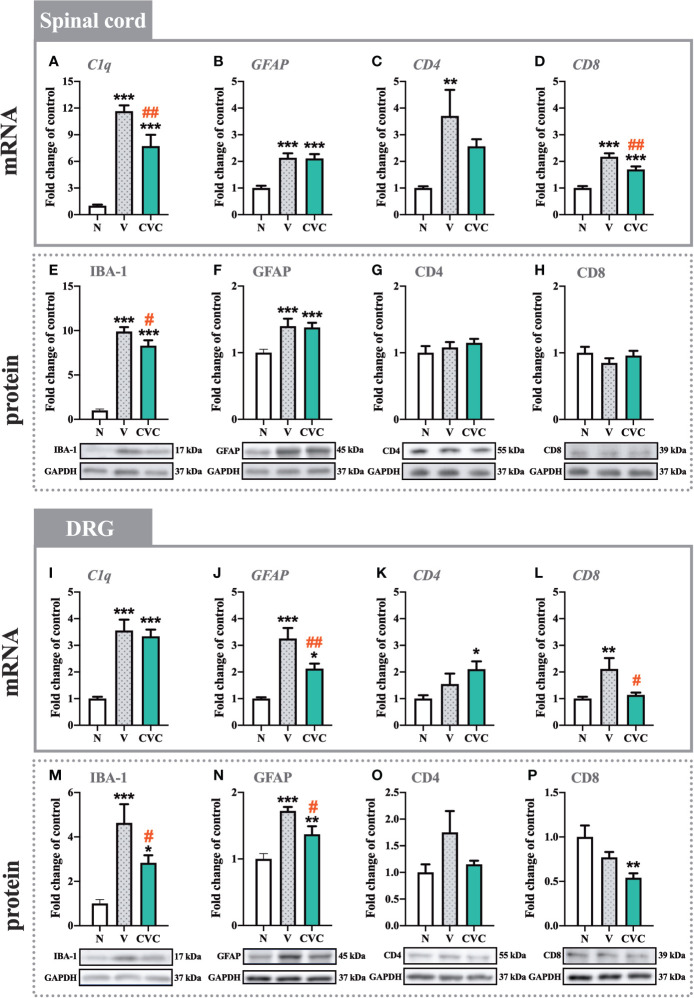
Changes in mRNA (A–D, I–L) and protein (E–H, M–P) levels of C1q/IBA-1, GFAP, CD4, and CD8 in the spinal cord (A–H) and DRG (I–P) on day 7 post CCI, after repeated vehicle or cenicriviroc (20 µg/5 µl, i.t.) administration, measured using RT-qPCR and Western blot method. Data are presented as the mean ± SEM (n = 4–8 per group for mRNA analysis and n = 5–9 per group for protein analysis). Intergroup differences were analyzed by ANOVA with Bonferroni’s multiple comparisons test. ***p < 0.001, **p < 0.01, and *p < 0.05 indicate differences between naive and V-treated/CVC-treated CCI-exposed rats; ##p < 0.01, #p < 0.05 indicate differences between V-treated and CVC-treated CCI-exposed rats. CCI, chronic constriction injury; CVC, cenicriviroc; N, naive; V, vehicle.
Figure 4
Figure 4
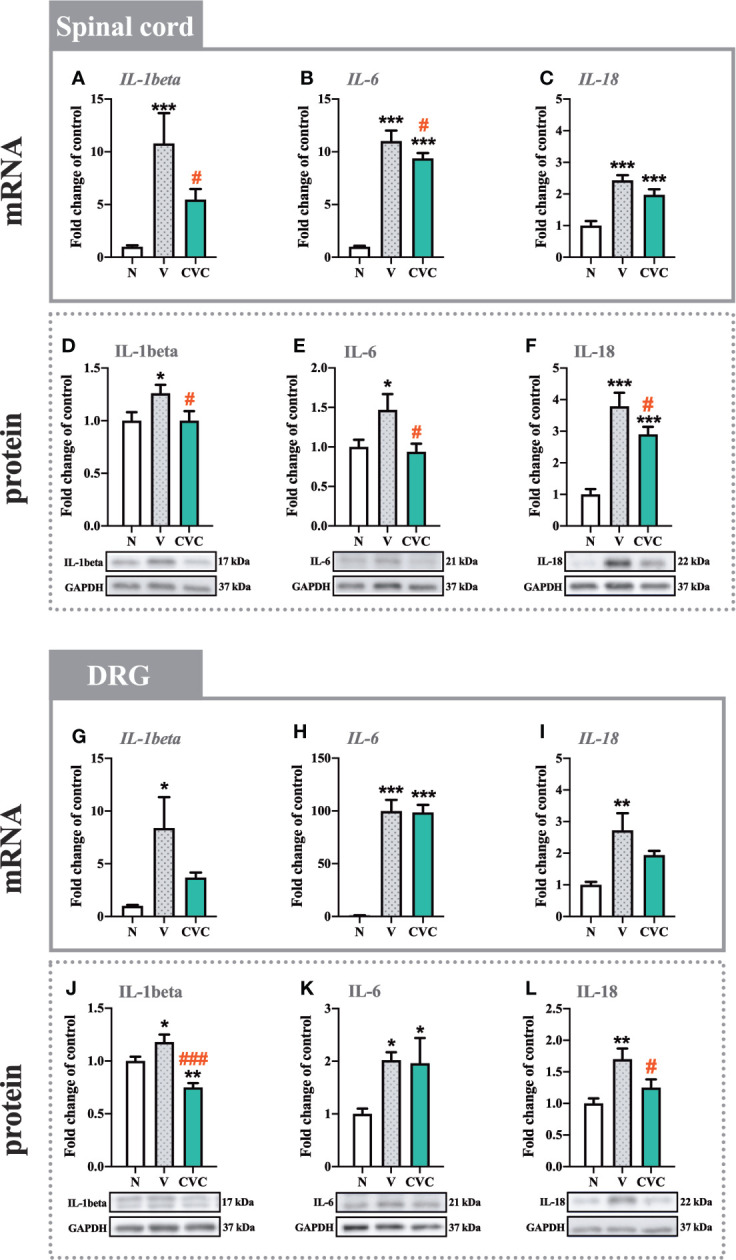
Changes in mRNA (A–C, G–I) and protein (D–F, J–L) levels of IL-1beta, IL-6 and IL-18 in the spinal cord (A–F) and DRG (G–L) on day 7 post CCI after repeated vehicle or cenicriviroc (20 µg/5 µl, i.t.) administration, measured using RT-qPCR and Western blot method. Data are presented as the mean ± SEM (n = 5–10 per group for mRNA analysis and n = 5-7 per group for protein analysis). Intergroup differences were analyzed by ANOVA with Bonferroni’s multiple comparisons test. ***p < 0.001, **p < 0.01, *p < 0.05 indicate differences between naive and V-treated/CVC-treated CCI-exposed rats; ###p < 0.001, #p < 0.05 indicate differences between V-treated and CVC-treated CCI-exposed rats. CCI, chronic constriction injury; CVC, cenicriviroc; N, naive; V, vehicle.
Figure 5
Figure 5
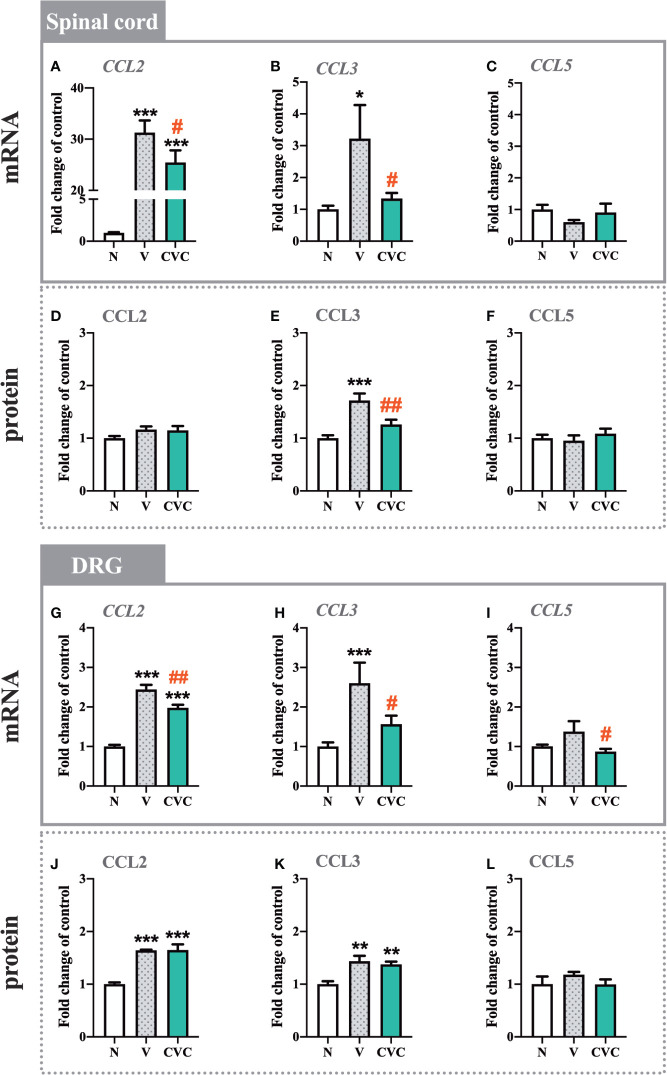
Changes in mRNA (A–C, G–I) and protein (D–F, J–L) levels of CCL2, CCL3 and CCL5 in the spinal cord (A–F) and DRG (G–L) on day 7 post CCI after repeated vehicle or cenicriviroc (20 µg/5 µl, i.t.) administration, measured using RT-qPCR and Luminex Assays. Data are presented as the mean ± SEM (n = 58 per group for mRNA analysis and n = 57 per group for protein analysis). Intergroup differences were analyzed by ANOVA with Bonferroni’s multiple comparisons test. ***p < 0.001, **p < 0.01, *p < 0.05 indicate differences between naive and V-treated/CVC-treated CCI-exposed rats; ##p < 0.01, #p < 0.05 indicate differences between V-treated and CVC-treated CCI-exposed rats. CCI, chronic constriction injury; CVC, cenicriviroc; N, naive; V, vehicle.
Figure 6
Figure 6
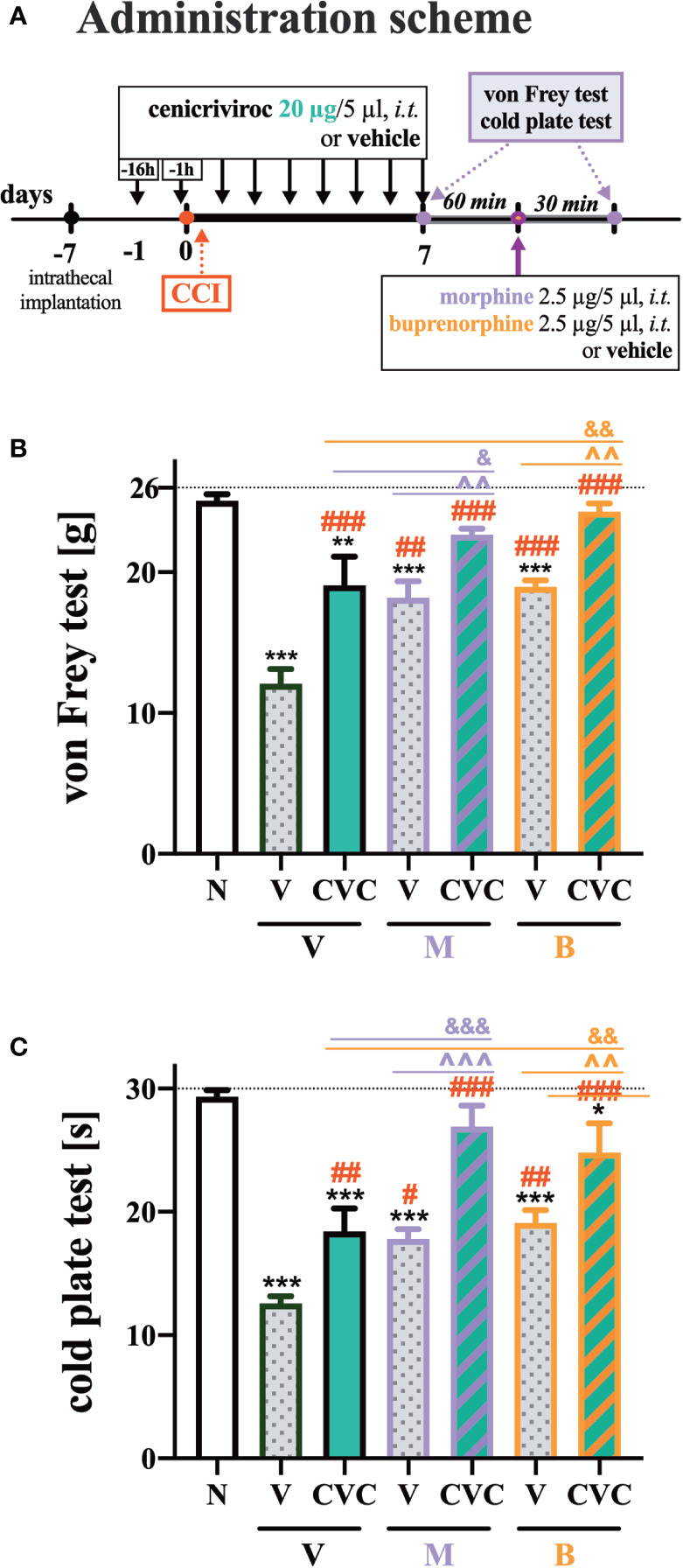
The influence of preemptive (16 h and 1 h before CCI) and then repeated i.t. administration of cenicriviroc in concentration of 20 µg/5 µl [(A) administration scheme] on opioid effectiveness, as measured by the von Frey (B) and cold plate (C) test at 7 days post CCI. On day 7, 60 min after the last cenicriviroc (CVC, 20 µg/5 µl) or vehicle (V) injection, rats received a single i.t. dose of morphine 2.5 µg/5 µl or buprenorphine 2.5 µg/5 µl. Behavioral tests were performed 30 min after opioid administration. The data are presented as the mean ± SEM (n = 6 per group). Intergroup differences were analyzed by ANOVA with Bonferroni’s multiple comparisons test. ***p < 0.001, **p < 0.01, *p < 0.05 indicate differences between naive and CCI-exposed rats; ###p < 0.001, ##p < 0.01, #p < 0.05 indicate differences versus V + V-treated CCI-exposed rats; &&&p < 0.001, &&p < 0.01, &p < 0.05 indicate differences between CVC + V- and CVC+ M/CVC+ B-treated, CCI-exposed rats; ^^^p < 0.001, ^^p < 0.01 indicate differences between V + M/V + B-treated and CVC + M/CVC + B-treated, CCI-exposed rats. The dotted line shows the cut-off value. B, buprenorphine; CCI, chronic constriction injury; CVC, cenicriviroc; M, morphine; N, naive; V, vehicle.
Figure 7
Figure 7
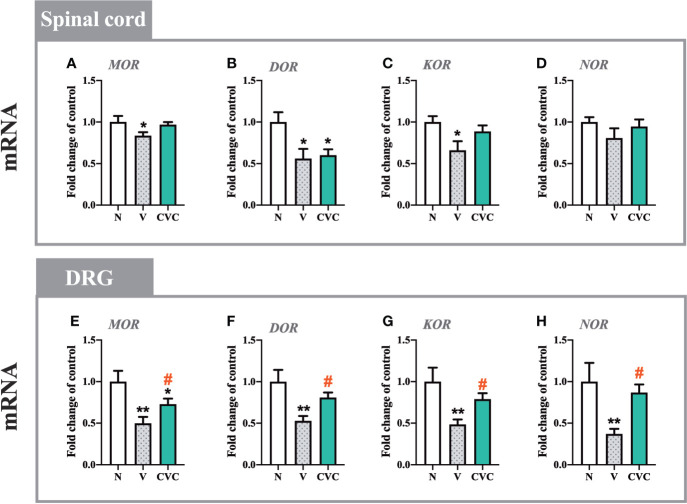
Changes in mRNA levels of MOR, DOR, KOR and NOR in the spinal cord (A–D) and DRG (E–H) on day 7 post CCI after repeated vehicle or cenicriviroc (20 µg/5 µl, i.t.) administration, measured using RT-qPCR method. Data are presented as the mean ± SEM (n = 48 per group). Intergroup differences were analyzed by ANOVA with Bonferroni’s multiple comparisons test. **p < 0.01, *p < 0.05 indicate differences between naive and V-treated/CVC-treated CCI-exposed rats; #p < 0.05 indicates differences between V-treated and CVC-treated CCI-exposed rats. CCI, chronic constriction injury; CVC, cenicriviroc; N, naive; V, vehicle.

References

    1. Mika J, Zychowska M, Popiolek-Barczyk K, Rojewska E, Przewlocka B. Importance of glial activation in neuropathic pain. Eur J Pharmacol (2013) 716:106–19. 10.1016/j.ejphar.2013.01.072 - DOI - PubMed
    1. Gao YJ, Ji RR. Chemokines, neuronal-glial interactions, and central processing of neuropathic pain. Pharmacol Ther (2010) 126:56–68. 10.1016/j.pharmthera.2010.01.002 - DOI - PMC - PubMed
    1. Kiguchi N, Kobayashi Y, Kishioka S. Chemokines and cytokines in neuroinflammation leading to neuropathic pain. Curr Opin Pharmacol (2012) 12:55–61. 10.1016/j.coph.2011.10.007 - DOI - PubMed
    1. Old EA, Clark AK, Malcangio M. The role of glia in the spinal cord in neuropathic and inflammatory pain. Handb Exp Pharmacol (2015) 227:145–70. 10.1007/978-3-662-46450-2_8 - DOI - PubMed
    1. Kwiatkowski K, Mika J. The importance of chemokines in neuropathic pain development and opioid analgesic potency. Pharmacol Rep (2018) 70:821–30. 10.1016/j.pharep.2018.01.006 - DOI - PubMed

Publication types

MeSH terms