


COVID-19-convalescence phase unmasks a silent myocardial infarction due to coronary plaque rupture
- PMID: 33410259
- PMCID: PMC8006695
- DOI: 10.1002/ehf2.13186
COVID-19-convalescence phase unmasks a silent myocardial infarction due to coronary plaque rupture
Abstract
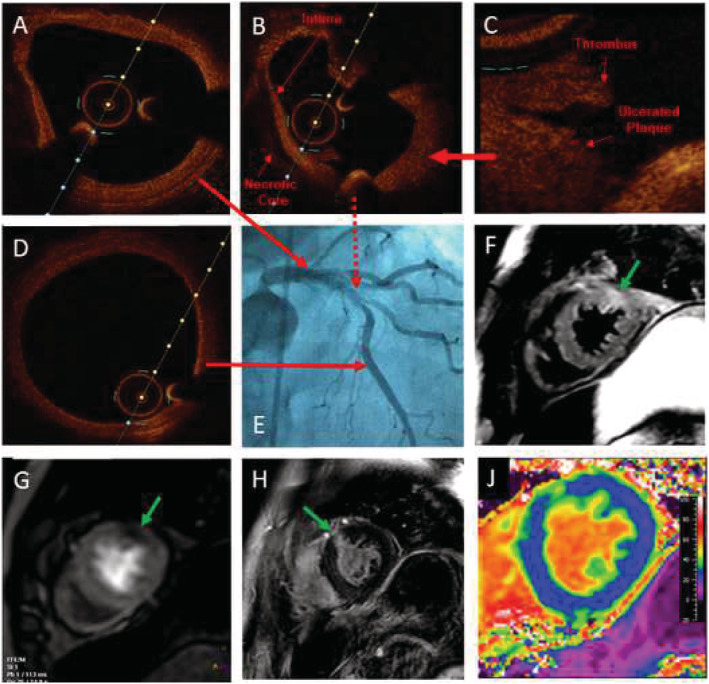
Increased risk of cardiovascular complications during and post-COVID-19 infection is more and more recognized-including myocarditis, arrhythmias, and myocardial infarctions (MIs). The mechanisms leading to these complications are direct virus-induced injuries, as well as potential thrombotic and inflammatory-induced mechanisms. To the latter, inflammatory plaque instability and plaque rupture are discussed entities contributing to MI-induced post-COVID-19 complications. Our case report describes the first time, when a temporary impairment of LVEF in the COVID-19-convalescence phase unmasks a silent MI due to coronary plaque rupture by using invasive (OCT) and non-invasive (CMR) modalities. Myocardial infarction might be an important differential diagnosis to consider in deteriorating patients with COVID-19, especially if dyspnoea persists after acute infection.
Keywords: CMR; COVID-19; OCT; SARS-CoV-2; convalescence; heart; magnetic resonance; myocardial infarction; myocarditis; recovery; thrombosis.
© 2021 The Authors. ESC Heart Failure published by John Wiley & Sons Ltd on behalf of European Society of Cardiology.
Conflict of interest statement
C.T., M.S.A., and S.K. have received research support by the DZHK (German Centre for Cardiovascular Research) and by the BMBF (German Ministry of Education and Research) and personal fees from Servier, outside the current work. All other authors have nothing to disclose.
Figures
References
-
- Stefanini GG, Montorfano M, Trabattoni D, Andreini D, Ferrante G, Ancona M, Metra M, Curello S, Maffeo D, Pero G, Cacucci M, Assanelli E, Bellini B, Russo F, Ielasi A, Tespili M, Danzi GB, Vandoni P, Bollati M, Barbieri L, Oreglia J, Lettieri C, Cremonesi A, Carugo S, Reimers B, Condorelli G, Chieffo A. ST‐elevation myocardial infarction in patients with COVID‐19: clinical and angiographic outcomes. Circulation 2020; 141: 2113–2116. - PMC - PubMed
-
- Goyal P, Choi JJ, Pinheiro LC, Schenck EJ, Chen R, Jabri A, Satlin MJ, Campion TR Jr, Nahid M, Ringel JB, Hoffman KL, Alshak MN, Li HA, Wehmeyer GT, Rajan M, Reshetnyak E, Hupert N, Horn EM, Martinez FJ, Gulick RM, Safford MM. Clinical characteristics of Covid‐19 in New York city. N Engl J Med 2020; 382: 2372–2374. - PMC - PubMed
-
- Kelle S, Bucciarelli‐Ducci C, Judd RM, Kwong RY, Simonetti O, Plein S, Raimondi F, Weinsaft JW, Wong TC, Carr J. Society for cardiovascular magnetic resonance (SCMR) recommended CMR protocols for scanning patients with active or convalescent phase COVID‐19 infection. J Cardiovasc Magn Reson 2020; 22: 61. - PMC - PubMed
Publication types
MeSH terms
Grants and funding
LinkOut - more resources
Full Text Sources
Other Literature Sources
Medical
Miscellaneous
