


Tuber Locations Associated with Infantile Spasms Map to a Common Brain Network
- PMID: 33410532
- PMCID: PMC7969435
- DOI: 10.1002/ana.26015
Tuber Locations Associated with Infantile Spasms Map to a Common Brain Network
Abstract
Objective: Approximately 50% of patients with tuberous sclerosis complex develop infantile spasms, a sudden onset epilepsy syndrome associated with poor neurological outcomes. An increased burden of tubers confers an elevated risk of infantile spasms, but it remains unknown whether some tuber locations confer higher risk than others. Here, we test whether tuber location and connectivity are associated with infantile spasms.
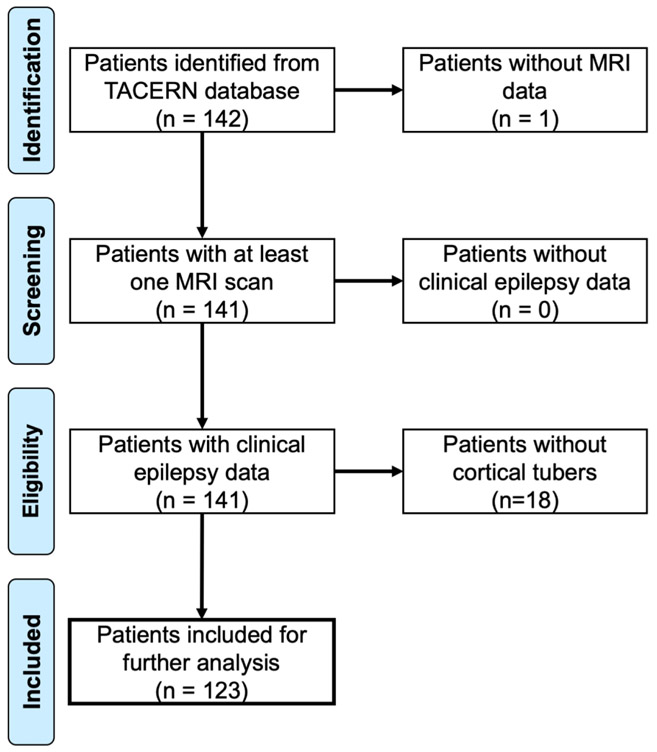
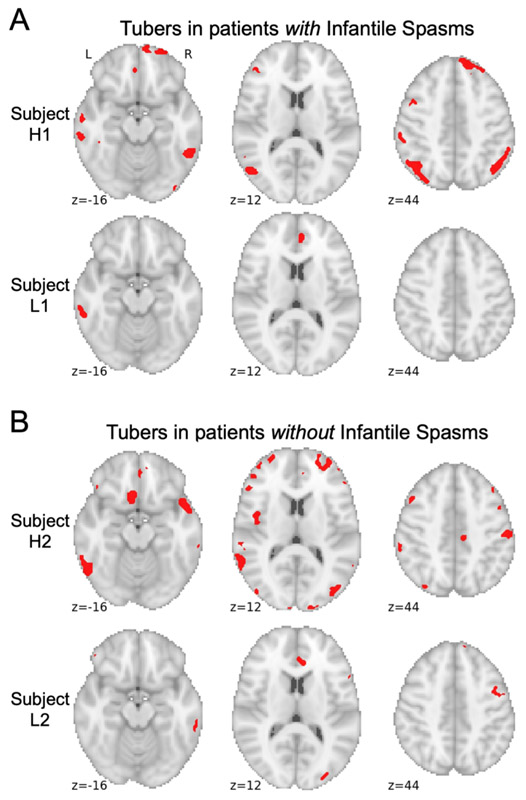
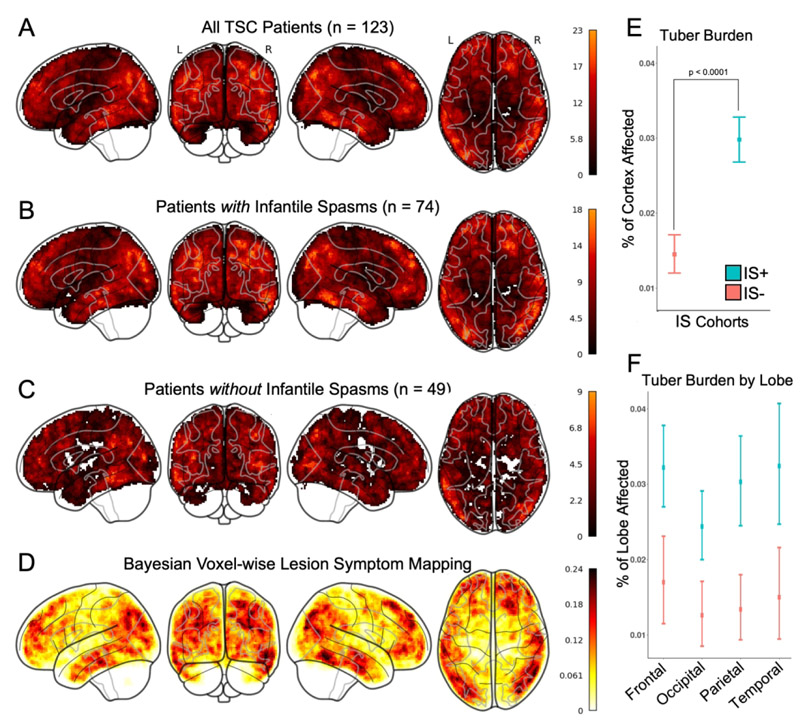
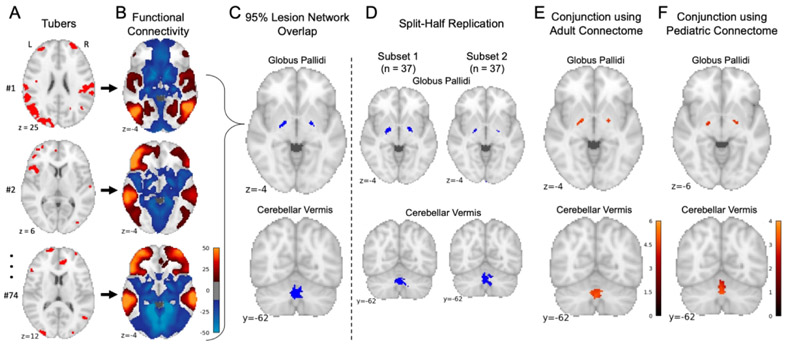
Methods: We segmented tubers from 123 children with (n = 74) and without (n = 49) infantile spasms from a prospective observational cohort. We used voxelwise lesion symptom mapping to test for an association between spasms and tuber location. We then used lesion network mapping to test for an association between spasms and connectivity with tuber locations. Finally, we tested the discriminability of identified associations with logistic regression and cross-validation as well as statistical mediation.
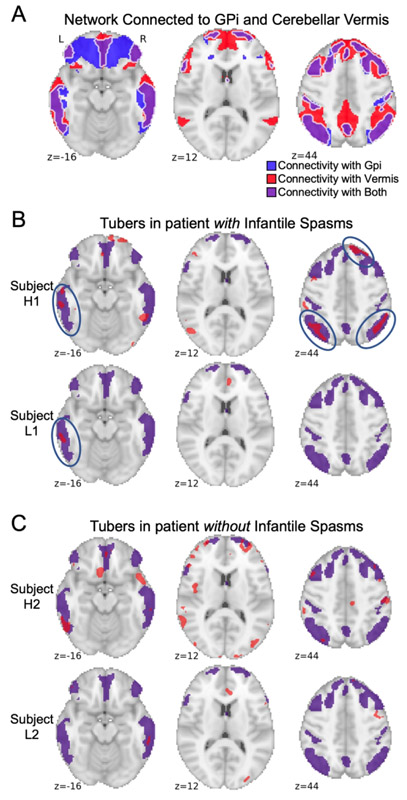
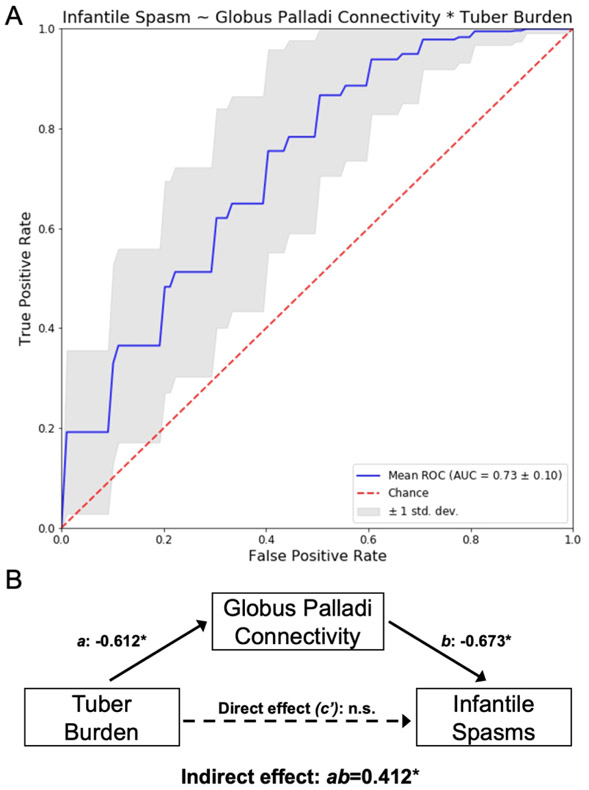
Results: Tuber locations associated with infantile spasms were heterogenous, and no single location was significantly associated with spasms. However, >95% of tuber locations associated with spasms were functionally connected to the globi pallidi and cerebellar vermis. These connections were specific compared to tubers in patients without spasms. Logistic regression found that globus pallidus connectivity was a stronger predictor of spasms (odds ratio [OR] = 1.96, 95% confidence interval [CI] = 1.10-3.50, p = 0.02) than tuber burden (OR = 1.65, 95% CI = 0.90-3.04, p = 0.11), with a mean receiver operating characteristic area under the curve of 0.73 (±0.1) during repeated cross-validation.
Interpretation: Connectivity between tuber locations and the bilateral globi pallidi is associated with infantile spasms. Our findings lend insight into spasm pathophysiology and may identify patients at risk. ANN NEUROL 2021;89:726-739.
© 2021 American Neurological Association.
Conflict of interest statement
Potential Conflicts of interest
Nothing to report.
Figures
References
Publication types
MeSH terms
Grants and funding
- U24 DA041147/DA/NIDA NIH HHS/United States
- U01 DA041120/DA/NIDA NIH HHS/United States
- U24 DA041123/DA/NIDA NIH HHS/United States
- U01 DA041156/DA/NIDA NIH HHS/United States
- U01 DA041025/DA/NIDA NIH HHS/United States
- U01 NS082320/NS/NINDS NIH HHS/United States
- U01 DA041089/DA/NIDA NIH HHS/United States
- U01 DA041106/DA/NIDA NIH HHS/United States
- U01 DA041117/DA/NIDA NIH HHS/United States
- U01 DA041174/DA/NIDA NIH HHS/United States
- U54 NS092090/NS/NINDS NIH HHS/United States
- K23 MH120510/MH/NIMH NIH HHS/United States
- U01 DA041093/DA/NIDA NIH HHS/United States
- K23 NS083741/NS/NINDS NIH HHS/United States
- U01 DA041134/DA/NIDA NIH HHS/United States
- U01 DA041022/DA/NIDA NIH HHS/United States
- U01 DA041028/DA/NIDA NIH HHS/United States
- U54 HD090255/HD/NICHD NIH HHS/United States
- U01 DA041048/DA/NIDA NIH HHS/United States
- T32 MH112510/MH/NIMH NIH HHS/United States
- U01 DA041148/DA/NIDA NIH HHS/United States
LinkOut - more resources
Full Text Sources
Other Literature Sources
Medical
