


SARS-CoV-2 infection associated with hepatitis in an infant with X-linked severe combined immunodeficiency
- PMID: 33412294
- PMCID: PMC7834850
- DOI: 10.1016/j.clim.2020.108662
SARS-CoV-2 infection associated with hepatitis in an infant with X-linked severe combined immunodeficiency
Abstract
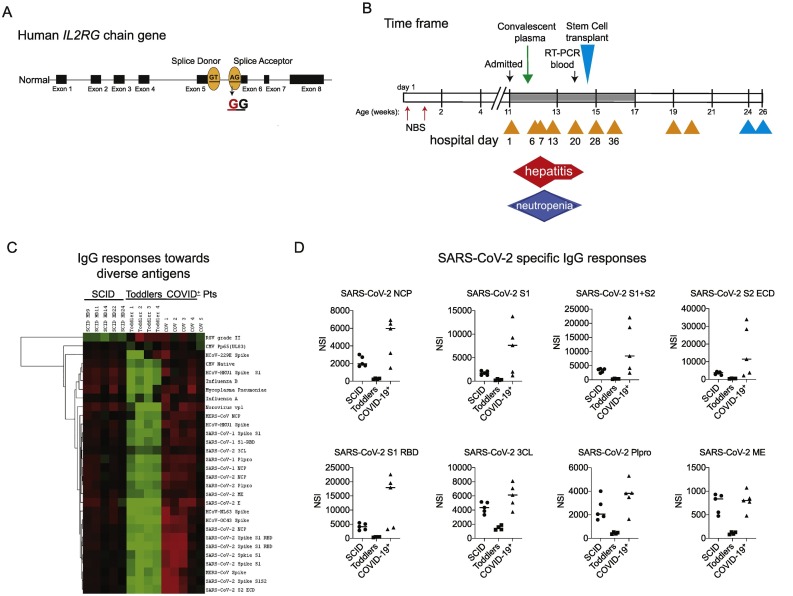
X-linked severe combined immunodeficiency (X-SCID) is a disorder of adaptive immunity caused by mutations in the IL-2 receptor common gamma chain gene resulting in deficiencies of T and natural killer cells, coupled with severe dysfunction in B cells. X-SCID is lethal without allogeneic stem cell transplant or gene therapy due to opportunistic infections. An infant with X-SCID became infected with SARS-CoV-2 while awaiting transplant. The patient developed severe hepatitis without the respiratory symptoms typical of COVID-19. He was treated with convalescent plasma, and thereafter was confirmed to have SARS-CoV-2 specific antibodies, as detected with a microfluidic antigen array. After resolution of the hepatitis, he received a haploidentical CD34 selected stem cell transplant, without conditioning, from his father who had recovered from COVID-19. SARS CoV-2 was detected via RT-PCR on nasopharyngeal swabs until 61 days post transplantation. He successfully engrafted donor T and NK cells, and continues to do well clinically.
Keywords: Adaptive immunity; COVID-19; Inborn errors of immunity; SARS-CoV-2; Severe combined immunodeficiency.
Copyright © 2020 Elsevier Inc. All rights reserved.
Conflict of interest statement
None.
Figures
References
-
- Huang C., Wang Y., Li X., Ren L., Zhao J., Hu Y., Zhang L., Fan G., Xu J., Gu X., Cheng Z., Yu T., Xia J., Wei Y., Wu W., Xie X., Yin W., Li H., Liu M., Xiao Y., Gao H., Guo L., Xie J., Wang G., Jiang R., Gao Z., Jin Q., Wang J., Cao B. Clinical features of patients infected with 2019 novel coronavirus in Wuhan, China. Lancet. 2020;395:497–506. doi: 10.1016/S0140-6736(20)30183-5. - DOI - PMC - PubMed
-
- Diao B., Wang C., Tan Y., Chen X., Liu Y., Ning L., Chen L., Li M., Liu Y., Wang G., Yuan Z., Feng Z., Zhang Y., Wu Y., Chen Y. Reduction and functional exhaustion of T cells in patients with coronavirus disease 2019 (COVID-19) Front. Immunol. 2020;11:1–7. doi: 10.3389/fimmu.2020.00827. - DOI - PMC - PubMed
-
- Salazar E., Perez K.K., Ashraf M., Chen J., Castillo B., Christensen P.A., Eubank T., Bernard D.W., Eagar T.N., Long S.W., Subedi S., Olsen R.J., Leveque C., Schwartz M.R., Dey M., Chavez-East C., Rogers J., Shehabeldin A., Joseph D., Williams G., Thomas K., Masud F., Talley C., Dlouhy K.G., Lopez B.V., Hampton C., Lavinder J., Gollihar J.D., Maranhao A.C., Ippolito G.C., Saavedra M.O., Cantu C.C., Yerramilli P., Pruitt L., Musser J.M. Treatment of coronavirus disease 2019 (COVID-19) patients with convalescent plasma. Am. J. Pathol. 2020;190:1680–1690. doi: 10.1016/j.ajpath.2020.05.014. - DOI - PMC - PubMed
-
- Shen C., Wang Z., Zhao F., Yang Y., Li J., Yuan J., Wang F., Li D., Yang M., Xing L., Wei J., Xiao H., Yang Y., Qu J., Qing L., Chen L., Xu Z., Peng L., Li Y., Zheng H., Chen F., Huang K., Jiang Y., Liu D., Zhang Z., Liu Y., Liu L. Treatment of 5 critically ill patients with COVID-19 with convalescent plasma. JAMA - J. Am. Med. Assoc. 2020;323:1582–1589. doi: 10.1001/jama.2020.4783. - DOI - PMC - PubMed
Publication types
MeSH terms
Grants and funding
LinkOut - more resources
Full Text Sources
Other Literature Sources
Medical
Miscellaneous
