Review
. 2021 Feb:66:195-204.
doi: 10.1016/j.conb.2020.12.006. Epub 2021 Jan 5.

Neuronal fate acquisition and specification: time for a change

Affiliations
Review

Neuronal fate acquisition and specification: time for a change

Jérôme Bonnefont et al. Curr Opin Neurobiol. 2021 Feb.

Abstract

During embryonic development, neural stem/progenitor cells generate hundreds of different cell types through the combination of intrinsic and extrinsic cues. Recent data obtained in mouse and human cortical neurogenesis provide novel views about this interplay and how it evolves with time, whether during irreversible cell fate transitions that neural stem cells undergo to become neurons, or through gradual temporal changes of competence that lead to increased neuronal diversity from a common stem cell pool. In each case the temporal changes result from a dynamic balance between intracellular states and extracellular signalling factors. The underlying mechanisms are mostly conserved across species, but some display unique features in human corticogenesis, thereby linking temporal features of neurogenesis and human brain evolution.


Figures

Figure 1
Figure 1
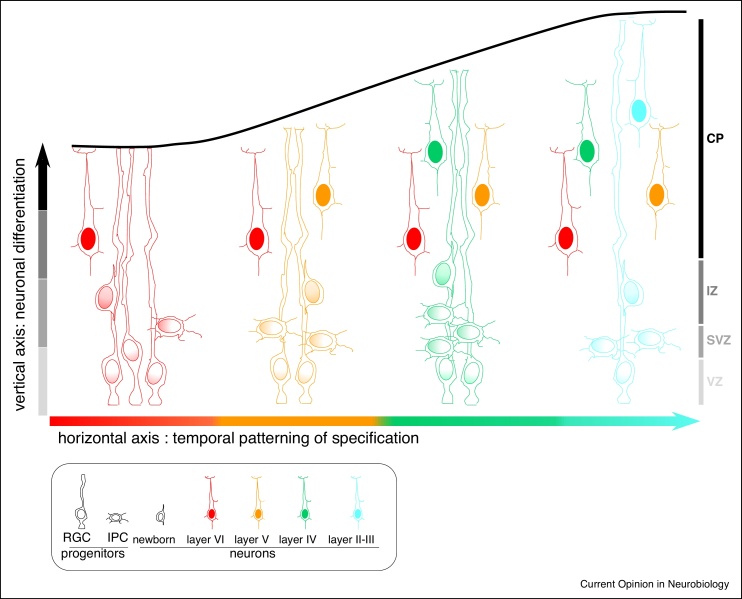
Two orthogonal temporal axes to define the corticogenesis process. Radial glial cells (RGC) differentiate into neurons directly or indirectly through the generation of progenitor subpopulations such as intermediate progenitors (IPC), defining a ‘vertical’ temporal axis of neurogenesis. Another ‘horizontal’ temporal axis is defined by temporal changes taking place in RGC and their progeny over embryonic development, leading to the sequential generation of distinct neuronal subtypes forming the different cortical layers.
Figure 2
Figure 2
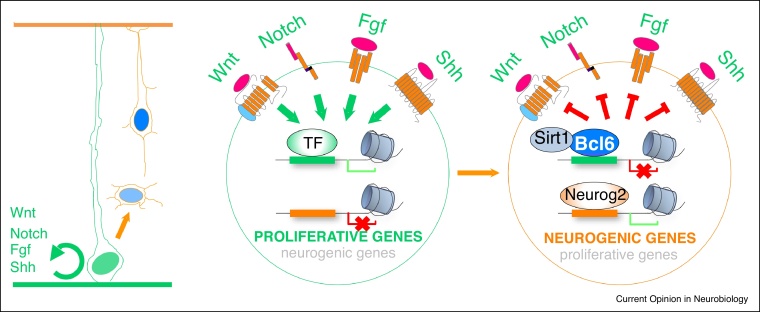
Neurogenesis and the balance of extrinsic and intrinsic cues. During differentiation, progenitors become insulated from extracellular proliferative cues (such as Notch, Wnts, FGFs, SHH), to ensure an irreversible commitment towards neuronal identity. Mechanistically, the switch from proliferation to differentiation of cortical progenitors is promoted by proneural factors like Neurogenin 2, together with Bcl6 repressor activity that ensures the insulation from the extrinsic proliferative cues.
Figure 3
Figure 3
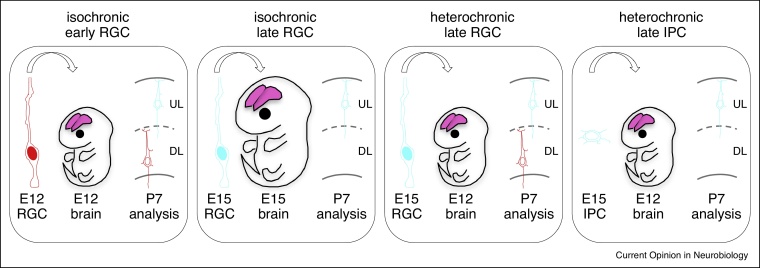
Timing of fate specification revealed by heterochronic transplantations. Isochronic and heterochronic transplantation experiments reveal that late radial glial cells can regain their ability to generate early deep-layer neurons while intermediate progenitors have a fixed identity that cannot be respecified by transplantation.
Figure 4
Figure 4
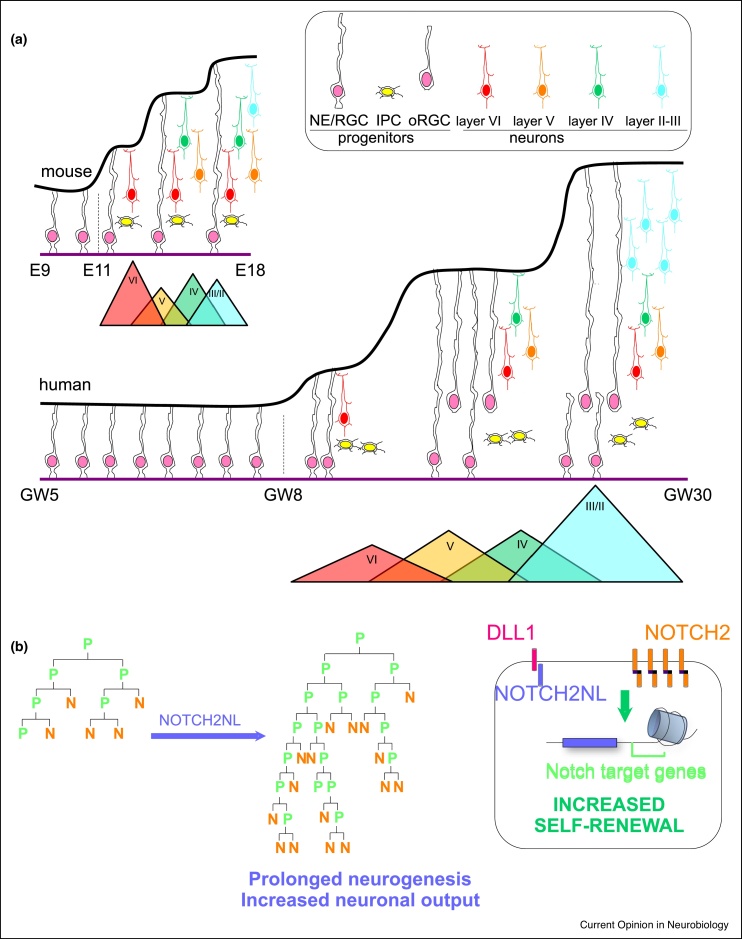
Species differences in the developmental timing of cortical neurogenesis. (a) Cortex expansion may rely on increased number and diversity of progenitor subpopulations (IPC: intermediate progenitor cells and oRGC: outer radial glial cells), as well as protacted steps of initial proliferation of stem/progenitor cells (NE: neuroepithelial cells, RGC: radial glial cells) and neurogenesis. (b) The latter is partly controlled by the human-specific NOTCH2NL genes that increase the self-renewal of cortical progenitors and their subsequent neuron output, by stimulating Notch signaling through a cell-autonomous mechanism.

References

    1. Greig L.C., Woodworth M.B., Galazo M.J., Padmanabhan H., Macklis J.D. Molecular logic of neocortical projection neuron specification, development and diversity. Nat Rev Neurosci. 2013;14:755–769. doi: 10.1038/nrn3586. - DOI - PMC - PubMed
    1. Economo M.N., Viswanathan S., Tasic B., Bas E., Winnubst J., Menon V., Graybuck L.T., Nguyen T.N., Smith K.A., Yao Z. Distinct descending motor cortex pathways and their roles in movement. Nature. 2018;563:79–84. doi: 10.1038/s41586-018-0642-9. - DOI - PubMed
    1. Tasic B., Yao Z., Graybuck L.T., Smith K.A., Nguyen T.N., Bertagnolli D., Goldy J., Garren E., Economo M.N., Viswanathan S. Shared and distinct transcriptomic cell types across neocortical areas. Nature. 2018;563:72–78. doi: 10.1038/s41586-018-0654-5. - DOI - PMC - PubMed
    1. Saunders A., Macosko E.Z., Wysoker A., Goldman M., Krienen F.M., de Rivera H., Bien E., Baum M., Bortolin L., Wang S. Molecular diversity and specializations among the cells of the adult mouse brain. Cell. 2018;174:1015–1030. doi: 10.1016/j.cell.2018.07.028. - DOI - PMC - PubMed
    1. Zeisel A., Hochgerner H., Ernfors P., Marklund U., Linnarsson S., Lö P., Johnsson A., Memic F., Van Der Zwan J., Hä Ring M. Molecular architecture of the mouse nervous system resource molecular architecture of the mouse nervous system. Cell. 2018;174:999–1014. doi: 10.1016/j.cell.2018.06.021. - DOI - PMC - PubMed

Publication types

LinkOut - more resources