


A comparison of COVID-19 epidemiological indicators in Sweden, Norway, Denmark, and Finland
- PMID: 33413051
- PMCID: PMC7797349
- DOI: 10.1177/1403494820980264
A comparison of COVID-19 epidemiological indicators in Sweden, Norway, Denmark, and Finland
Abstract
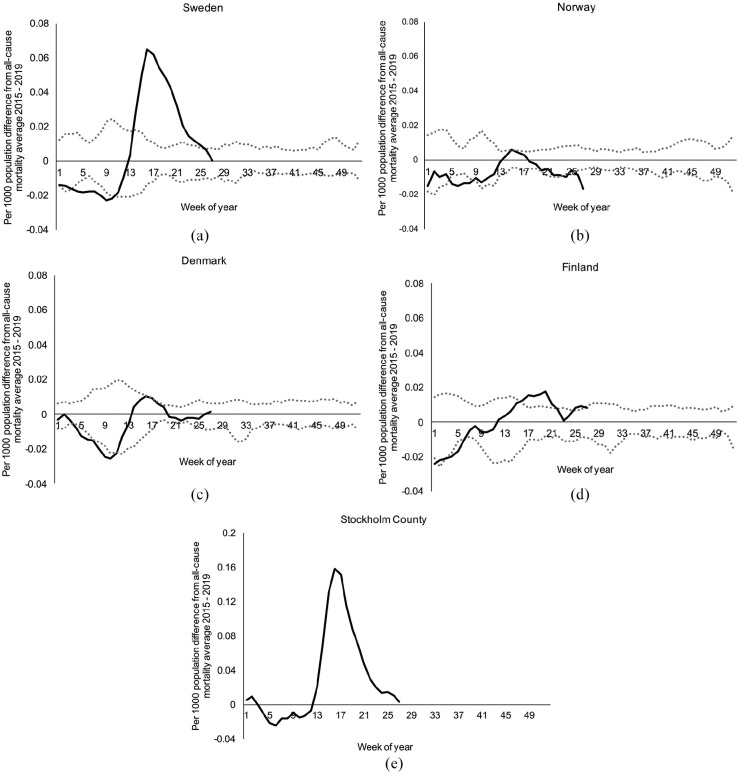
Aims: To compare the early impact of COVID-19 infections and mortality from February to July 2020 across the Nordic nations of Sweden, Norway, Denmark, and Finland through available public data sources and conduct a descriptive analysis of the potential factors that drove different epidemiological outcomes, with a focus on Sweden's response. Methods: COVID-19 cases, deaths, tests, case age distribution, and the difference between 2020 all-cause mortality and the average mortality of the previous 5 years were compared across nations. Patterns in cell phone mobility data, testing strategies, and seniors' care home deaths were also compared. Data for each nation were based on publicly available sources as of July 31, 2020. Results: Compared with its Nordic peers, Sweden had a higher incidence rate across all ages, a higher COVID-19-related death rate only partially explained by population demographics, a higher death rate in seniors' care, and higher all-cause mortality. Sweden had approximately half as much mobility change as its Nordic neighbours until April and followed similar rates as its neighbours from April to July. Denmark led its Nordic peers in testing rates, while Sweden had the highest cumulative test-positivity rate continuously from mid-March. Conclusions: COVID-19 pushed Sweden's health system to its capacity, exposed systemic weaknesses in the seniors' care system, and revealed challenges with implementing effective contact tracing and testing strategies while experiencing a high case burden. Looser government restrictions at the beginning of the outbreak are likely to have played a role in the impact of COVID-19 in Sweden. In an effort to improve epidemic control, Sweden has increased testing rates, implemented more restrictive prevention measures, and increased their intensive care unit bed capacity.
Keywords: COVID-19; COVID-19 mortality; Nordic; infectious disease prevention; infectious disease transmission; policy analysis; public health strategy.
Conflict of interest statement
Figures



References
-
- Häkkinen L. Hallengren: Ett misslyckande att vi inte lyckats skydda våra äldre [Hallengren: A failure that we have not managed to protect our elderly], SVT Nyheter, www.svt.se/nyheter/inrikes/hallengren-ett-misslyckande-att-vi-inte-lycka... (2020, accessed 14 July 2020).
-
- Tegnell A. Tegnell: Fler åtgärder hade behövts – Nyheter (Ekot) [Tegnell: More preventive measures were needed], Sveriges Radio, sverigesradio.se/sida/artikel.aspx?programid=83&artikel=7487188 (accessed 14 July 2020).
-
- Juranek S, Zoutman F. The effect of social distancing measures on intensive care occupancy: evidence on COVID-19 in Scandinavia. SSRN Electron J. Epub ahead of print 22 April 2020. DOI: 10.2139/ssrn.3577213. - DOI
-
- Hale T, Webster S, Petherick A, et al. Coronavirus Government Response Tracker, www.bsg.ox.ac.uk/research/research-projects/coronavirus-government-respo... (2020, accessed 31 July 2020).
-
- Paterlini M. ‘Closing borders is ridiculous’: the epidemiologist behind Sweden’s controversial coronavirus strategy. Nature, 21 April, www.nature.com/articles/d41586-020-01098-x (2020, accessed 14 July 2020). - PubMed
Publication types
MeSH terms
LinkOut - more resources
Full Text Sources
Other Literature Sources
Medical
Miscellaneous
