


Association between prehospital prognostic factors on out-of-hospital cardiac arrest in different age groups
- PMID: 33413131
- PMCID: PMC7792209
- DOI: 10.1186/s12873-020-00400-4
Association between prehospital prognostic factors on out-of-hospital cardiac arrest in different age groups
Abstract
Background: The prognosis of out-of-hospital cardiac arrest (OHCA) is very poor. While several prehospital factors are known to be associated with improved survival, the impact of prehospital factors on different age groups is unclear. The objective of the study was to access the impact of prehospital factors and pre-existing comorbidities on OHCA outcomes in different age groups.
Methods: A retrospective observational analysis was conducted using the emergency medical service (EMS) database from January 2015 to December 2019. We collected information on prehospital factors, underlying diseases, and outcome of OHCAs in different age groups. Kaplan-Meier type survival curves and multivariable logistic regression were used to analyze the association between modifiable pre-hospital factors and outcomes.
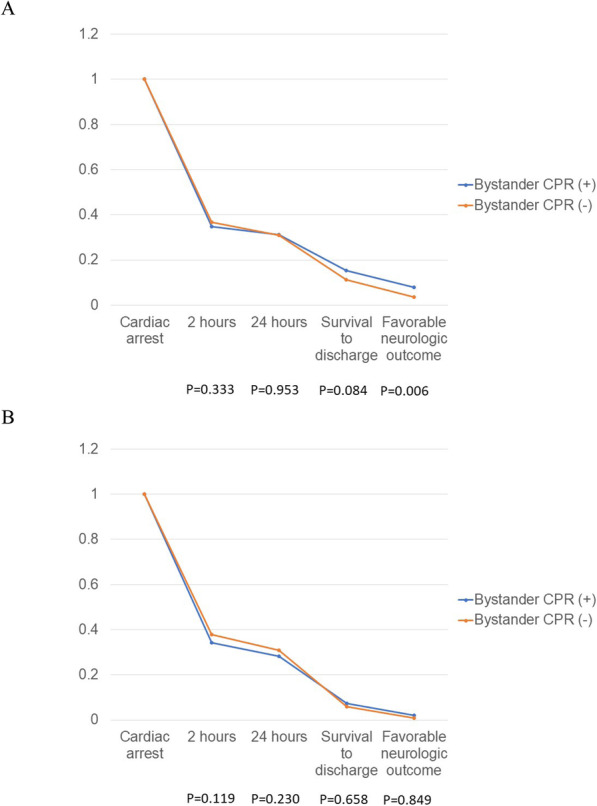
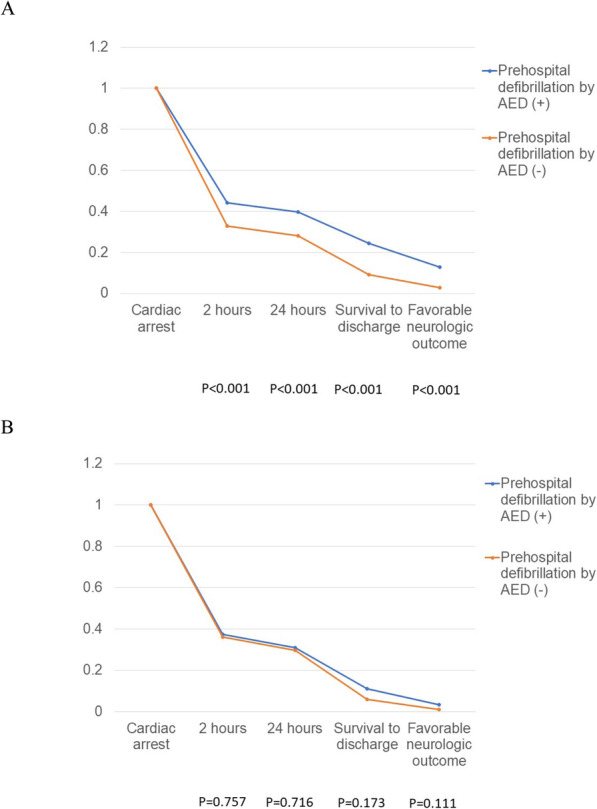
Results: A total of 4188 witnessed adult OHCAs were analyzed. For the age group 1 (age ≦75 years old), after adjustment for confounding factors, EMS response time (odds ratio [OR] = 0.860, 95% confidence interval [CI]: 0.811-0.909, p < 0.001), public location (OR = 1.843, 95% CI: 1.179-1.761, p < 0.001), bystander CPR (OR = 1.329, 95% CI: 1.007-1.750, p = 0.045), attendance by an EMT-Paramedic (OR = 1.666, 95% CI: 1.277-2.168, p < 0.001), and prehospital defibrillation by automated external defibrillator (AED)(OR = 1.666, 95% CI: 1.277-2.168, p < 0.001) were prognostic factors for survival to hospital discharge in OHCA patients. For the age group 2 (age > 75 years old), age (OR = 0.924, CI:0.880-0.966, p = 0.001), EMS response time (OR = 0.833, 95% CI: 0.742-0.928, p = 0.001), public location (OR = 4.290, 95% CI: 2.450-7.343, p < 0.001), and attendance by an EMT-Paramedic (OR = 2.702, 95% CI: 1.704-4.279, p < 0.001) were independent prognostic factors for survival to hospital discharge in OHCA patients.
Conclusions: There were variations between younger and older OHCA patients. We found that bystander CPR and prehospital defibrillation by AED were independent prognostic factors for younger OHCA patients but not for the older group.
Keywords: Age; Bystander CPR; Defibrillation; Out-of-hospital cardiac arrest; Prehospital.
Conflict of interest statement
The authors declare that they have no competing interests.
Figures
References
MeSH terms
LinkOut - more resources
Full Text Sources
Other Literature Sources
Medical
