


Essential amino acid-enriched whey enhances post-exercise whole-body protein balance during energy deficit more than iso-nitrogenous whey or a mixed-macronutrient meal: a randomized, crossover study
- PMID: 33413462
- PMCID: PMC7791816
- DOI: 10.1186/s12970-020-00401-5
Essential amino acid-enriched whey enhances post-exercise whole-body protein balance during energy deficit more than iso-nitrogenous whey or a mixed-macronutrient meal: a randomized, crossover study
Abstract
Background: The effects of ingesting varying essential amino acid (EAA)/protein-containing food formats on protein kinetics during energy deficit are undetermined. Therefore, recommendations for EAA/protein food formats necessary to optimize both whole-body protein balance and muscle protein synthesis (MPS) during energy deficit are unknown. We measured protein kinetics after consuming iso-nitrogenous amounts of free-form essential amino acid-enriched whey (EAA + W; 34.7 g protein, 24 g EAA sourced from whey and free-form EAA), whey (WHEY; 34.7 g protein, 18.7 g EAA), or a mixed-macronutrient meal (MEAL; 34.7 g protein, 11.4 g EAA) after exercise during short-term energy deficit.
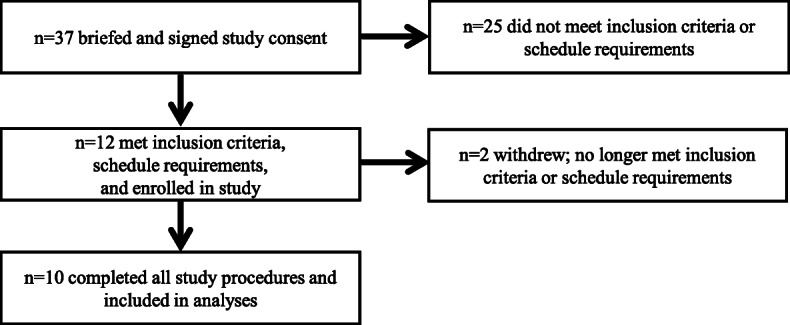
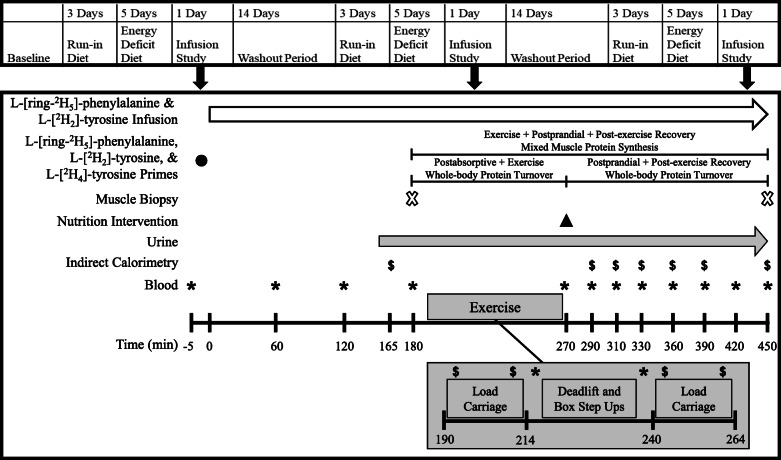
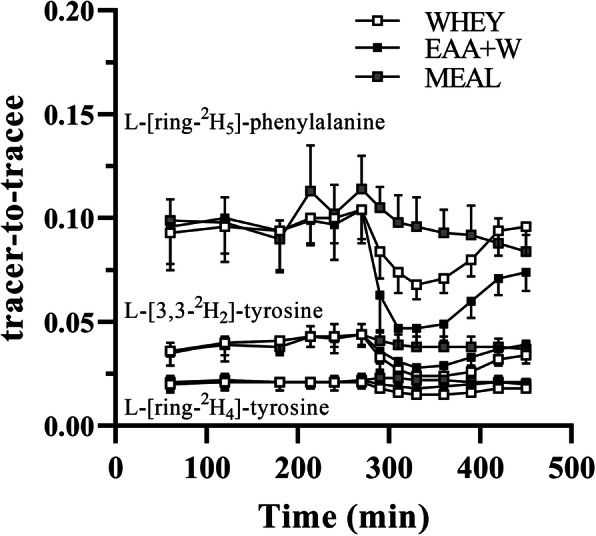
Methods: Ten adults (mean ± SD; 21 ± 4 y; 25.7 ± 1.7 kg/m2) completed a randomized, double-blind crossover study consisting of three, 5 d energy-deficit periods (- 30 ± 3% of total energy requirements), separated by 14 d. Whole-body protein synthesis (PS), breakdown (PB), and net balance (NET) were determined at rest and in response to combination exercise consisting of load carriage treadmill walking, deadlifts, and box step-ups at the end of each energy deficit using L-[2H5]-phenylalanine and L-[2H2]-tyrosine infusions. Treatments were ingested immediately post-exercise. Mixed-muscle protein synthesis (mixed-MPS) was measured during exercise through recovery.
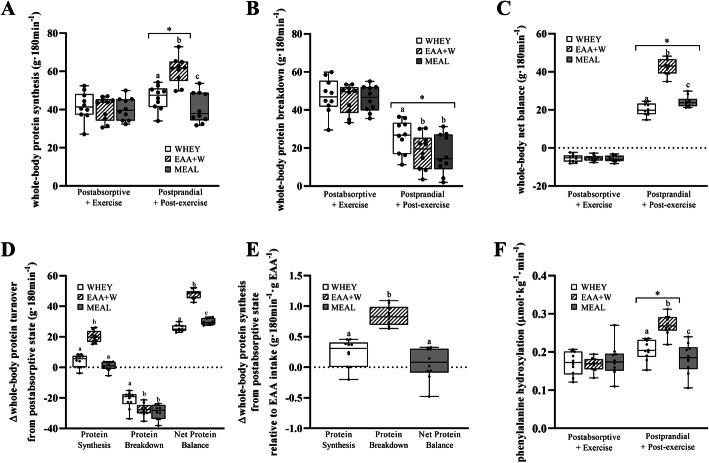
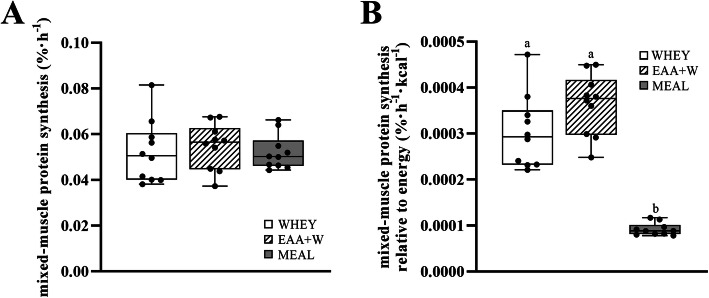
Results: Change (Δ postabsorptive + exercise to postprandial + recovery [mean treatment difference (95%CI)]) in whole-body (g/180 min) PS was 15.8 (9.8, 21.9; P = 0.001) and 19.4 (14.8, 24.0; P = 0.001) greater for EAA + W than WHEY and MEAL, respectively, with no difference between WHEY and MEAL. ΔPB was - 6.3 (- 11.5, - 1.18; P = 0.02) greater for EAA + W than WHEY and - 7.7 (- 11.9, - 3.6; P = 0.002) greater for MEAL than WHEY, with no difference between EAA + W and MEAL. ΔNET was 22.1 (20.5, 23.8; P = 0.001) and 18.0 (16.5, 19.5; P = 0.00) greater for EAA + W than WHEY and MEAL, respectively, while ΔNET was 4.2 (2.7, 5.6; P = 0.001) greater for MEAL than WHEY. Mixed-MPS did not differ between treatments.
Conclusions: While mixed-MPS was similar across treatments, combining free-form EAA with whey promotes greater whole-body net protein balance during energy deficit compared to iso-nitrogenous amounts of whey or a mixed-macronutrient meal.
Trial registration: ClinicalTrials.gov, Identifier no. NCT04004715 . Retrospectively registered 28 June 2019, first enrollment 6 June 2019.
Keywords: And energy restriction; Free-form amino acids; Muscle protein synthesis; Whole-body protein turnover.
Conflict of interest statement
JAG, DDC, AHM, JTA, MAW, ANV, CTC, NEM, LMM, JWC, AAF, and SMP have no conflicts of interest associated with this research. RRW is an inventor of patent entitled “Composition for Stimulating Muscle Growth, Repair, and Maintenance,” US Patent (16; 382,984). RRW is a shareholder in Essential Blends, LLC, and The Amino Company, LLC. RRW was not involved in data collection or analyses and was blinded to all data until final consolidation into manuscript form by JAG and SMP.
Figures
References
-
- Hector AJ, Marcotte GR, Churchward-Venne TA, Murphy CH, Breen L, von Allmen M, et al. Whey protein supplementation preserves postprandial myofibrillar protein synthesis during short-term energy restriction in overweight and obese adults. J Nutr. 2014;145(2):246–252. doi: 10.3945/jn.114.200832. - DOI - PubMed
Publication types
MeSH terms
Substances
Associated data
LinkOut - more resources
Full Text Sources
Other Literature Sources
Medical
