


Improving gait adaptability in patients with hereditary spastic paraplegia (Move-HSP): study protocol for a randomized controlled trial
- PMID: 33413555
- PMCID: PMC7788541
- DOI: 10.1186/s13063-020-04932-9
Improving gait adaptability in patients with hereditary spastic paraplegia (Move-HSP): study protocol for a randomized controlled trial
Abstract
Background: People with hereditary spastic paraplegia (HSP) experience difficulties adapting their gait to meet environmental demands, a skill required for safe and independent ambulation. Gait adaptability training is possible on the C-Mill, a treadmill equipped with augmented reality, enabling visual projections to serve as stepping targets or obstacles. It is unknown whether gait adaptability can be trained in people with HSP.
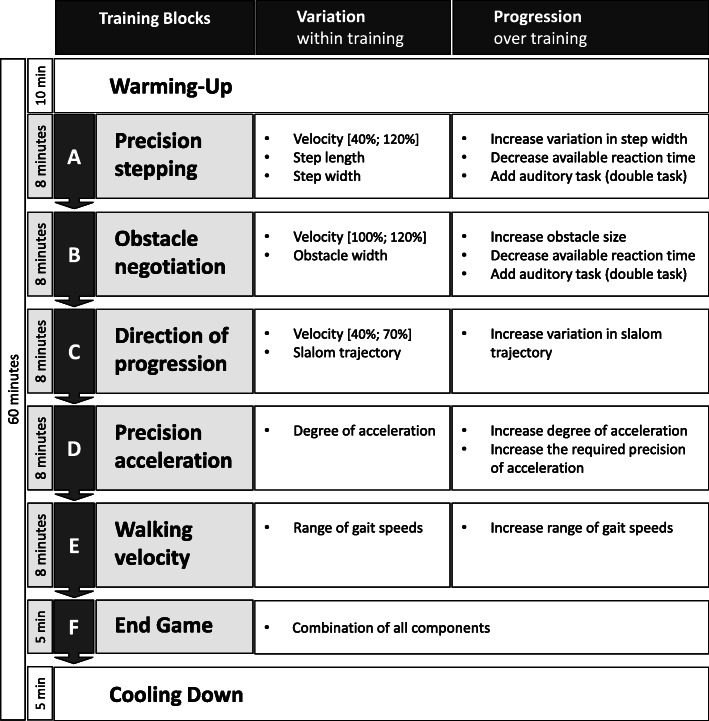
Aim: The aim of Move-HSP is to study the effects of ten 1-h sessions of C-Mill training, compared with usual care, on gait adaptability in people with pure HSP. In addition, this study aims to identify key determinants of C-Mill training efficacy in people with pure HSP.
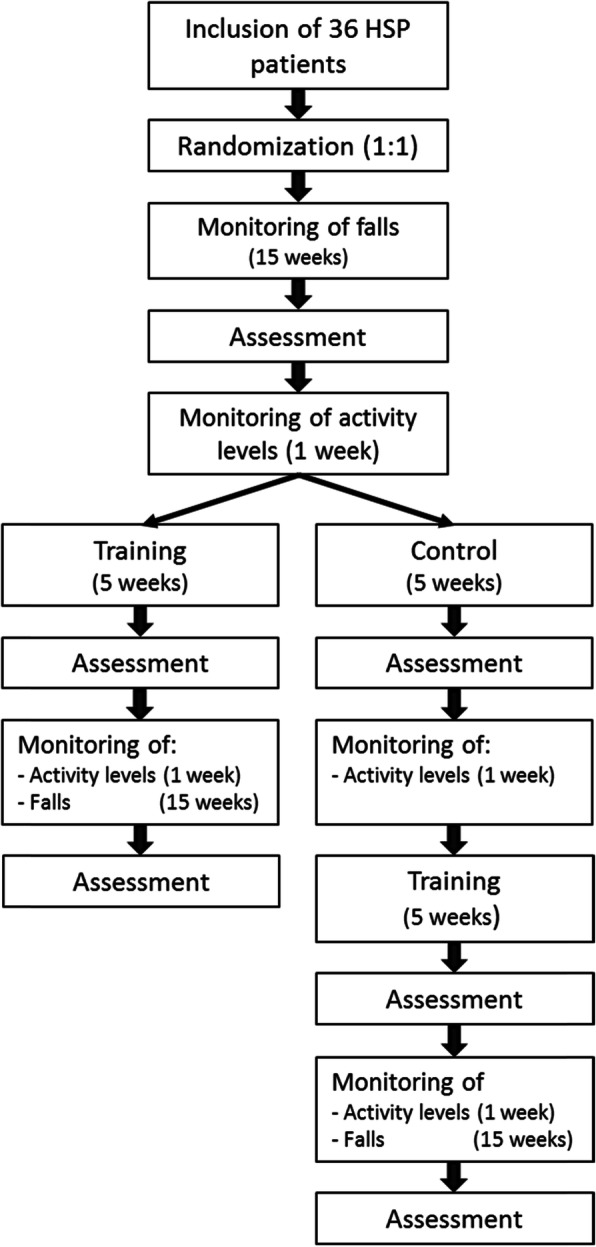
Method: Move-HSP is a 5-week, two-armed, open-label randomized controlled trial with a cross-over design for the control group. Thirty-six participants with pure HSP will be included. After signing informed consent, participants are randomized (1:1) to intervention or control group. All participants register (near) falls for 15 weeks, followed by the first assessment (week 16), and, thereafter, wear an Activ8 activity monitor for 7 days (week 16). The intervention group receives 10 sessions of C-Mill training (twice per week, 1-h sessions; weeks 17-21), whereas control group continues with usual care (weeks 17-21). Afterwards, both groups are re-assessed (week 22). Subsequently, the intervention group enter follow-up, whereas control group receives 10 sessions of C-Mill training (weeks 23-27), is re-assessed (week 28), and enters follow-up. During follow-up, both groups wear Activ8 activity monitors for 7 days (intervention group: week 23, control group: week 29) and register (near) falls for 15 weeks (intervention group: weeks 23-37, control group: weeks 29-43), before the final assessment (intervention group: week 38, control group: week 44). The primary outcome is the obstacle subtask of the Emory Functional Ambulation Profile. Secondary outcomes consist of clinical tests assessing balance and walking capacity, physical activity, and fall monitoring.
Discussion: Move-HSP will be the first RCT to assess the effects of C-Mill gait adaptability training in people with pure HSP. It will provide proof of concept for the efficacy of gait adaptability training in people with pure HSP.
Trial registration: Clinicaltrials.gov NCT04180098 . Registered on November 27, 2019.
Keywords: C-Mill; Gait adaptability; Hereditary spastic paraplegia; Rehabilitation.
Conflict of interest statement
The authors declare that they have no competing interests.
Figures
References
-
- Salinas S, Proukakis C, Crosby A, Warner TT. Hereditary spastic paraplegia: clinical features and pathogenetic mechanisms. Lancet Neurol. 2008;7(12):1127–1138. - PubMed
-
- Harding AE. Classification of the hereditary ataxias and paraplegias. Lancet. 1983;1(8334):1151–1155. - PubMed
-
- Nonnekes J, van Lith B, van de Warrenburg BP, Weerdesteyn V, Geurts ACH. Pathophysiology, diagnostic work-up and management of balance impairments and falls in patients with hereditary spastic paraplegia. J Rehabil Med. 2017;49(5):369–377. - PubMed
-
- Harding AE. Hereditary spastic paraplegias. Semin Neurol. 1993;13(4):333–336. - PubMed
Publication types
MeSH terms
Associated data
LinkOut - more resources
Full Text Sources
Other Literature Sources
Medical
