


14-3-3 mitigates alpha-synuclein aggregation and toxicity in the in vivo preformed fibril model
- PMID: 33413679
- PMCID: PMC7792107
- DOI: 10.1186/s40478-020-01110-5
14-3-3 mitigates alpha-synuclein aggregation and toxicity in the in vivo preformed fibril model
Abstract
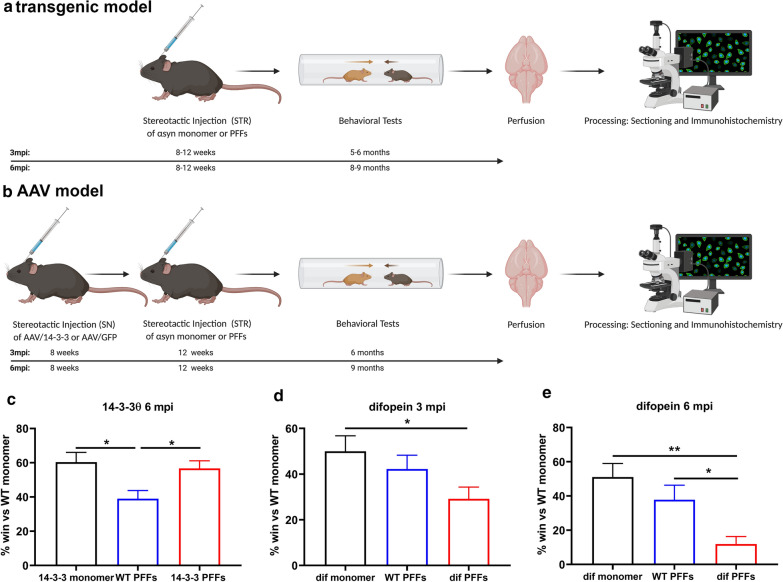
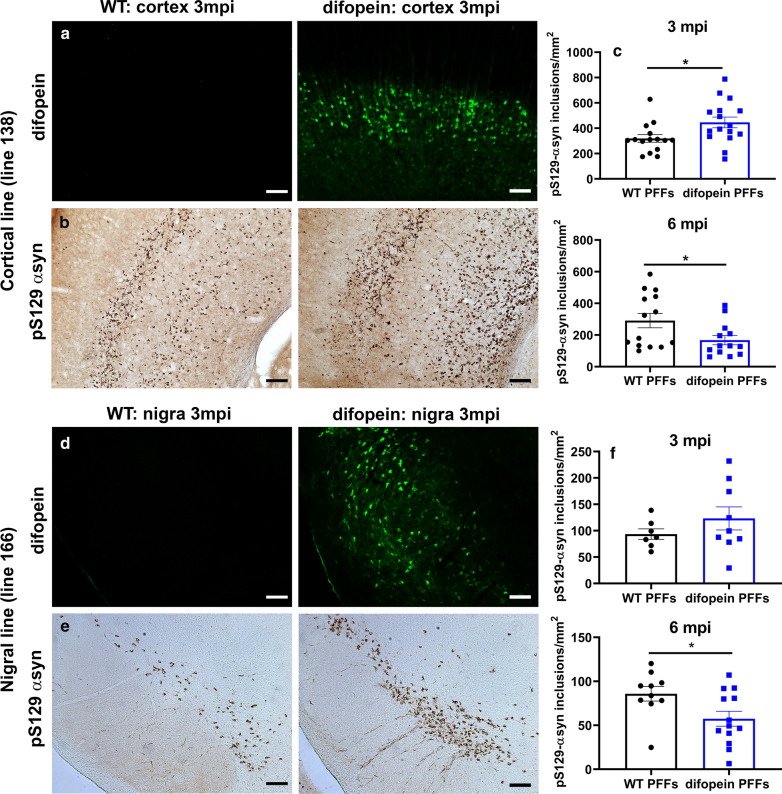
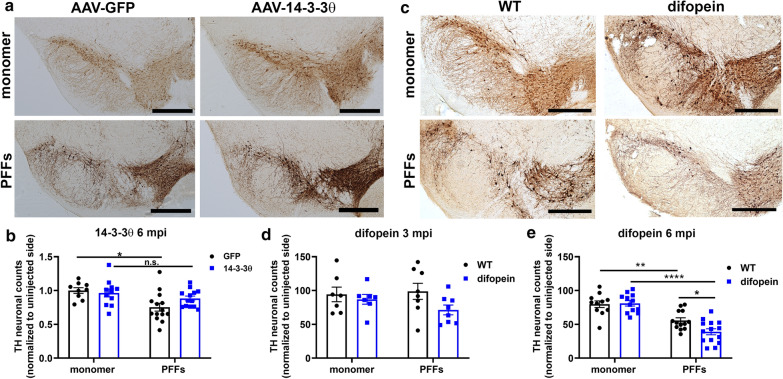
Alpha-synuclein (αsyn) is the key component of proteinaceous aggregates termed Lewy Bodies that pathologically define a group of disorders known as synucleinopathies, including Parkinson's Disease (PD) and Dementia with Lewy Bodies. αSyn is hypothesized to misfold and spread throughout the brain in a prion-like fashion. Transmission of αsyn necessitates the release of misfolded αsyn from one cell and the uptake of that αsyn by another, in which it can template the misfolding of endogenous αsyn upon cell internalization. 14-3-3 proteins are a family of highly expressed brain proteins that are neuroprotective in multiple PD models. We have previously shown that 14-3-3θ acts as a chaperone to reduce αsyn aggregation, cell-to-cell transmission, and neurotoxicity in the in vitro pre-formed fibril (PFF) model. In this study, we expanded our studies to test the impact of 14-3-3s on αsyn toxicity in the in vivo αsyn PFF model. We used both transgenic expression models and adenovirus associated virus (AAV)-mediated expression to examine whether 14-3-3 manipulation impacts behavioral deficits, αsyn aggregation, and neuronal counts in the PFF model. 14-3-3θ transgene overexpression in cortical and amygdala regions rescued social dominance deficits induced by PFFs at 6 months post injection, whereas 14-3-3 inhibition by transgene expression of the competitive 14-3-3 peptide inhibitor difopein in the cortex and amygdala accelerated social dominance deficits. The behavioral rescue by 14-3-3θ overexpression was associated with delayed αsyn aggregation induced by PFFs in these brain regions. Conversely, 14-3-3 inhibition by difopein in the cortex and amygdala accelerated αsyn aggregation and reduction in NECAB1-positive neuron counts induced by PFFs. 14-3-3θ overexpression by AAV in the substantia nigra (SN) also delayed αsyn aggregation in the SN and partially rescued PFF-induced reduction in tyrosine hydroxylase (TH)-positive dopaminergic cells in the SN. 14-3-3 inhibition in the SN accelerated nigral αsyn aggregation and enhanced PFF-induced reduction in TH-positive dopaminergic cells. These data indicate a neuroprotective role for 14-3-3θ against αsyn toxicity in vivo.
Keywords: 14-3-3s; Alpha-synuclein; Amygdala; Cortex; Dementia with Lewy Bodies; Mouse; Parkinson’s disease; Substantia nigra.
Conflict of interest statement
Dr. Yacoubian has a U.S. Patent No. 7,919,262 on the use of 14-3-3s in neurodegeneration. The remaining authors have no competing interests to declare.
Figures


References
-
- Cabin DE, Shimazu K, Murphy D, Cole NB, Gottschalk W, McIlwain KL, Orrison B, Chen A, Ellis CE, Paylor R. Synaptic vesicle depletion correlates with attenuated synaptic responses to prolonged repetitive stimulation in mice lacking α-synuclein. J Neurosci. 2002;22:8797–8807. doi: 10.1523/JNEUROSCI.22-20-08797.2002. - DOI - PMC - PubMed
-
- Nemani VM, Lu W, Berge V, Nakamura K, Onoa B, Lee MK, Chaudhry FA, Nicoll RA, Edwards RH. Increased expression of α-synuclein reduces neurotransmitter release by inhibiting synaptic vesicle reclustering after endocytosis. Neuron. 2010;65:66–79. doi: 10.1016/j.neuron.2009.12.023. - DOI - PMC - PubMed
-
- Wang B, Underwood R, Kamath A, Britain C, McFerrin MB, McLean PJ, Volpicelli-Daley LA, Whitaker RH, Placzek WJ, Becker K, et al. 14-3-3 proteins reduce cell-to-cell transfer and propagation of pathogenic α-synuclein. J Neurosci. 2018;38:8211–8232. doi: 10.1523/jneurosci.1134-18.2018. - DOI - PMC - PubMed
Publication types
MeSH terms
Substances
Grants and funding
LinkOut - more resources
Full Text Sources
Other Literature Sources
Medical
Molecular Biology Databases
