Review
. 2021 Jan 6;13(2):167.
doi: 10.3390/cancers13020167.

IL-12 Family Cytokines in Cancer and Immunotherapy

Affiliations
Review

IL-12 Family Cytokines in Cancer and Immunotherapy

Bhalchandra Mirlekar et al. Cancers (Basel). .

Abstract

The IL-12 family cytokines are a group of unique heterodimeric cytokines that include IL-12, IL-23, IL-27, IL-35 and, most recently, IL-39. Recent studies have solidified the importance of IL-12 cytokines in shaping innate and adaptive immune responses in cancer and identified multipronged roles for distinct IL-12 family members, ranging from effector to regulatory immune functions. These cytokines could serve as promising candidates for the development of immunomodulatory therapeutic approaches. Overall, IL-12 can be considered an effector cytokine and has been found to engage anti-tumor immunity by activating the effector Th1 response, which is required for the activation of cytotoxic T and NK cells and tumor clearance. IL-23 and IL-27 play dual roles in tumor immunity, as they can both activate effector immune responses and promote tumor growth by favoring immune suppression. IL-35 is a potent regulatory cytokine and plays a largely pro-tumorigenic role by inhibiting effector T cells. In this review, we summarize the recent findings on IL-12 family cytokines in the control of tumor growth with an emphasis primarily on immune regulation. We underscore the clinical implications for the use of these cytokines either in the setting of monotherapy or in combination with other conventional therapies for the more effective treatment of malignancies.

Keywords: B cell; IL-12 family cytokines; STAT; T cell; anti-tumor immunity; cancer immunotherapy; tumor microenvironment.


Conflict of interest statement

The authors declare no conflict of interest.

Figures
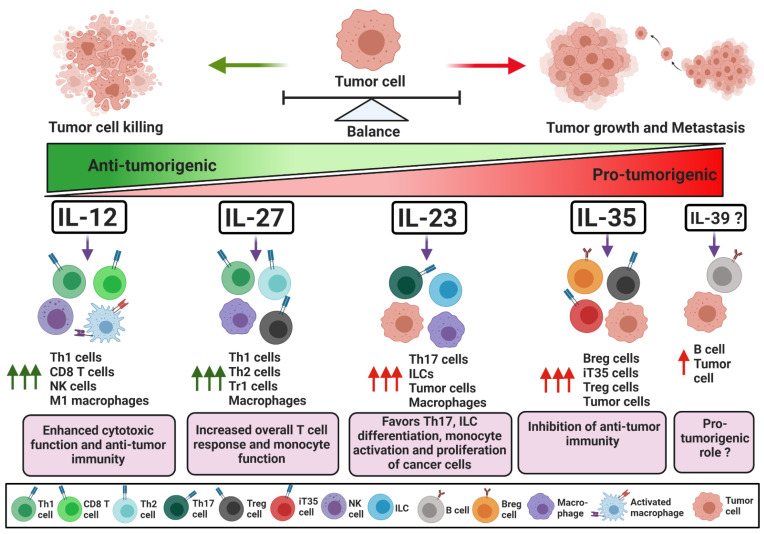
Figure 1
Figure 1
Role of IL-12 family cytokines in maintaining a balance between effector and regulatory immune responses in tumorigenesis. IL-12 activates an effector immune response against tumor cells by promoting both M1 macrophage polarization and IFN-γ- production by Th1 cells, which in turn, stimulate anti-tumor cytotoxic CD8+ and NK cells. IL-27 and IL-23 have dual effects on immune cells in cancer. IL-27 and IL-23 can induce an overall T cell-mediated immune response and also modulate immune suppressive macrophages. Furthermore, IL-23 can stimulate the proliferation and growth of tumor cells. Conversely, IL-35 is a strong immune suppressive cytokine; it induces regulatory B and T cell activation and proliferation that subverts anti-tumor immunity and stimulates tumor growth and metastasis. IL-39 was recently shown to be secreted by B cells and may increase cancer cell proliferation. ↑ Arrow indicates increase in respective cell type activity; Tr1—T regulatory type 1; ILC—innate lymphoid cell; Breg—regulatory B cell; Treg—regulatory T cell; iT35—IL35-inducible regulatory T cell.
Figure 2
Figure 2
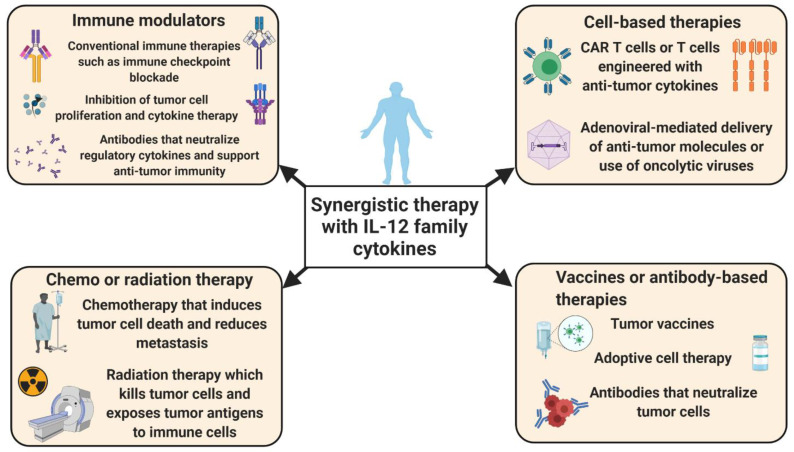
The therapeutic modulation of IL-12 family cytokines may enhance the efficacy of conventional therapy. Recent studies indicate that the therapies targeting (either upregulating or downregulating) the IL-12 family cytokines in combination with other standard therapies may increase treatment effectiveness. Context-dependent functions of IL-12 cytokines in cancer could drive the development of inhibitor or augmentative therapy axes, respectively. Drugs or antibodies targeting IL-12 family cytokines may help to restrain immune suppression within the tumor microenvironment (TME) and allow for the infiltration and proliferation of anti-tumor immune cells. Additionally, the targeted delivery of these cytokines with the help of adenovirus or chimeric antigen receptor (CAR) T cells may enhance cytotoxicity and tumor cell clearance. Such approaches could make tumor cells more sensitive to radiation, chemotherapy and immune checkpoint blockade therapy.

References

    1. Wojno E.D.T., Hunter C.A., Stumhofer J.S. The immunobiology of the interleukin-12 family: Room for discovery. Immunity. 2019;50:851–870. doi: 10.1016/j.immuni.2019.03.011. - DOI - PMC - PubMed
    1. Mal X., Trinchieri G. Regulation of interleukin-12 production in antigen-presenting cells. Dev. Funct. Myeloid Subsets. 2001;79:55–92. - PubMed
    1. Vignali D.A., Kuchroo V.K. Il-12 family cytokines: Immunological playmakers. Nat. Immunol. 2012;13:722–728. - PMC - PubMed
    1. Zundler S., Neurath M.F. Interleukin-12: Functional activities and implications for disease. Cytokine Growth Factor Rev. 2015;26:559–568. doi: 10.1016/j.cytogfr.2015.07.003. - DOI - PubMed
    1. Tugues S., Burkhard S., Ohs I., Vrohlings M., Nussbaum K., Berg J.V., Kulig P., Becher B. New insights into il-12-mediated tumor suppression. Cell Death Differ. 2015;22:237–246. doi: 10.1038/cdd.2014.134. - DOI - PMC - PubMed