


Can Coronaviruses Steal Genes from the Host as Evidenced in Western European Hedgehogs by EriCoV Genetic Characterization?
- PMID: 33419245
- PMCID: PMC7765933
- DOI: 10.3390/v12121471
Can Coronaviruses Steal Genes from the Host as Evidenced in Western European Hedgehogs by EriCoV Genetic Characterization?
Abstract
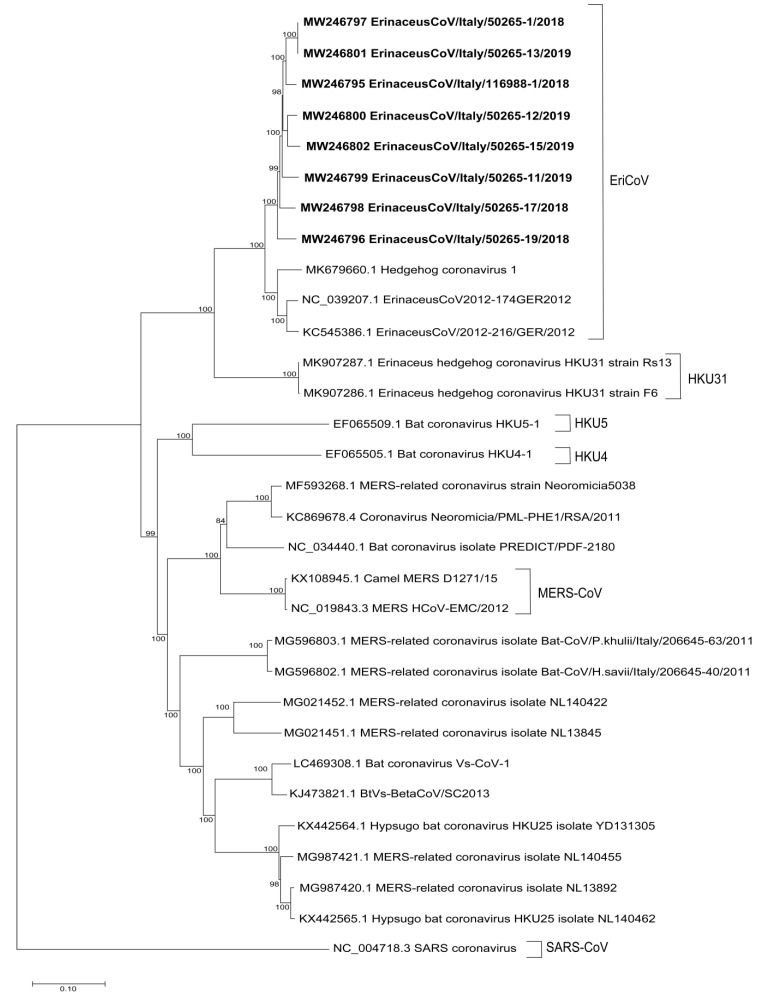
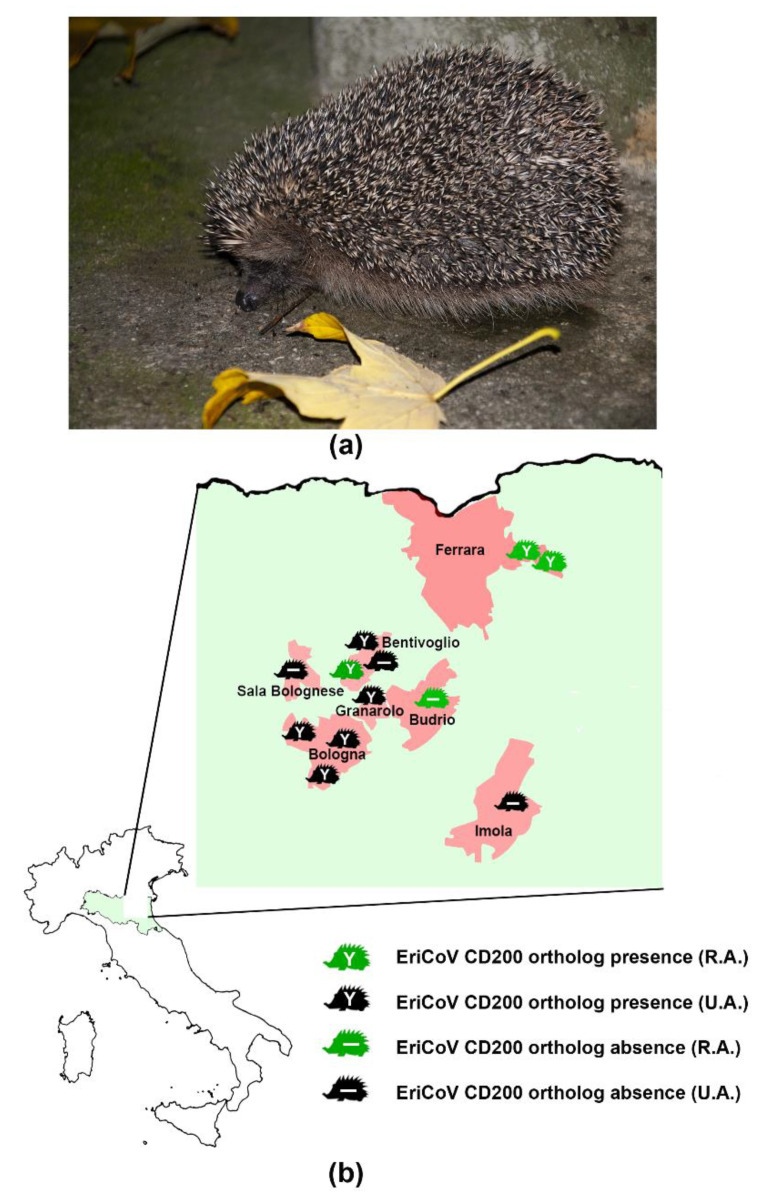
Due to their need for living cells, viruses have developed adaptive evolutionary strategies to survive and perpetuate in reservoir hosts that play a crucial role in the ecology of emerging pathogens. Pathogenic and potentially pandemic betacoronaviruses arose in humans in 2002 (SARS-CoV, disappeared in July 2003), 2012 (MERS-CoV, still circulating in Middle East areas), and 2019 (SARS-CoV-2, causing the current global pandemic). As universally recognized, bats host ancestors of the above-mentioned zoonotic viruses. However, hedgehogs have been recently identified in Europe and Asia as possible reservoirs of MERS-CoV-like strains classified as Erinaceus coronavirus (EriCoV). To elucidate the evolution and genetics of EriCoVs, NGS (next generation sequencing) and Sanger sequencing were used to examine fecal samples collected in Northern Italy in 2018/2019 from 12 hedgehogs previously found EriCoV-positive by RT-PCR. By sequence analysis, eight complete EriCoV genomes, obtained by NGS, showed a high phylogenetic correlation with EriCoV strains previously reported in Eurasia. Interestingly, eight viral strains presented an additional ORF encoding for the CD200 ortholog located between the genes encoding for the Spike and the ORF3a proteins. The CD200 ortholog sequences were closely similar to the host CD200 protein but varying among EriCoVs. The result, confirmed by Sanger sequencing, demonstrates for the first time that CoVs can acquire host genes potentially involved in the immune-modulatory cascade and possibly enabling the virus to escape the host defence.
Keywords: Betacoronavirus infection; CD200 glycoprotein; CD200 ortholog; EriCoV; Erinaceus coronavirus; Erinaceus europaeus; Eulipotyphla; betacoronaviruses; hedgehogs.
Conflict of interest statement
The authors declare no conflict of interest.
Figures
References
-
- Wang L., Zhang Y. Animal coronaviruses: A brief introduction. In: Wang L., editor. Animal Coronaviruses. Humana Press; New York, NY, USA: 2016. pp. 3–11. Springer Protocols Handbooks.
-
- World Health Organization Disease Outbreak News Update: Middle East Respiratory Syndrome Coronavirus (MERS-CoV) [(accessed on 16 November 2020)]; Available online: https://www.who.int/csr/don/02-jul-2020-mers-saudi-arabia/en/
MeSH terms
Substances
LinkOut - more resources
Full Text Sources
Other Literature Sources
Research Materials
Miscellaneous
