. 2021 Mar;95(3):1055-1069.
doi: 10.1007/s00204-020-02968-z. Epub 2021 Jan 9.

Benzo[a]pyrene and Caenorhabditis elegans: defining the genotoxic potential in an organism lacking the classical CYP1A1 pathway

Affiliations

Benzo[a]pyrene and Caenorhabditis elegans: defining the genotoxic potential in an organism lacking the classical CYP1A1 pathway

Mustafa Abbass et al. Arch Toxicol. 2021 Mar.

Abstract

Benzo[a]pyrene (BaP) is bioactivated in most organisms by the cytochrome P450 (CYP) enzymes, mainly CYP1A1, ultimately resulting in the reactive metabolite BaP-7,8-dihydrodiol-9,10-epoxide (BPDE) capable of covalently binding to DNA and forming adducts. This step has been defined as the key process in cancer initiation in humans. However, limited knowledge is available about the consequences of BaP exposure in organisms lacking this classical CYP1A1 pathway, one example is the model nematode Caenorhabditis elegans. The aim of this study was to define the genotoxic potential of BaP in C. elegans and to advance our understanding of xenobiotic processing in the absence of the CYP1A1 pathway. Exposure to high concentrations of BaP (0-40 µM) significantly affected life cycle endpoints of C. elegans, which were manifested by a reduced reproductive output and shortened life span. An optimised comet assay revealed that DNA damage increased in a dose-dependent manner; however, no bulky DNA adducts (dG-N2-BPDE) were observed by 32P-postlabelling. Global transcriptomic analysis by RNA-Seq identified responsive transcript families, most prominently members of the cyp-35 and UDP-glucuronosyltransferases (UGTs) enzyme families, both of which are linked to xenobiotic metabolism. Strains harbouring mutations in the cyp-35A2 and cyp-35A3 genes were notably less prone to BaP-mediated toxicity, and BaP led to longevity in cyp-35A5 mutants. In summary, BaP induces transcriptional, genotoxic and phenotypic responses in C. elegans, despite the absence of the classical CYP1A1 bioactivation pathway. This provides first evidence that parallel pathways are implicated in BaP metabolism in C. elegans and this seems to be mediated via the cyp-35 pathway.

Keywords: Benzo[a]pyrene; Caenorhabditis elegans; DNA adducts; Xenobiotics.


Conflict of interest statement

The author(s) declare no potential conflicts of interest with respect to the research, authorship, and/or publication of this article.

Figures
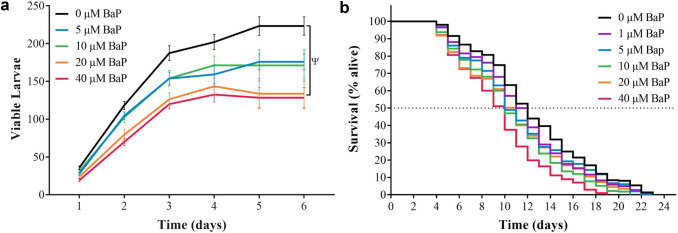
Fig. 1
Fig. 1
a Wild-type C. elegans were exposed to BaP (0–40 µM) for 8 days, and the average daily number of viable larvae was counted every 24 h and cumulatively added during the egg laying phase (marked 1–6). Error bars represent SEM. Statistical analysis was performed using a two-way ANOVA, followed by a Tukey’s multiple comparisons test, n = 24 per BaP concentration. Ψ = the p value of 0 vs. 20 µM BaP ≤ 0.01, and of 0 vs. 40 ≤ 0.001. b The percentage survival of wild-type C. elegans exposed to different concentrations of BaP (0–40 μM). The worms were scored by transferring them all to a new plate every 24 h from L1 stage until all worms were dead. Lost or mistakenly killed worms were censored and removed from the data. Note that the median survival (50% alive) of worms was measured to be 12 days for the control worms (BaP [0 μM]; DMSO [0.1% v/v]) but only 10 days for the highest BaP concentration (40 μM). Statistical analysis was performed using log-rank (Mantel-Cox) test, n = 400 per BaP concentration. All samples contained DMSO (0.1% v/v)
Fig. 2
Fig. 2
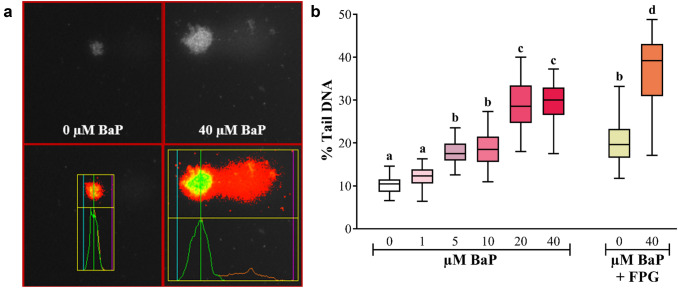
a Images on the upper row are representative cells after performing the comet assay isolated from wild-type C. elegans exposed for 48 h to different BaP doses (0, 1, 5, 10, 20, or 40 μM). The images on the lower row are outputs from the Comet IV software (version 4.11, Perceptive Instruments Ltd., UK). b A box plot of the % tail DNA in cells isolated from wild-type C. elegans exposed for 48 h to different doses of BaP (0, 1, 5, 10, 20, or 40 μM) and treatment with FPG at 0 and 40 μM BaP. Fifty cell nucleoids were measured per slide (technical replicates), for a total of 150 cells per biological replicate (3 slides) and 450 total cells per experimental condition (3 biological replicates). The average of 150 cells was calculated for all biological replicates and then averaged (n = 3). Statistical analysis was performed using a one-way ANOVA, followed by a Tukey’s multiple comparisons test; a, b, c, d refers to the calculated probability (p value), where different letter denote p ≤ 0.0001. All samples contained DMSO (0.1% v/v)
Fig. 3
Fig. 3
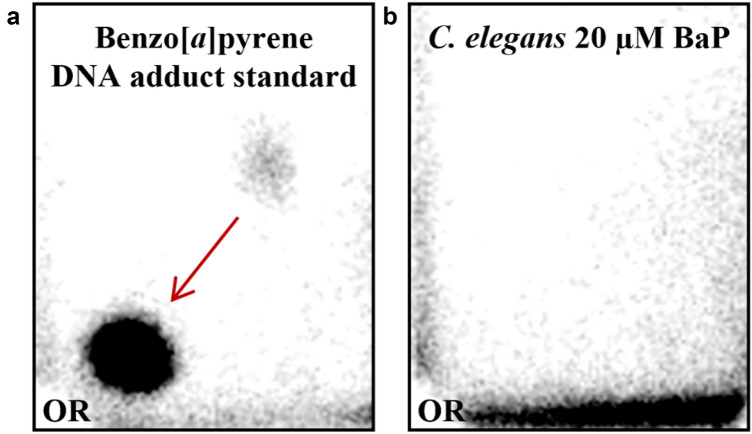
Representative autoradiographic profiles of DNA adducts obtained by TLC 32P-postlabelling in wild-type C. elegans exposed to 20 µM BaP for 48 h. a Liver DNA isolated from mice treated with a single intraperitoneal dose of 125 mg/kg body weight BaP was used as positive control (Arlt et al. 2012). b The arrow indicates the dG-N2-BPDE adduct. Solvent conditions for the separation of BaP-derived DNA adducts on PEI-cellulose TLC were as follows: D1, sodium phosphate (1 M), pH = 6.0; D3, lithium formate (3.5 M), urea (8.5 M), pH = 3.5; D4, lithium chloride (0.8 M), Tris (0.5 M), urea (8.5 M), pH = 8.0. The origins (OR), at the bottom left-hand corners, of each chromatogram were cut off before exposure
Fig. 4
Fig. 4
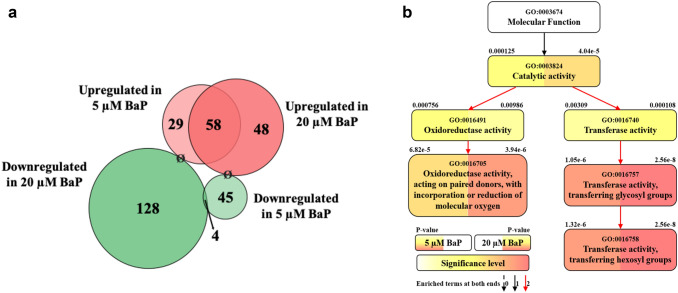
a Proportionally sized Venn diagram showing the 312 significantly (t test, p ≤ 0.05, n = 3) and differentially regulated genes (> 2-fold change) of wild-type C. elegans exposed to different doses of BaP (0, 5, or 20 µM) for 48 h. Ø marks a zero gene overlap. b Partial gene ontology (GO) hierarchical tree presenting molecular functions which were found to be significantly enriched in wild-type C. elegans exposed to different concentrations of BaP (0 vs. 5 and 0 vs. 20 µM) for 48 h. Boxes on the graph represent GO terms labelled with their GO number, term definition, and statistical information (p value) on both sides on top of the boxes (5 and 20 µM BaP on the left and right side, respectively). The degree of colour saturation (from white through yellow to red) of one side of the box is positively correlated to the enrichment level of the term for that exposure condition. Black dashed, black solid, and red solid lines represent zero, one, and two enriched terms at both ends connected by a line. The graph was based on the results of DAVID Bioinformatics Resources version 6.8 and PANTHER classification version 14.0 and was constructed manually. All samples contained DMSO (0.1% v/v) (colour figure online)
Fig. 5
Fig. 5
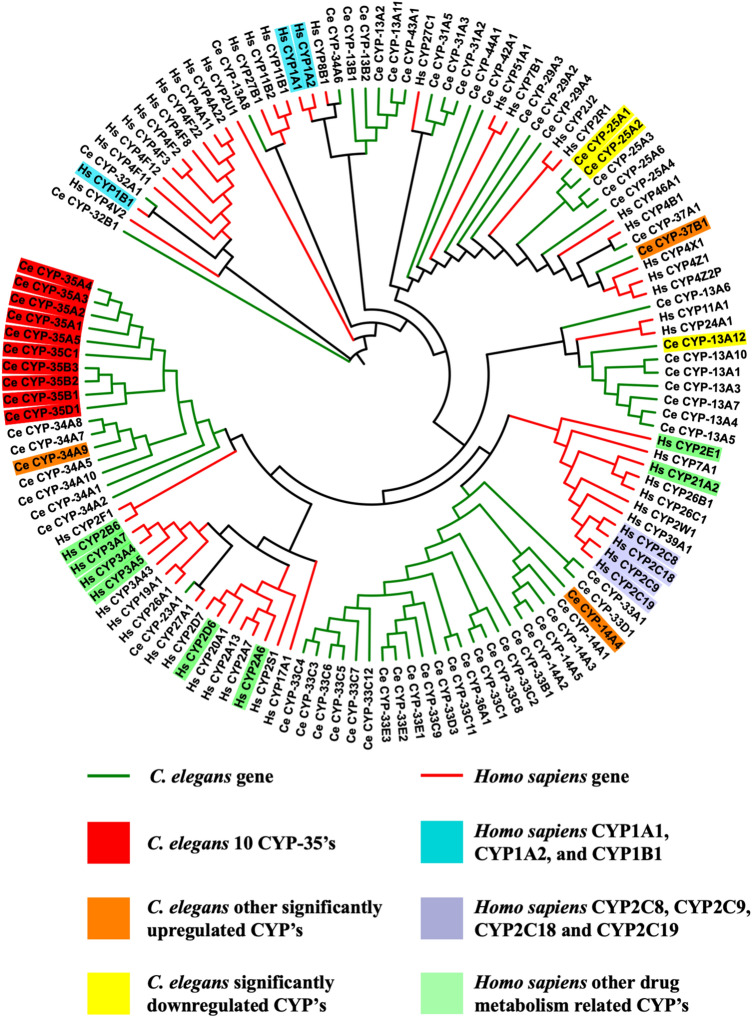
Maximum likelihood cladogram showing the relationships between the different CYP proteins of C. elegans: 10 CYP-35′s (red), other significantly (t test, p ≤ 0.05, n = 3) up-regulated CYP’s (orange), and the significantly (t test, p ≤ 0.05) down-regulated CYP’s (yellow), in Homo sapiens: CYP1′s (blue), the CYP2C’s (purple), and others (green). The tree was generated using the MEGA software, version 7.0.26 (colour figure online)
Fig. 6
Fig. 6
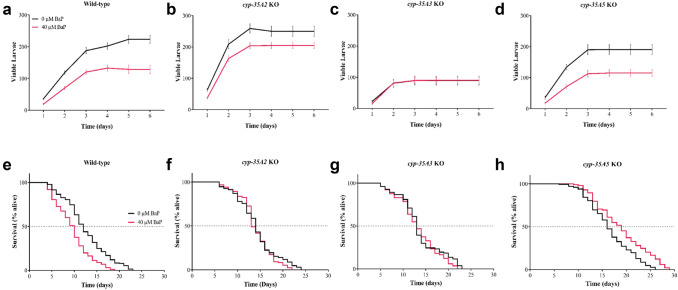
Brood size and percentage survival of wild-type C. elegans and cyp-35 knockout (KO) strains that were exposed to BaP (0 and 40 µM). a–d Wild-type C. elegans and cyp-35 knockout (KO) strains were exposed to BaP (0 and 40 µM) for 8 days, and the average daily number of viable larvae was counted and cumulatively added during the egg laying phase, i.e., 6 days (starting at day 4 from L1) and are labelled 1–6 on the graphs. The number of viable larvae was counted every 24 h. Error bars represent SEM. Statistical analysis was performed using a two-way ANOVA, followed by a Sidak’s multiple comparisons test, n = 24 per condition. e–h The worms were scored every 24 h until all worms were dead. Statistical analysis was performed using the log-rank (Mantel-Cox) test, n = 200 per BaP concentration per strain. All BaP doses contained DMSO (0.1% v/v)
Fig. 7
Fig. 7
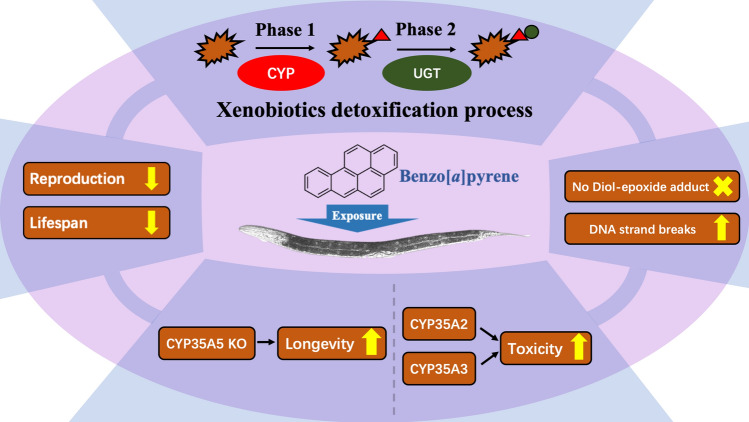
Summary of the molecular genetic and physiological responses of C. elegans exposed to BaP based on our research. The physiological end points of the wild-type animals showed the significant reduction of reproduction and lifespan. The global transcriptomic analysis demonstrated that the cyp and ugt families were involved in xenobiotics detoxification process. The assessment of genotoxicity confirmed an increase in DNA damage (comet) although no BaP-derived DNA adducts (i.e., dG-N2-BPDE) were detectable by 32P-postlabelling. The physiological measurements on KO strains revealed potential candidates which induce BaP toxicity and contribute to longevity

References

    1. Aarnio V, Lehtonen M, Storvik M, et al. Caenorhabditis elegans mutants predict regulation of fatty acids and endocannabinoids by the CYP-35A gene family. Front Pharmacol. 2011;2:12. doi: 10.3389/fphar.2011.00012. - DOI - PMC - PubMed
    1. Albert RE, Miller ML, Cody T, et al. Benzo[a]pyrene-induced skin damage and tumor promotion in the mouse. Carcinogenesis. 1991;12(7):1273–1280. doi: 10.1093/carcin/12.7.1273. - DOI - PubMed
    1. Alexandrov LB, Ju YS, Haase K, et al. Mutational signatures associated with tobacco smoking in human cancer. Science. 2016;354(6312):618–622. doi: 10.1126/science.aag0299. - DOI - PMC - PubMed
    1. Arlt VM, Stiborová M, Henderson CJ, et al. Metabolic activation of benzo[a]pyrene in vitro by hepatic cytochrome P450 contrasts with detoxification in vivo: experiments with hepatic cytochrome P450 reductase null mice. Carcinogenesis. 2008;29(3):656–665. doi: 10.1093/carcin/bgn002. - DOI - PubMed
    1. Arlt VM, Poirier MC, Sykes SE, et al. Exposure to benzo[a]pyrene of Hepatic Cytochrome P450 Reductase Null (HRN) and P450 Reductase Conditional Null (RCN) mice: detection of benzo[a]pyrene diol epoxide-DNA adducts by immunohistochemistry and 32P-postlabelling. Toxicol Lett. 2012;213(2):160–166. doi: 10.1016/j.toxlet.2012.06.016. - DOI - PMC - PubMed

Publication types

MeSH terms