. 2021 Apr;27(4):633.e9-633.e16.
doi: 10.1016/j.cmi.2020.12.029. Epub 2021 Jan 6.

The importance of anosmia, ageusia and age in community presentation of symptomatic and asymptomatic SARS-CoV-2 infection in Louisiana, USA; a cross-sectional prevalence study

Affiliations

The importance of anosmia, ageusia and age in community presentation of symptomatic and asymptomatic SARS-CoV-2 infection in Louisiana, USA; a cross-sectional prevalence study

Amy K Feehan et al. Clin Microbiol Infect. 2021 Apr.

Abstract

Objective: While many seroprevalence studies of severe acute respiratory syndrome coronavirus 2 (SARS-CoV-2) have been performed, few are demographically representative. This investigation focused on defining the nature and frequency of symptomatic and asymptomatic SARS-CoV-2 infection in a representative, cross-sectional sample of communities in Louisiana, USA.

Methods: A sample of 4778 adults from New Orleans and Baton Rouge, Louisiana were given a survey of symptoms and co-morbidities, nasopharyngeal swab to test for active infection (PCR), and blood draw to test for past infection (IgG). Odds ratios, cluster analysis, quantification of virus and antibody, and linear modelling were used to understand whether certain symptoms were associated with a positive test, how symptoms grouped together, whether virus or antibody varied by symptom status, and whether being symptomatic was different across the age span.

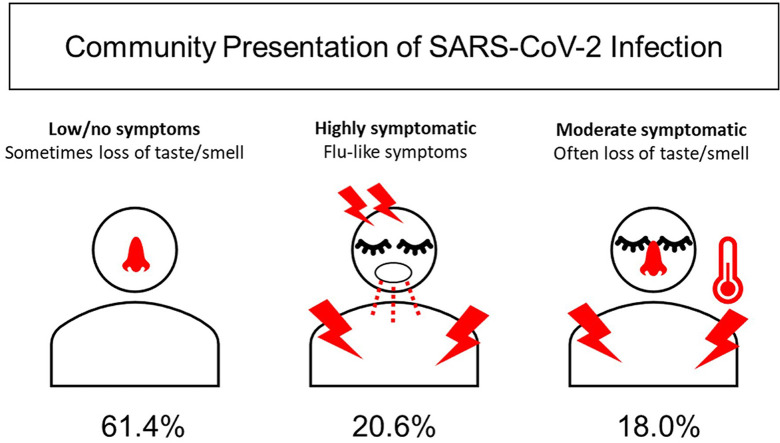
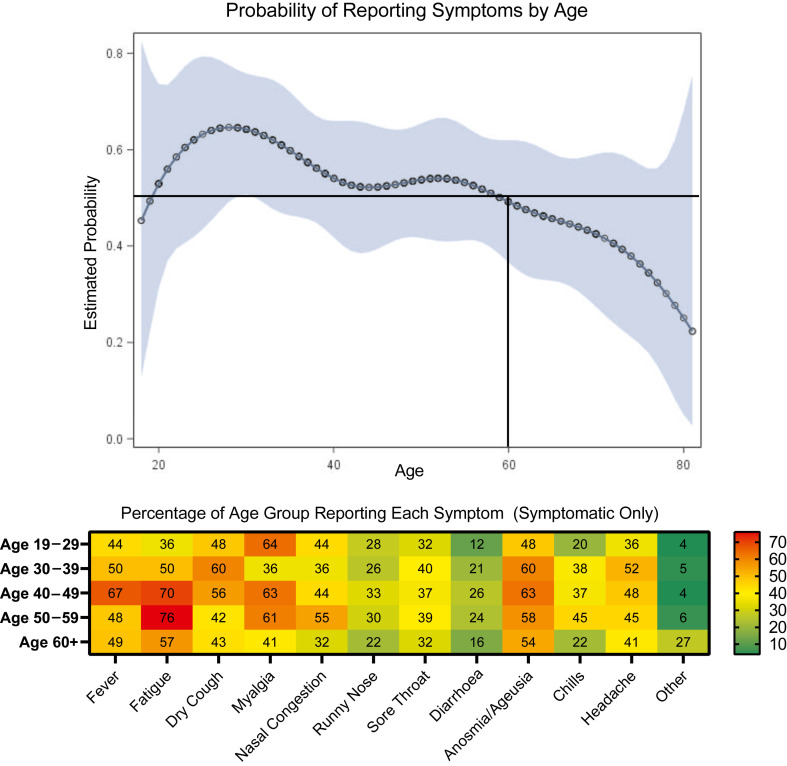
Results: Reported anosmia/ageusia was strongly associated with a positive test; 40.6% (93/229) tested positive versus 4.8% (218/4549) positivity in those who did not report anosmia/ageusia (OR 13.6, 95% CI 10.1-18.3). Of the people who tested positive, 47.3% (147/311) were completely asymptomatic. Symptom presentation clustered into three groups; low/no symptoms (0.4 ± 0.9, mean ± SD), highly symptomatic (7.5 ± 1.9) or moderately symptomatic (4.0 ± 1.5). Quantity of virus was lower in the asymptomatic versus symptomatic group (cycle number 23.3 ± 8.3 versus 17.3 ± 9.0; p < 0.001). Modelling the probability of symptoms showed changes with age; the highest probability of reporting symptoms was 64.6% (95% CI 50.4-76.5) at age 29 years, which decreased to a probability of 49.3% (95% CI 36.6-62.0) at age 60 years and only 25.1% (95% CI 5.0-68.1) at age 80 years.

Conclusion: Anosmia/ageusia can be used to differentiate SARS-CoV-2 infection from other illnesses, and, given the high ratio of asymptomatic individuals, contact tracing should include those without symptoms. Regular testing in congregant settings of those over age 60 years may help mitigate asymptomatic spread.

Keywords: Ageusia; Anosmia; Asymptomatic infection; Severe acute respiratory syndrome coronavirus 2 prevalence; Symptom incidence.


Figures

Image 1
Graphical abstract
Fig. 1
Fig. 1
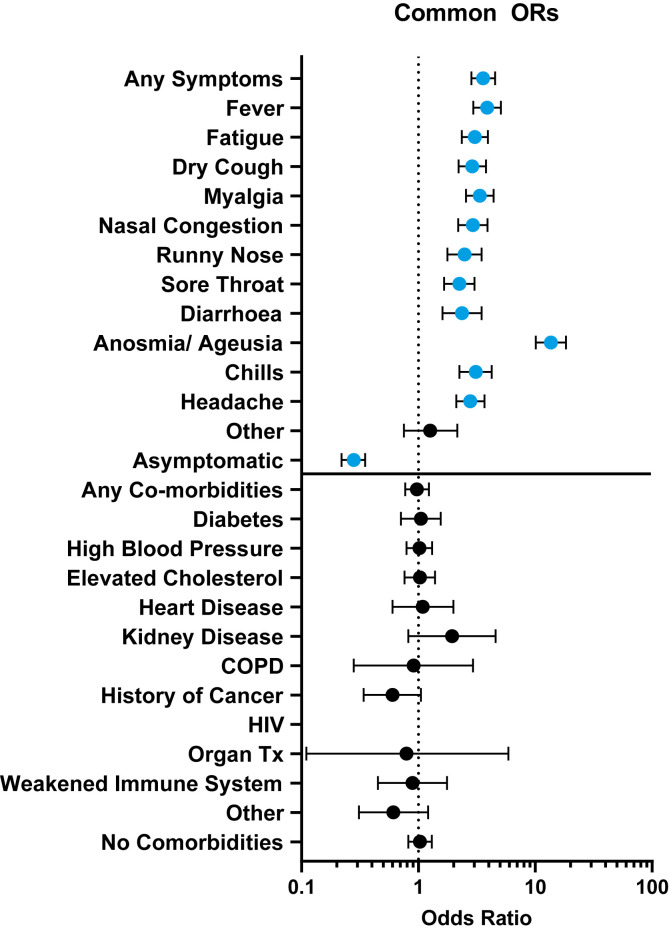
Odds ratios of SARS-CoV-2 infections by symptoms and co-morbidities in New Orleans and Baton Rouge, LA. Odds ratios from Cochran–Mantel–Haenszel analysis are shown with 95% CI. Symptoms of any kind increased the odds of testing positive, but co-morbidities were not associated with infection. No one reporting HIV or history of tuberculosis tested positive. Abbreviations: COPD, chronic obstructive pulmonary disease; HIV, human immunodeficiency viruses; SARS-CoV-2, severe acute respiratory syndrome coronavirus 2; TX, transplant.
Fig. 2
Fig. 2
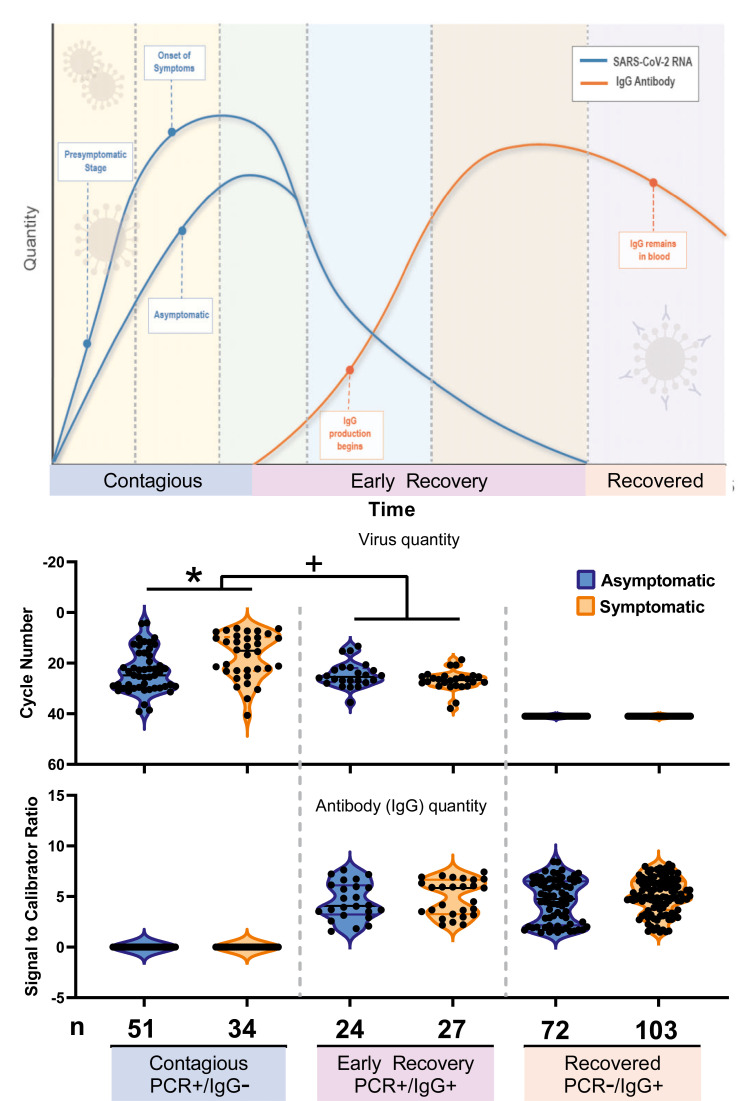
Quantity of virus and antibody by disease stage and symptom status. The top panel is a schematic of disease progression. Cycle number (CN) and signal-to-calibrator ratio (S/C) were averaged by disease stage to assess differences in CN or S/C by symptom status, using a Wilcoxon–Mann–Whitney test. The symptomatic group had lower mean CN versus the asymptomatic group during the contagious phase of disease. Antibody levels did not differ by symptom or disease stage. CN is inversely related to viral quantity, so the axis is reversed for clarity. ∗p < 0.001, + p 0.004.
Fig. 3
Fig. 3
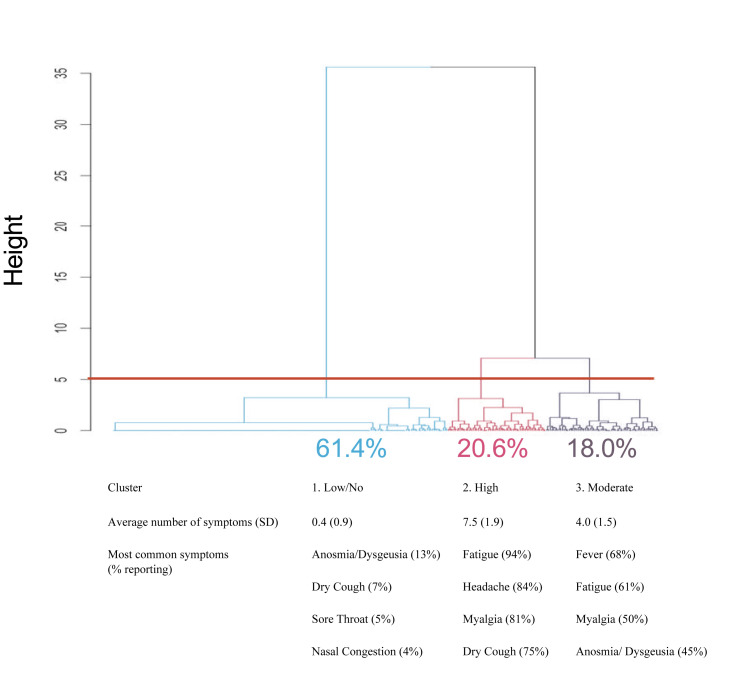
Cluster analysis of symptom presentation in the community. Symptom data were hierarchically clustered and plotted using the Ward method with the hclust and dendextend packages in R to explore patterns in patient-reported symptom presentation. The above plot of patient-reported symptoms of severe acute respiratory syndrome coronavirus 2 (SARS-CoV-2) infection with cut at height = 5 generated three symptomatic clusters. Clusters varied in mean (SD) number of symptoms as well as specific symptom prevalence. The top four most frequently reported symptoms are listed. Frequency of other symptoms in each cluster are listed in the Supplementary material (Table S1).
Fig. 4
Fig. 4
Reported symptoms of severe acute respiratory syndrome coronavirus 2 (SARS-CoV-2) infection by age. (Top) Probability and confidence band of reporting symptoms by age for individuals testing positive for active or past SARS-CoV-2 infection in New Orleans and Baton Rouge, Louisiana. The probability of reporting symptoms by age was modelled using a logistic regression with cubic splines and four nodes. Older individuals (>60 years) had decreasing probability of reporting symptoms as age increased. The highest probability of reporting symptoms was 64.6% (50.4%–76.5%) at age 29 years which decreased to a probability of 49.3% (36.6%–62.0%) at age 60 and only 25.1% (5.0%–68.1%) at age 80. (Bottom) Percentage of symptomatic individuals reporting each symptom by age group with an overlaid heatmap to indicate the relative detectability of each symptom in each age group.

References

    1. Amorim Filho L., Szwarcwald C.L., Mateos S.O.G., Leon A., Medronho R.A., Veloso V.G. Seroprevalence of anti-SARS-CoV-2 among blood donors in Rio de Janeiro, Brazil. Rev Saude Publica. 2020;54:69. - PMC - PubMed
    1. Emmenegger M., De Cecco E., Lamparter D., Jacquat R.P.B., Ebner D., Schneider M.M. Early plateau of SARS-CoV-2 seroprevalence identified by tripartite immunoassay in a large population. medRxiv. 2020:2020. 05.31.20118554.
    1. Erikstrup C., Hother C.E., Pedersen O.B.V., Mølbak K., Skov R.L., Holm D.K. Estimation of SARS-CoV-2 infection fatality rate by real-time antibody screening of blood donors. medRxiv. 2020:2020. 04.24.20075291. - PMC - PubMed
    1. Fiore J.R., Centra M., de Carlo A., Granato M., Rosa A., de Feo L. Far away from herd immunity to SARS-CoV-2: results from a survey in healthy blood donors in South Eastern Italy. medRxiv. 2020:2020. 06.17.20133678. - PMC - PubMed
    1. Ng D.L., Goldgof G.M., Shy B.R., Levine A.G., Balcerek J., Bapat S.P. SARS-CoV-2 seroprevalence and neutralizing activity in donor and patient blood. Nat Commun. 2020;11:4698. - PMC - PubMed

MeSH terms