


Rate of rebound in follicle growth after cessation of ovarian stimulation in initial non-responders: a prospective cohort study
- PMID: 33422140
- PMCID: PMC7797149
- DOI: 10.1186/s13048-021-00765-5
Rate of rebound in follicle growth after cessation of ovarian stimulation in initial non-responders: a prospective cohort study
Abstract
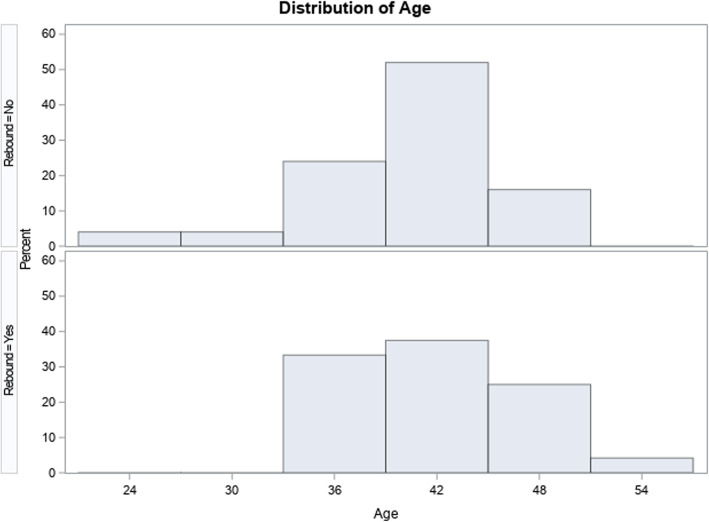
Previously anecdotally observed rebounds in follicle growth after interruption of exogenous gonadotropins in absolute non-responders were the impetus for here reported study. In a prospective cohort study, we investigated 49 consecutive patients, absolutely unresponsive to maximal exogenous gonadotropin stimulation, for a so-called rebound response to ovarian stimulation. A rebound response was defined as follicle growth following complete withdrawal of exogenous gonadotropin stimulation after complete failure to respond to maximal gonadotropin stimulation over up to 5-7 days. Median age of study patients was 40.5 ± 5.1 years (range 23-52). Women with and without rebound did not differ significantly (40.0 ± 6.0 vs. 41.0 ± 7.0 years, P = 0.41), with 24 (49.0%) recording a rebound and 25 (51.0%) not. Among the former, 21 (87.5%) reached retrieval of 1-3 oocytes and 15 (30.6%) reached embryo transfer. A successful rebound in almost half of prior non-responders was an unsuspected response rate, as was retrieval of 1-3 oocytes in over half of rebounding patients. Attempting rebounds may, thus, represent another incremental step in very poor prognosis patients before giving up on utilization of autologous oocytes. Here presented findings support further investigations into the underlying physiology leading to such an unexpectedly high rebound rate.
Keywords: Failure to respond, gonadotropin isotype; Glycosylation; In vitro fertilization (IVF); Low ovarian reserve; Poor prognosis.
Conflict of interest statement
N.G., and D.H.B. are listed as co-owners of a number of already awarded and still pending U.S. patents, some claiming benefits from androgen supplementation in women with low ovarian reserve, a topic peripherally addressed in this manuscript. N.G. is a shareholder in Fertility Nutraceuticals, LLC, which produces a DHEA product, and is owner of The CHR. N.G. and D.H.B. receive patent royalties from Fertility Nutraceuticals, LLC. N.G., and D.H.B also received research support, travel funding and lecture fees from various Pharma and medical device companies, none, in any way related to this manuscript.
Figures
References
-
- Albertini DF, Barad DH, Darmon S, Gleicher N, Kushnir VA. Older women using their own eggs? Issue framed with two oldest reported IVF pregnancies and a live birth. Reprod Biomed Online. 2018 Aug;37(2):172–7. - PubMed
-
- Albertini DF, Barad DH, Darmon SK, Gleicher N, Kushnir VA, Sen A, Wang Q, Weghofer A, Wu YG, Zhang L. Definition by FSH, AMH and embryo numbers of good-, intermediate- and poor-prognosis patients suggests previously unknown IVF outcome-determining factor associated with AMH. J Transl Med. 2016 Jun;10(1):172. 14(. - PMC - PubMed
MeSH terms
Grants and funding
LinkOut - more resources
Full Text Sources
Other Literature Sources
Medical
