


The Association of COVID-19 With Acute Kidney Injury Independent of Severity of Illness: A Multicenter Cohort Study
- PMID: 33422598
- PMCID: PMC7791318
- DOI: 10.1053/j.ajkd.2020.12.007
The Association of COVID-19 With Acute Kidney Injury Independent of Severity of Illness: A Multicenter Cohort Study
Abstract
Rationale & objective: Although coronavirus disease 2019 (COVID-19) has been associated with acute kidney injury (AKI), it is unclear whether this association is independent of traditional risk factors such as hypotension, nephrotoxin exposure, and inflammation. We tested the independent association of COVID-19 with AKI.
Study design: Multicenter, observational, cohort study.
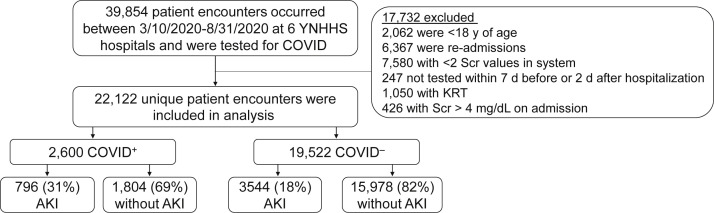
Setting & participants: Patients admitted to 1 of 6 hospitals within the Yale New Haven Health System between March 10, 2020, and August 31, 2020, with results for severe acute respiratory syndrome coronavirus 2 (SARS-CoV-2) testing via polymerase chain reaction of a nasopharyngeal sample.
Exposure: Positive test for SARS-CoV-2.
Outcome: AKI by KDIGO (Kidney Disease: Improving Global Outcomes) criteria.
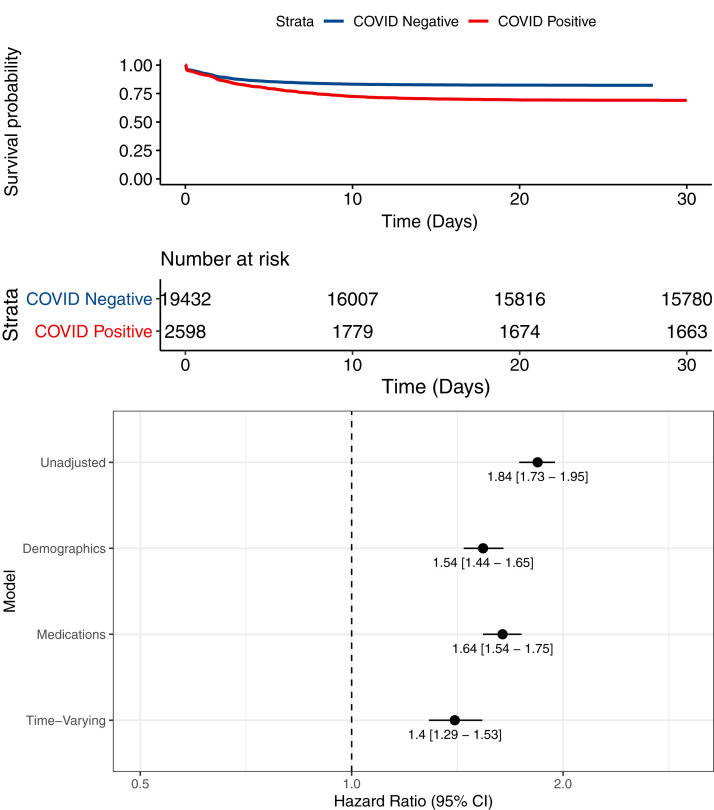
Analytical approach: Evaluated the association of COVID-19 with AKI after controlling for time-invariant factors at admission (eg, demographic characteristics, comorbidities) and time-varying factors updated continuously during hospitalization (eg, vital signs, medications, laboratory results, respiratory failure) using time-updated Cox proportional hazard models.
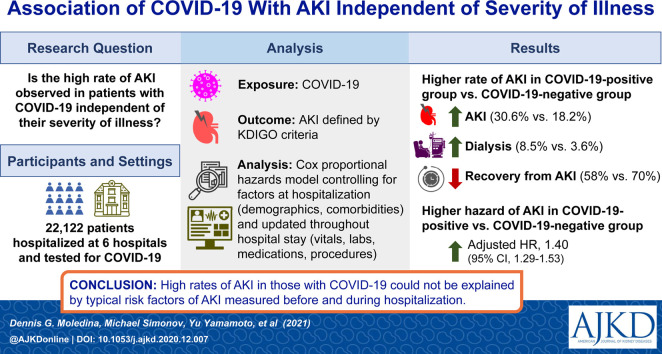
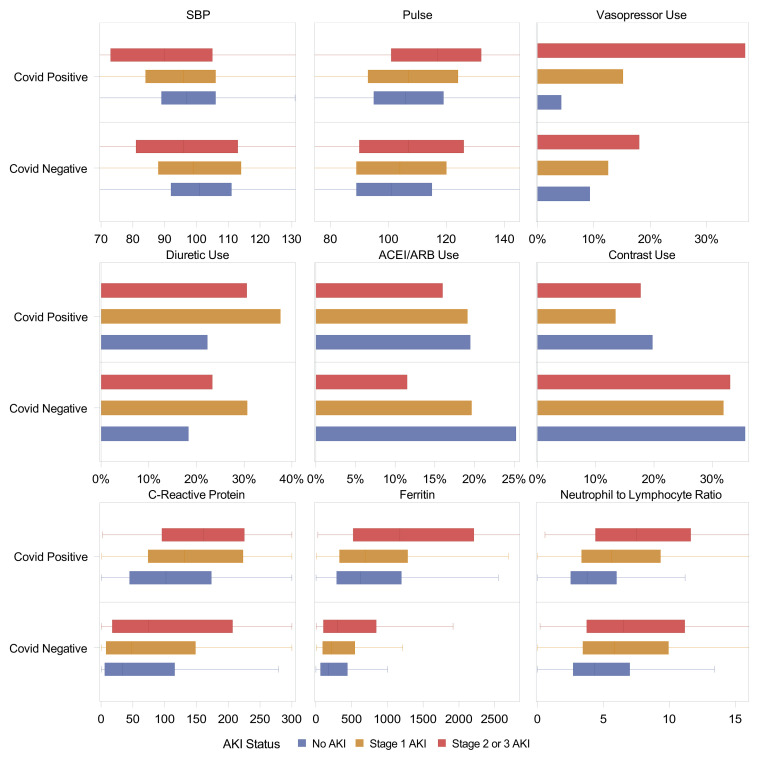
Results: Of the 22,122 patients hospitalized, 2,600 tested positive and 19,522 tested negative for SARS-CoV-2. Compared with patients who tested negative, patients with COVID-19 had more AKI (30.6% vs 18.2%; absolute risk difference, 12.5% [95% CI, 10.6%-14.3%]) and dialysis-requiring AKI (8.5% vs 3.6%) and lower rates of recovery from AKI (58% vs 69.8%). Compared with patients without COVID-19, patients with COVID-19 had higher inflammatory marker levels (C-reactive protein, ferritin) and greater use of vasopressors and diuretic agents. Compared with patients without COVID-19, patients with COVID-19 had a higher rate of AKI in univariable analysis (hazard ratio, 1.84 [95% CI, 1.73-1.95]). In a fully adjusted model controlling for demographic variables, comorbidities, vital signs, medications, and laboratory results, COVID-19 remained associated with a high rate of AKI (adjusted hazard ratio, 1.40 [95% CI, 1.29-1.53]).
Limitations: Possibility of residual confounding.
Conclusions: COVID-19 is associated with high rates of AKI not fully explained by adjustment for known risk factors. This suggests the presence of mechanisms of AKI not accounted for in this analysis, which may include a direct effect of COVID-19 on the kidney or other unmeasured mediators. Future studies should evaluate the possible unique pathways by which COVID-19 may cause AKI.
Keywords: C-reactive protein (CRP); Coronavirus disease 2019 (COVID-19); acute kidney injury (AKI); death; dialysis; ferritin; hospital-acquired AKI; hypotension; inflammation; mortality; renal recovery; risk factors; serum creatinine; severe acute respiratory syndrome coronavirus 2 (SARS-CoV-2); time-updated variables.
Copyright © 2021 National Kidney Foundation, Inc. Published by Elsevier Inc. All rights reserved.
Figures
References
Publication types
MeSH terms
Substances
Grants and funding
LinkOut - more resources
Full Text Sources
Other Literature Sources
Medical
Research Materials
Miscellaneous
