


The nAChR Chaperone TMEM35a (NACHO) Contributes to the Development of Hyperalgesia in Mice
- PMID: 33422618
- PMCID: PMC7897319
- DOI: 10.1016/j.neuroscience.2020.12.027
The nAChR Chaperone TMEM35a (NACHO) Contributes to the Development of Hyperalgesia in Mice
Abstract
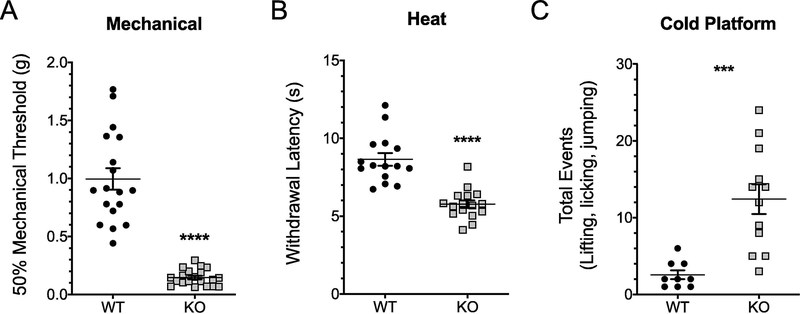
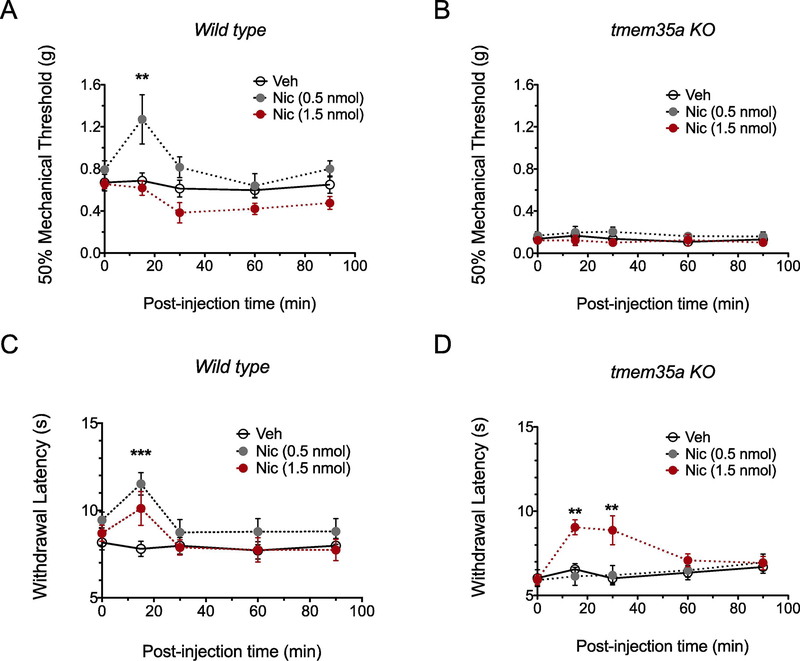
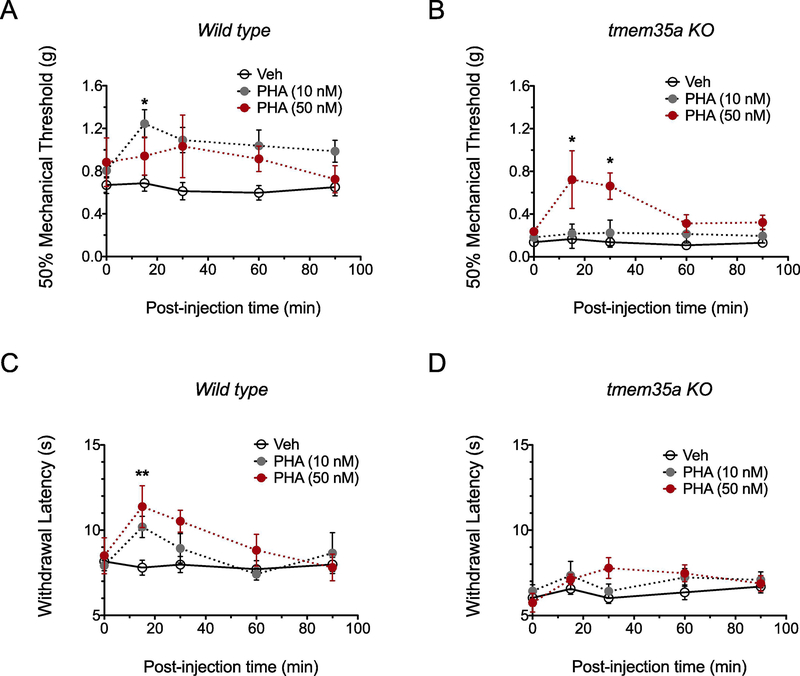
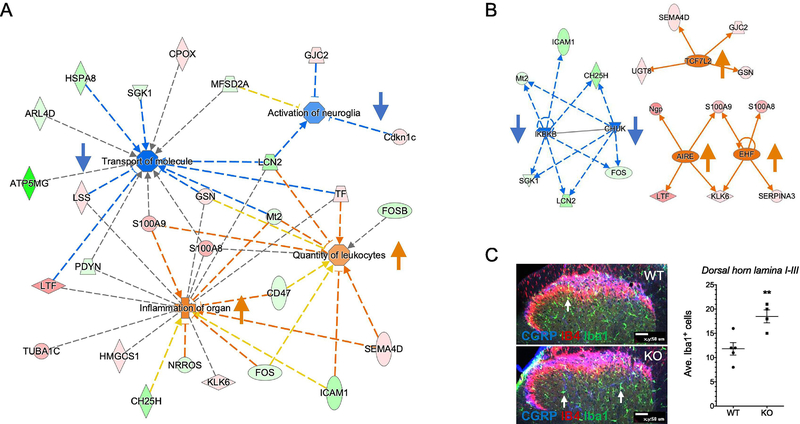
Pain is a major health problem, affecting over fifty million adults in the US alone, with significant economic cost in medical care and lost productivity. Despite evidence implicating nicotinic acetylcholine receptors (nAChRs) in pathological pain, their specific contribution to pain processing in the spinal cord remains unclear given their presence in both neuronal and non-neuronal cell types. Here we investigated if loss of neuronal-specific TMEM35a (NACHO), a novel chaperone for functional expression of the homomeric α7 and assembly of the heteromeric α3, α4, and α6-containing nAChRs, modulates pain in mice. Mice with tmem35a deletion exhibited thermal hyperalgesia and mechanical allodynia. Intrathecal administration of nicotine and the α7-specific agonist, PHA543613, produced analgesic responses to noxious heat and mechanical stimuli in tmem35a KO mice, respectively, suggesting residual expression of these receptors or off-target effects. Since NACHO is expressed only in neurons, these findings indicate that neuronal α7 nAChR in the spinal cord contributes to heat nociception. To further determine the molecular basis underlying the pain phenotype, we analyzed the spinal cord transcriptome. Compared to WT control, the spinal cord of tmem35a KO mice exhibited 72 differentially-expressed genes (DEGs). These DEGs were mapped onto functional gene networks using the knowledge-based database, Ingenuity Pathway Analysis, and suggests increased neuroinflammation as a potential contributing factor for the hyperalgesia in tmem35a KO mice. Collectively, these findings implicate a heightened inflammatory response in the absence of neuronal NACHO activity. Additional studies are needed to determine the precise mechanism by which NACHO in the spinal cord modulates pain.
Keywords: TMEM35a/NACHO; inflammation; nicotinic acetylcholine receptor; pain; spinal transcriptome.
Copyright © 2021 IBRO. Published by Elsevier Ltd. All rights reserved.
Conflict of interest statement
Figures
References
-
- Aceto MD, Bagley RS, Dewey WL, Fu TC, and Martin BR. The Spinal-Cord as a Major Site for the Antinociceptive Action of Nicotine in the Rat. Neuropharmacology 25: 1031–1036, 1986. - PubMed
-
- Alsharari SD, Freitas K, and Damaj MI. Functional role of alpha7 nicotinic receptor in chronic neuropathic and inflammatory pain: studies in transgenic mice. Biochemical pharmacology 86: 1201–1207, 2013. - PubMed
-
- Bertrand D, and Terry AV Jr. The wonderland of neuronal nicotinic acetylcholine receptors. Biochemical pharmacology 151: 214–225, 2018. - PubMed
Publication types
MeSH terms
Substances
Grants and funding
LinkOut - more resources
Full Text Sources
Other Literature Sources
Molecular Biology Databases
Research Materials
