


Newborn telomere length predicts later life telomere length: Tracking telomere length from birth to child- and adulthood
- PMID: 33422989
- PMCID: PMC7808927
- DOI: 10.1016/j.ebiom.2020.103164
Newborn telomere length predicts later life telomere length: Tracking telomere length from birth to child- and adulthood
Abstract
Background: Telomere length (TL) is considered a biological marker of aging and may indicate age-related disease susceptibility. Adults and children show a fixed ranking and tracking of TL over time. However, the contribution of an individual's initial birth TL to their later life TL is unknown. We evaluated change and tracking of TL from birth to child- and adulthood.
Methods: Telomere length at birth was measured using qPCR in two independent prospective birth cohorts. After a median follow-up period of 4 years in ENVIRONAGE (n = 273) we assessed leukocyte telomere length (LTL) and after 23 years in EFPTS (n = 164) buccal TL was assessed. Correlations and multivariable regression models were applied to study telomere tracking and determinants of TL change from birth onwards.
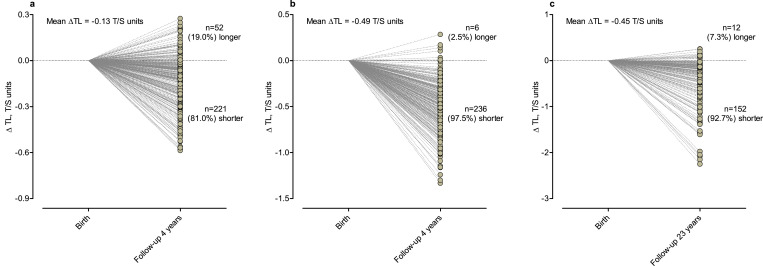
Findings: In children, LTL at the age of 4 correlates with TL at the start of life both in cord blood (r = 0.71, P < 0.0001;) and placenta (r = 0.60, P < 0.0001) and was -11.2% and -33.1% shorter, respectively. In adulthood, buccal TL at the age of 23 correlates with placental TL (r = 0.46, P < 0.0001) and was -35.9% shorter. TL attrition was higher in individuals with longer birth TL. However, based on TL ranking, individuals do not tend to change dramatically from TL rank after 4 or 23 years of follow-up. Finally, longer maternal TL associates with lower telomere attrition in the next generation.
Interpretation: The high prediction of newborn TL for later life TL, and stable TL ranking from birth onwards underscores the importance of understanding the initial setting of newborn TL and its significance for later life.
Funding: European Research Council (ERC-StG310898) and Flemish Scientific Fund (12X9620N).
Keywords: Early life aging; Newborn telomere length; Telomere dynamics; Telomere tracking.
Copyright © 2020 The Authors. Published by Elsevier B.V. All rights reserved.
Conflict of interest statement
Declaration of Interests We declare no competing interests.
Figures



References
-
- Shay J.W., Wright W.E. Telomeres and telomerase: three decades of progress. Nat Rev Genet. 2019;20:299–309. - PubMed
-
- De Meyer T., Nawrot T., Bekaert S., De Buyzere M.L., Rietzschel E.R., Andres V. Telomere length as cardiovascular aging biomarker: JACC review topic of the week. J Am Coll Cardiol. 2018;72:805–813. - PubMed
-
- Wang Q., Zhan Y., Pedersen N.L., Fang F., Hagg S. Telomere length and all-cause mortality: a meta-analysis. Ageing Res Rev. 2018;48:11–20. - PubMed
MeSH terms
LinkOut - more resources
Full Text Sources
Other Literature Sources
