. 2021 Apr 30;27(2):231-239.
doi: 10.5056/jnm20114.

Characteristics of symptomatic belching in patients with belching disorder and patients who exhibit gastroesophageal reflux disease with belching

Affiliations

Characteristics of symptomatic belching in patients with belching disorder and patients who exhibit gastroesophageal reflux disease with belching

Shin Ok Jeong et al. J Neurogastroenterol Motil. .

Abstract

Background/aims: Belching disorder (BD) is clinically distinct from gastroesophageal reflux disease (GERD) with belching. Supragastric belching (SGB) is closely associated with reflux episodes. This study investigates belch characteristics in association with reflux, compared between patients with BD and those who had GERD with belching.

Methods: Impedance pH monitoring data from 10 patients with BD and 10 patients with GERD who exhibited belching were retrospectively analyzed. Belches were considered "isolated" or "reflux-related" and acidic/non-acidic. Belch characteristics were compared between patients with BD and those with GERD.

Results: Symptomatic belches were more frequent in patients with BD than in patients with GERD (median, 160.5 vs 56.0, P < 0.05). SGB was the most common type in both groups; common subtypes comprised "isolated" in patients with BD and "isolated during the reflux period" in patients with GERD. Reflux-related SGB was more common in patients with GERD than in BD (78.3% vs 45.2%, P < 0.005). Both "preceding belching" including the reflux period and acidic SGB were more common in patients with GERD than in BD (31.8% vs 8.6% and 38.1% vs 8.9%, both P < 0.05). Supragastric belch number positively correlated with all reflux episodes in patients with GERD (adjusted R2 = 0.572, P = 0.007).

Conclusions: BD is characterized by more belching, compared to GERD. SGB is more frequently associated with reflux in GERD than in BD; acidity may be related to GERD. In BD, SGB is typically non-acidic and unrelated to reflux. Distinct SGB characteristics may reflect different pathogenic mechanisms of reflux and associated symptoms.

Keywords: Electric impedance; Eructation; Esophageal pH monitorings; Gastroesophageal reflux.


Conflict of interest statement

Conflicts of interest: None.

Figures

Figure 1
Figure 1
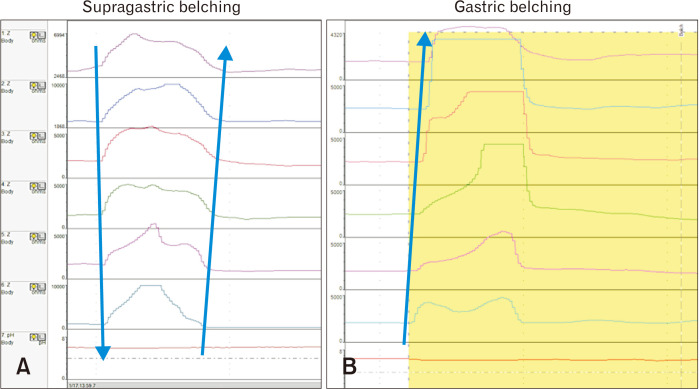
Supragastric belching (SGB) and gastric belching (GB). (A) SGB was defined as a rapid rise in impedance (≥ 1000 Ω) moving in an aboral direction, followed by a return to baseline moving in the oral direction. (B) GB was defined as an elevation of intraluminal impedance (≥ 1000 Ω), including pure gas and mixed liquid gas reflux episodes, moving in the oral direction and reaching the most proximal impedance recording segment. Modified from Bredenoord et al.
Figure 2
Figure 2
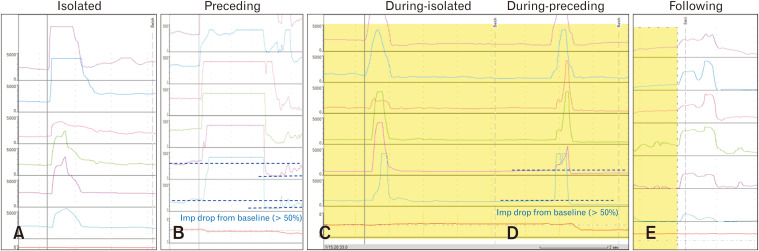
Supragastric belching (SGB) related to reflux. (A) SGB was regarded as “isolated belching” when the belch was unrelated to a reflux event. (B) “Preceding belching” was defined as a belch that occurred immediately prior (< 1 second) to the onset of the reflux episode, which appeared as a > 50% reduction in impedance level. (C) “During-isolated belching” was defined as a belch that occurred during the reflux episode but did not induce re-reflux. (D) “During-preceding belching” was defined as a supragastric belch that preceded the during the reflux period (re-reflux). (E) “Following belching” was defined as a belch that occurred immediately after the reflux episode (< 1 second). Modified from Hemmink et al.
Figure 3
Figure 3
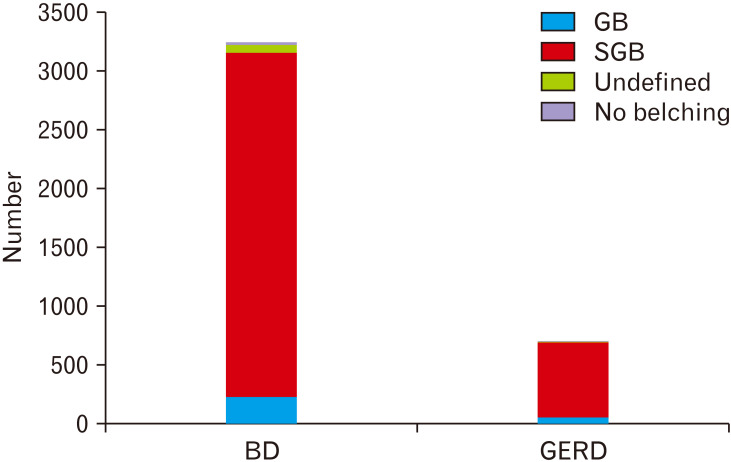
Distribution of symptomatic belching types between belching disorder (BD) and gastroesophageal reflux disease (GERD). The total number of symptomatic belches was significantly higher in the BD group than in the GERD group (P < 0.05). The most common type of belching in the 2 groups was supragastric belching (SGB); the ratio of SGB to GB did not differ between the 2 groups.
Figure 4
Figure 4
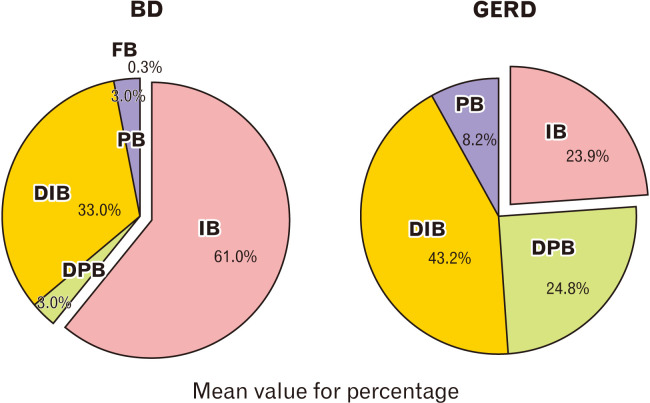
Distribution of the supragastric belching types. Most common belching was isolated belching (IB) in belching disorder (BD), and during belching in gastroesophageal reflux disease (GERD) group. Gastroesophageal reflux related supragastric belching (excluding IB) was significantly higher in GERD group than BD group (P < 0.005). Total preceding belching (PB) before and during reflux events was also significantly higher in GERD group than BD group (P < 0.05). These finding suggest that supragastric belching may have a role in GERD. FB, following belching; DIB, during-isolated belching; DPB, during-preceding belching. Percentage was a mean value of each individual.
Figure 5
Figure 5
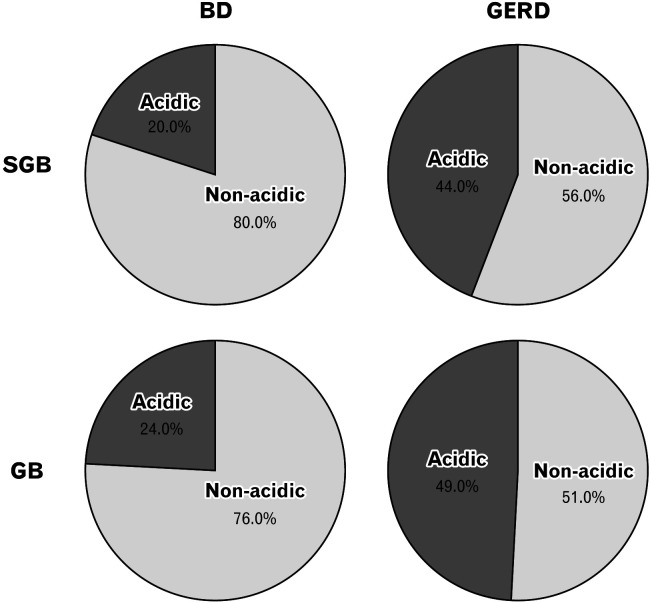
Acidity of supragastric and gastric belches in the belching disorder (BD) and gastroesophageal reflux disease (GERD) groups. In supragastric belching (SGB), the ratio of acidic belches was significantly higher in the GERD group than in the BD group (median, 38.1% vs 8.9%, P < 0.05); the ratio of non-acidic SGB was significantly higher in the BD group. In gastric belching (GB), the ratio of acidic belching was also significantly higher in the GERD group than in the BD group (median: 49.2% vs 16.9%, P < 0.05).
Figure 6
Figure 6
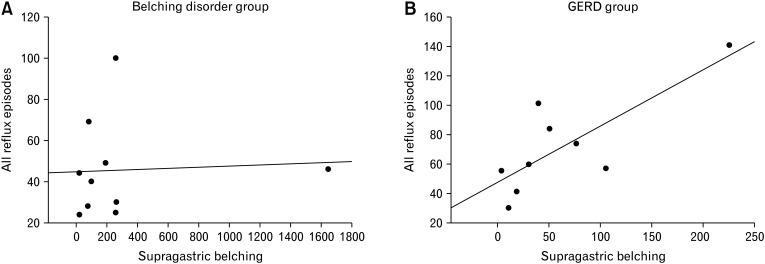
Correlations between supragastric belching (SGB) and all reflux episodes, as determined by impedance pH monitoring. In patients with belching disorder (BD), total reflux episodes were not correlated with the number of supragastric belches (A). However, the number of all reflux episodes was positively correlated with the number of supragastric belches (adjusted R2 = 0.572, P < 0.05) (B).

References

    1. Stanghellini V, Chan FK, Hasler WL, et al. Gastroduodenal disorders. Gastroenterology. 2016;150:1380–1392. doi: 10.1053/j.gastro.2016.02.011. - DOI - PubMed
    1. Kessing BF, Bredenoord AJ, Smout AJ. Mechanisms of gastric and supragastric belching: a study using concurrent high-resolution manometry and impedance monitoring. Neurogastroenterol Motil. 2012;24:e573–e579. doi: 10.1111/nmo.12024. - DOI - PubMed
    1. Lin M, Triadafilopoulos G. Belching: dyspepsia or gastroesophageal reflux disease? Am J Gastroenterol. 2003;98:2139–2145. doi: 10.1111/j.1572-0241.2003.07627.x. - DOI - PubMed
    1. Hemmink GJ, Bredenoord AJ, Weusten BL, Timmer R, Smout AJ. Supragastric belching in patients with reflux symptoms. Am J Gastroenterol. 2009;104:1992–1997. doi: 10.1038/ajg.2009.203. - DOI - PubMed
    1. Kessing BF, Bredenoord AJ, Velosa M, Smout AJ. Supragastric belches are the main determinants of troublesome belching symptoms in patients with gastro-oesophageal reflux disease. Aliment Pharmacol Ther. 2012;35:1073–1079. doi: 10.1111/j.1365-2036.2012.05070.x. - DOI - PubMed

LinkOut - more resources