


Prevalence of post-traumatic stress disorder during the COVID-19 pandemic in Saudi Arabia
- PMID: 33424259
- PMCID: PMC7783103
- DOI: 10.1016/j.jsps.2020.10.013
Prevalence of post-traumatic stress disorder during the COVID-19 pandemic in Saudi Arabia
Abstract
Background: The coronavirus diseases of 2019 (COVID-19) pandemic was classified as one of the worst pandemics in the 21st century. Its rapid transmission, unpredicted mortality rate, and the uncertainty surrounding its transmission method have evoked additional fear and anxiety. Nonetheless, to the best of our knowledge, no prior study has explored PTSD prevalence three months after the start of the quarantine procedures in Saudi Arabia nor has examined PTSD prevalence by three different methods.
Objective: This observational cross-sectional study aimed to identify the prevalence, severity, and influencing factors of PTSD in different regions of Saudi Arabia three months after the onset of the quarantine procedures related to the COVID-19 pandemic.
Methods: Through the month of June 2020, 1374 people (49.05% men and 50.95% women) completed a 35-item, 10-minute online. The prevalence of PTSD was measured using PCL-S (specific for COVID-19) that assesses the 17 symptoms of PTSD. Resilience was measured using 2-items Arabic version of the Connor-Davidson Resilience Scale 2 (CD-RISC 2).
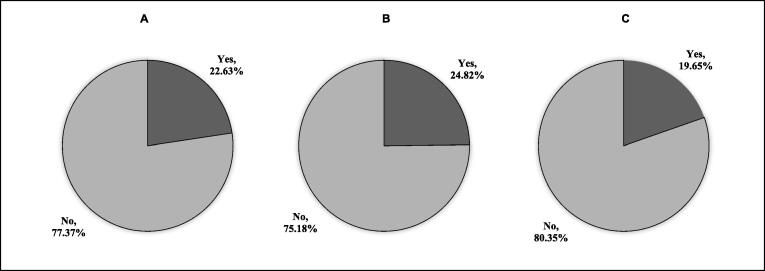
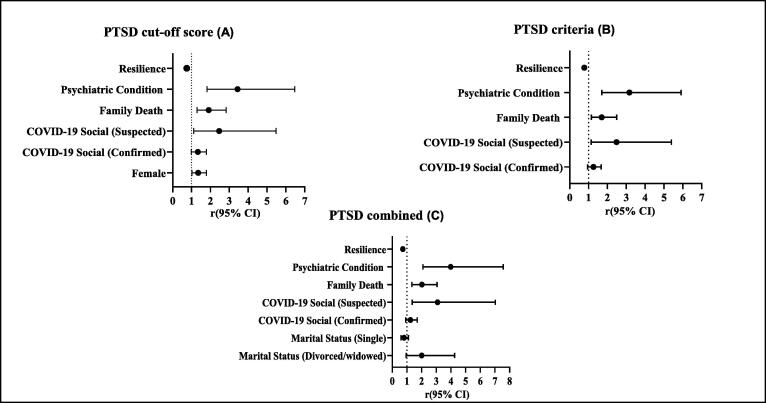
Results: We calculated the prevalence by three methods, namely, PTSD cut-off score, criteria, and combined, and the prevalence was 22.63%, 24.8%, and 19.6%, respectively. Female participants showed higher prevalence than male. As well, participants who were either tested positive or suspected of having been infected with COVID-19 showed higher PTSD prevalence. Higher resilience was associated with lower PTSD prevalence.
Conclusions: This was the first study to report PTSD prevalence by three differential methods three months after the onset of the quarantine procedures related to the COVID-19 pandemic in Saudi Arabia. We observed a significant impact of the COVID-19 pandemic in the Saudi population; therefore, great attention should be performed in implementing new procedures that deal with the highlighted risk factors, especially in vulnerable groups, to overcome the psychological impact of the COVID-19 pandemic.
Keywords: COVID-19; Disease prevalence; Mental health; Post-traumatic stress disorder; Resilience; Saudi Arabia.
© 2020 The Author(s).
Conflict of interest statement
No potential competing interest was reported by the authors.
Figures
References
-
- Al Najjar N.S., Attar L.M., Farahat F.M., Al Thaqafi A. Psychobehavioural responses to the 2014 Middle East respiratory syndrome-novel corona virus [MERS CoV] among adults in two shopping malls in Jeddah, western Saudi Arabia. EMHJ-Eastern Mediterranean Health J. 2016;22(11):817–823. https://apps.who.int/iris/handle/10665/260277 - PubMed
LinkOut - more resources
Full Text Sources