


COVID-19 lockdowns reduce the Black carbon and polycyclic aromatic hydrocarbons of the Asian atmosphere: source apportionment and health hazard evaluation
- PMID: 33424424
- PMCID: PMC7779106
- DOI: 10.1007/s10668-020-01167-1
COVID-19 lockdowns reduce the Black carbon and polycyclic aromatic hydrocarbons of the Asian atmosphere: source apportionment and health hazard evaluation
Abstract
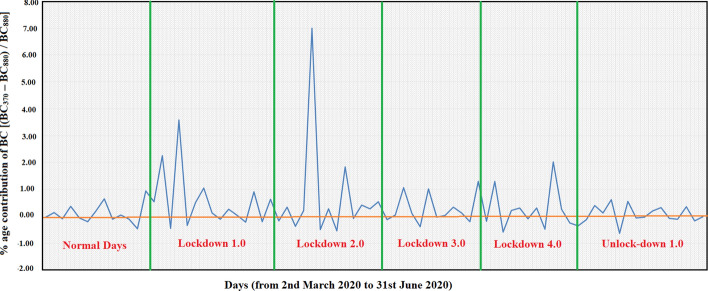
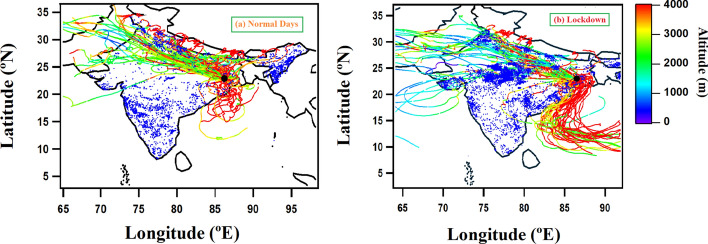
Abstract: The entire world is affected by Coronavirus disease (COVID-19), which is spreading worldwide in a short time. India is one of the countries which is affected most, therefore, the Government of India has implemented several lockdowns in the entire country from April 25, 2020. We studied air pollutants (i.e., PM2.5, Black Carbon (BC), and Polycyclic Aromatic Hydrocarbons (PAHs) level, and observed significantly sudden reduced. In India, most of the anthropogenic activities completely stopped. Therefore, we studied the levels of BC, PAHs and PM2.5 concentrations, their sources apportion, and health risk assessment during normal days, lockdown (from lockdown 1.0 to lockdown 4.0) and unlock down 1.0 situation at Sakchi, Jamshedpur city. It was observed that lockdowns and unlock down situations BC, PAHs and PM2.5 concentrations were significantly lower than regular days. We applied the advanced air mass back trajectory (AMBT) model to locate airborne particulate matter dispersal from different directions to strengthen the new result. The diagnostic ratio analyses of BC shows that wood burning contribution was too high during the lockdown situations. However, during normal days, the PAHs source profile was dedicated toward biomass, coal burning, and vehicle emission as primary sources of PAHs. During the lockdown period, emission from biomass and coal burning was a significant contributor to PAHs. The summaries of health risk assessment of BC quantified an equal number of passively smoked cigarettes (PSC) for an individual situation was studied. This study focuses on the overall climate impact of pandemic situations.
Keywords: Backward trajectory; Black carbon; COVID-19; Health risk assessment; PAHs.
© The Author(s), under exclusive licence to Springer Nature B.V. part of Springer Nature 2021, corrected publication, 2021.
Conflict of interest statement
Conflict of interestThe authors declare that they have no known competing financial interests or personal relationships that could have appeared to influence the work reported in this paper.
Figures
References
-
- Allen GA, Lawrence J, Koutrakis P. Field validation of a semicontinuous method for aerosol black carbon (aethalometer) and temporal patterns of summertime hourly black carbon measurements in southwestern PA. Atmospheric Environment. 1999;33:817–823.
-
- Arey J, Atkinson R. Photochemical reactions of PAH in the atmosphere. In: Douben PET, editor. PAHs: An ecotoxicological perspective. New York, NY: John Wiley and Sons Ltd; 2003. pp. 47–63.
-
- Baek SO, Field RA, Goldstone ME, Kirk PW, Lester JN, Perry R. A review of atmospheric polycyclic aromatic hydrocarbons: sources, fate and behavior. Water, Air, and Soil Pollution. 1991;60:79–300.
-
- Belis CA, Karagulian F, Larsen BR, Hopke PK. Critical review and metaanalysis of ambient particulate matter source apportionment using receptor models in Europe. Atmospheric Environment. 2013;69:94–108.
-
- Boeuf B, Fritsch O, Martin-Ortega J. Undermining European environmental policy goals? The EU water framework directive and the politics of exemptions. Water. 2016;8:388.
LinkOut - more resources
Full Text Sources
Other Literature Sources
Miscellaneous