


Insights into the Neurobiology of Craving in Opioid Use Disorder
- PMID: 33424457
- PMCID: PMC7790122
- DOI: 10.1007/s40140-020-00420-7
Insights into the Neurobiology of Craving in Opioid Use Disorder
Abstract
Purpose of review: Opioids remain the most potent form of pain relief currently available, yet have a high abuse liability. Here we discuss underlying neurobiological changes in Opioid Use Disorder (OUD) that likely contribute to drug craving, which in turn drives continued drug use and relapse.
Recent findings: Craving has emerged as a strong indicator in drug-seeking and relapse. Studies have demonstrated a number of allostatic changes in circuitry that facilitate learning of drug-stimuli relationships, thereby augmenting cue-triggered drug use and relapse.
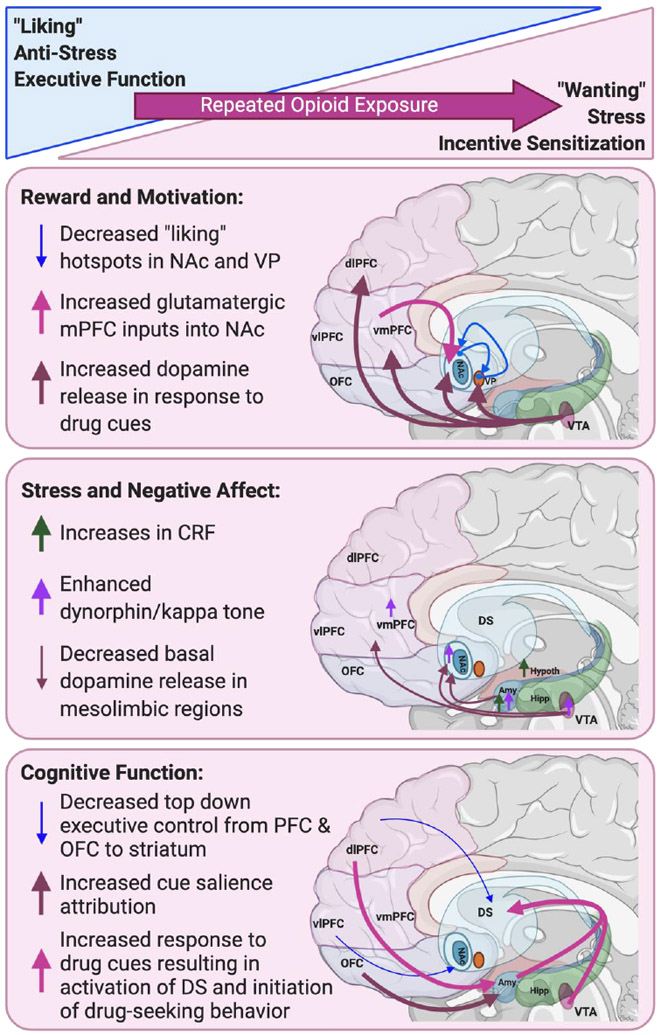
Summary: This review will focus on key neurobiological changes in underlying circuitry observed during the initial and continued exposure to opioids that result in an increase in neural-reactivity to drug-related intrinsic and extrinsic drug cues, and to enhanced learning of drug-context correlations. This sensitized learning state may be an indication of the underlying framework that drives craving and ultimately, motivates increased salience of drug cues and drives drug-seeking.
Keywords: Drug craving; Incentive sensitization; Negative affect; Negative reinforcement; Opioid Use Disorder; Stress.
Figures
References
-
- U.S. Opioid Prescribing Rate Maps ∣ Drug Overdose ∣ CDC Injury Center; 2020.
-
- Board INC. Narcotic Drugs: Estimated world requirements for 2018, statistics for 2016. 2017.
Grants and funding
LinkOut - more resources
Full Text Sources
Research Materials