


Not Able to Lead a Healthy Life When You Need It the Most: Dual Role of Lifestyle Behaviors in the Association of Blurred Work-Life Boundaries With Well-Being
- PMID: 33424717
- PMCID: PMC7786197
- DOI: 10.3389/fpsyg.2020.607294
Not Able to Lead a Healthy Life When You Need It the Most: Dual Role of Lifestyle Behaviors in the Association of Blurred Work-Life Boundaries With Well-Being
Abstract
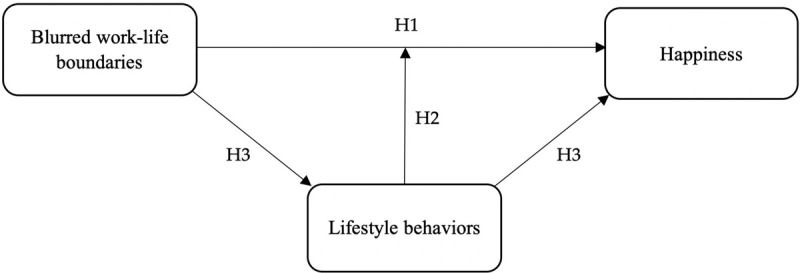
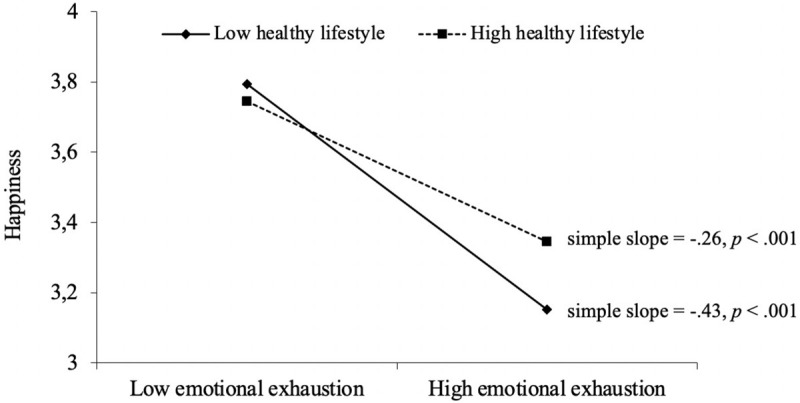
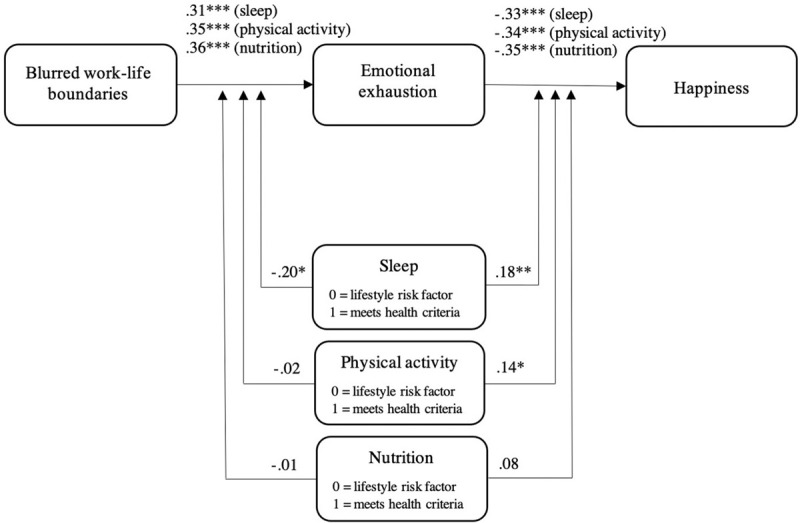
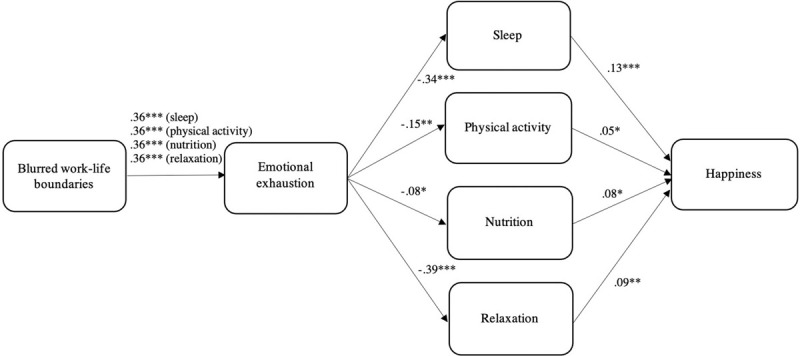
As there is a growing trend for people to work from home, precipitated by the COVID-19 pandemic, this research examines the impact of blurred work-life boundaries on lifestyle and subjective well-being. Our cross-sectional study in the Netherlands demonstrates that heightened levels of blurred work-life boundaries predict negative changes in happiness through enhanced emotional exhaustion. In addition, the findings point to a dual role of lifestyle in this process. On the one hand, we observed that healthy overall lifestyle patterns buffered employees against the detrimental effects of blurred work-life boundaries and emotional exhaustion on happiness. On the other hand, employees who experienced increases in blurring of work-life boundaries reported a deterioration in healthy lifestyle behaviors, which in turn was related to reduced happiness. Paradoxically, it seems that those who would benefit the most from a healthy lifestyle are less able to sustain health-promoting behaviors. A case for shared responsibility between employers and employees is built as we discuss the practical implications of the current research.
Keywords: COVID-19; blurred work-life boundaries; emotional exhaustion; happiness; lifestyle; well-being.
Copyright © 2020 Pluut and Wonders.
Conflict of interest statement
JW at the time of study was employed by company SMC Rijnland Fysiotherapeuten. The remaining authors declare that the research was conducted in the absence of any commercial or financial relationships that could be construed as a potential conflict of interest.
Figures
References
-
- Abdel-Khalek A. M. (2006). Measuring happiness with a single-item scale. Soc. Behav. Pers. 34 139–150. 10.2224/sbp.2006.34.2.139 - DOI
-
- Agarwal G., Mosquera M., Ring M., Victorson D. (2020). Work engagement in medical students: an exploratory analysis of the relationship between engagement, burnout, perceived stress, lifestyle factors, and medical student attitudes. Med. Teach. 42 299–305. 10.1080/0142159X.2019.1679746 - DOI - PubMed
-
- Allen T. D., Armstrong J. (2006). Further examination of the link between work-family conflict and physical health: the role of health-related behaviors. Am. Behav. Sci. 49 1204–1221. 10.1177/0002764206286386 - DOI
-
- Ashfort B. E., Kreiner G. E., Fugate M. (2000). All in a day’s work: boundaries and micro role transitions. Acad. Manag. Rev. 25 472–491. 10.5465/AMR.2000.3363315 - DOI
LinkOut - more resources
Full Text Sources
Research Materials
