


A Roadmap Toward the Definition of Actionable Tumor-Specific Antigens
- PMID: 33424836
- PMCID: PMC7793940
- DOI: 10.3389/fimmu.2020.583287
A Roadmap Toward the Definition of Actionable Tumor-Specific Antigens
Abstract
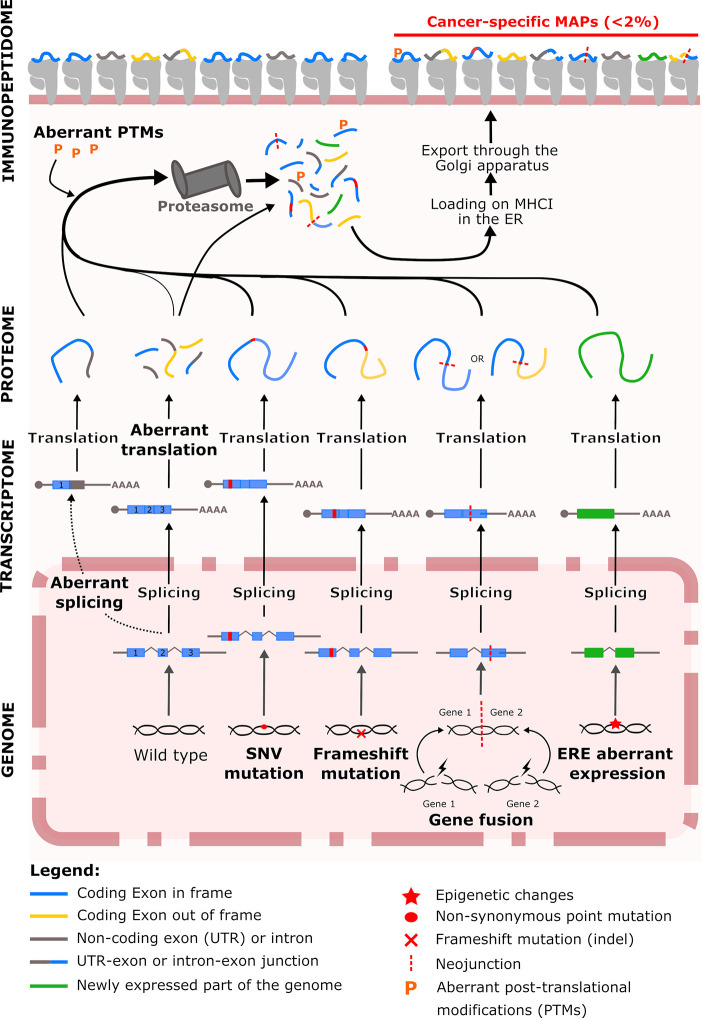
The search for tumor-specific antigens (TSAs) has considerably accelerated during the past decade due to the improvement of proteogenomic detection methods. This provides new opportunities for the development of novel antitumoral immunotherapies to mount an efficient T cell response against one or multiple types of tumors. While the identification of mutated antigens originating from coding exons has provided relatively few TSA candidates, the possibility of enlarging the repertoire of targetable TSAs by looking at antigens arising from non-canonical open reading frames opens up interesting avenues for cancer immunotherapy. In this review, we outline the potential sources of TSAs and the mechanisms responsible for their expression strictly in cancer cells. In line with the heterogeneity of cancer, we propose that discrete families of TSAs may be enriched in specific cancer types.
Keywords: alternative antigens; cancer immunotherapy; immunopeptidome; neoantigens; pan-cancer antigen research; proteogenomics; tumor-specific antigens.
Copyright © 2020 Minati, Perreault and Thibault.
Conflict of interest statement
The authors declare that the research was conducted in the absence of any commercial or financial relationships that could be construed as a potential conflict of interest. The reviewer AA declared a past co-authorship with two of the authors CP and PT to the handling editor.
Figures
References
-
- Grillo-López AJ, White CA, Varns C, Shen D, Wei A, McClure A, et al. Overview of the clinical development of rituximab: first monoclonal antibody approved for the treatment of lymphoma. Semin Oncol (1999) 26:66–73. - PubMed
Publication types
MeSH terms
Substances
LinkOut - more resources
Full Text Sources
Other Literature Sources
Medical
Research Materials
Miscellaneous
