


Challenges for cysteamine stabilization, quantification, and biological effects improvement
- PMID: 33425447
- PMCID: PMC7775854
- DOI: 10.1016/j.jpha.2020.03.007
Challenges for cysteamine stabilization, quantification, and biological effects improvement
Abstract
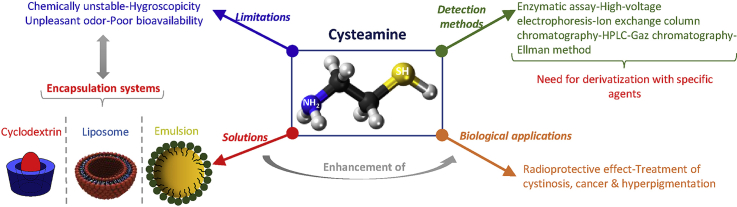
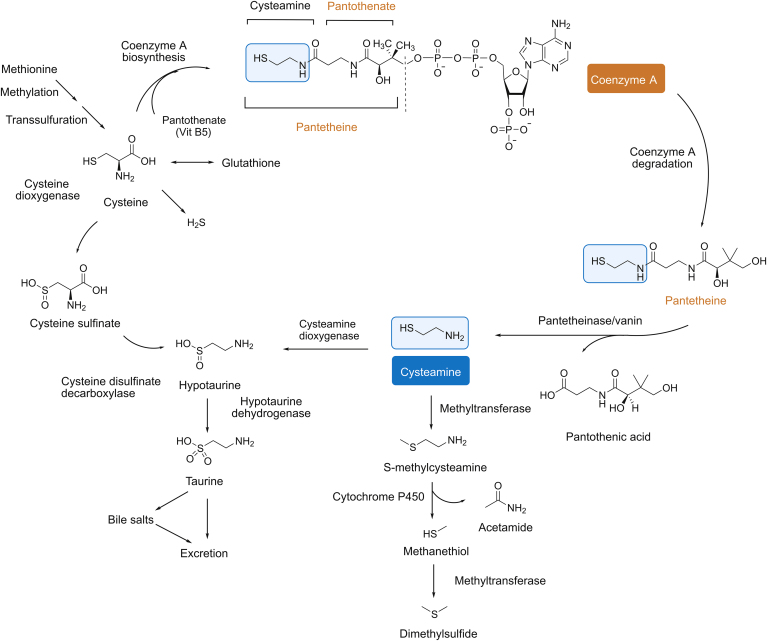
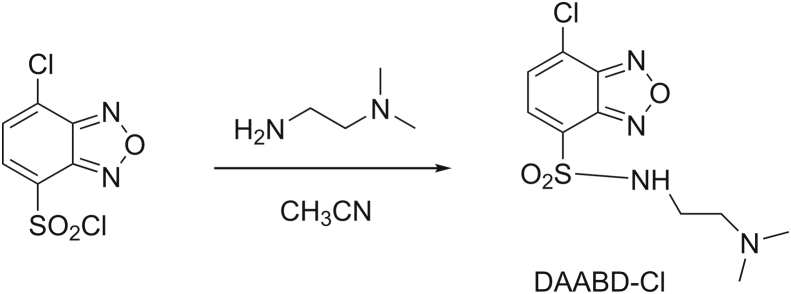
The aminothiol cysteamine, derived from coenzyme A degradation in mammalian cells, presents several biological applications. However, the bitter taste and sickening odor, chemical instability, hygroscopicity, and poor pharmacokinetic profile of cysteamine limit its efficacy. The use of encapsulation systems is a good methodology to overcome these undesirable properties and improve the pharmacokinetic behavior of cysteamine. Besides, the conjugation of cysteamine to the surface of nanoparticles is generally proposed to improve the intra-oral delivery of cyclodextrin-drug inclusion complexes, as well as to enhance the colorimetric detection of compounds by a gold nanoparticle aggregation method. On the other hand, the detection and quantification of cysteamine is a challenging mission due to the lack of a chromophore in its structure and its susceptibility to oxidation before or during the analysis. Derivatization agents are therefore applied for the quantification of this molecule. To our knowledge, the derivatization techniques and the encapsulation systems used for cysteamine delivery were not reviewed previously. Thus, this review aims to compile all the data on these methods as well as to provide an overview of the various biological applications of cysteamine focusing on its skin application.
Keywords: Cysteamine; Detection; Encapsulation; Skin; Stability.
© 2020 Xi'an Jiaotong University. Production and hosting by Elsevier B.V.
Conflict of interest statement
The authors declare that there are no conflicts of interest.
Figures





References
-
- Bacq Z.M., Dechamps G., Fischer P. Protection against x-rays and therapy of radiation sickness with beta-mercaptoethylamine. Science. 1953;117:633–636. - PubMed
-
- Eker P., Pihl A. Studies on the growth-inhibiting and radioprotective effect of cystamine, cysteamine, and AET on mammalian cells in tissue culture. Radiat. Res. 1964;21:165–179. - PubMed
-
- Takagi Y., Shikita M., Terasima T. Specificity of radioprotective and cytotoxic effects of cysteamine in HeLa S3 cells: generation of peroxide as the mechanism of paradoxical toxicity. Radiat. Res. 1974;60:292–301. - PubMed
-
- Korystov Y.N., Vexler F.B. Mechanisms of the radioprotective effect of cysteamine in Escherichia coli. Radiat. Res. 1988;114:550–555. - PubMed
-
- Mitznegg P., Säbel M. On the mechanism of radioprotection by cysteamine. I. Relationship between cysteamine-induced mitotic inhibition and radioprotective effects in the livers of young and senile white mice. Int. J. Radiat. Biol. Relat. Stud. Phys. Chem. Med. 1973;24:329–337. - PubMed
Publication types
LinkOut - more resources
Full Text Sources
Other Literature Sources
