. 2020 Dec 2:26:100341.
doi: 10.1016/j.jbo.2020.100341. eCollection 2021 Feb.

Effects of abiraterone acetate plus prednisone on bone turnover markers in chemotherapy-naïve mCRPC patients after ADT failure: A prospective analysis of the italian real-world study ABITUDE

Affiliations

Effects of abiraterone acetate plus prednisone on bone turnover markers in chemotherapy-naïve mCRPC patients after ADT failure: A prospective analysis of the italian real-world study ABITUDE

Daniele Santini et al. J Bone Oncol. .

Abstract

Background: Bone remodeling is disrupted in metastatic disease, which affects > 70% of metastatic castration-resistant prostate cancer (mCRPC) patients. As a result, abnormal levels of specific bone turnover biomarkers (BTMs) are released. In this prospective ancillary analysis of the Italian real-world study ABITUDE, four markers were measured during abiraterone acetate plus prednisone (AAP) treatment in chemotherapy-naïve mCRPC men failing androgen-deprivation therapy.

Methods: Patients were enrolled if a blood sample was obtained before the first administration of abiraterone (baseline); ad-hoc blood samples were withdrawn during routine tests after 3, 6, and 12 months. A centralized lab measured bone alkaline phosphatase (BALP, osteoblast activity marker), type-I collagen-C-telopeptide (CTX-1, bone resorption marker), parathyroid hormone (PTH) and vitamin D (vitD). At each time point, intra-patient variations vs baseline were compared by the signed-rank test (statistical significance: P-value < 0.05).

Results: Of 481 patients enrolled in ABITUDE, 186 (median age: 76 [range: 53-93] years) met the substudy criteria: 74.7% had bone metastases, 11.8% were on bone-targeted therapies (BTT) and 14.0% on vitD supplementation. BALP decreased significantly at month 6 (P = 0.0010) and 12 (P < 0.0001) and CTX-1 at month 6 (P = 0.0028); PTH increased at month 3 (P < 0.0001); no significant difference in vitD levels was observed. Similar findings were observed in BTT-untreated patients. The reduction in BALP and CTX-1 levels was more pronounced in patients with than without bone metastases; in the latter group, no significant variation in BALP and CTX-1 levels was observed.

Conclusions: AAP seems to exert an effect on the microenvironment of metastatic but not of normal bone, which likely contributes to its antitumoral activity.

Keywords: Abiraterone acetate; Bone alkaline phosphatase; Bone targeting therapy; Bone turnover biomarkers; C-terminal telopeptide; mCRPC.


Conflict of interest statement

The authors declare the following financial interests/personal relationships which may be considered as potential competing interests: R. Bordonaro discloses honoraria/consulting or advisory role/speaker’s bureau from Bayer, AstraZeneca, Sanofi, Novartis, Amgen, Roche, Pfizer, Janssen Cilag, Bristol Mayer Squibb; travel accommodations expenses from Bayer, Pfizer, Astellas, Roche; fellowship or research program from AstraZeneca, Astellas. V.E. Chiuri discloses fees for Advisory Board and speaker from Bristol Mayer Squibb, Ipsen, Janssen Cilag and Pfizer. P. Carlini discloses congressional sponsorships from Sanofi, Aventis, Bayer SPA, Astellas, Janssen Cilag. F. Panebianco and P. Beccaglia are Janssen Cilag employees. G. Procopio discloses consultant or advisory board from AstraZeneca, Bayer, Bristol Mayer Squibb, Ipsen, Janssen Cilag, Merk, MSD, Pfizer, Novartis. The other authors have nothing to disclose.

Figures

Fig. 1
Fig. 1
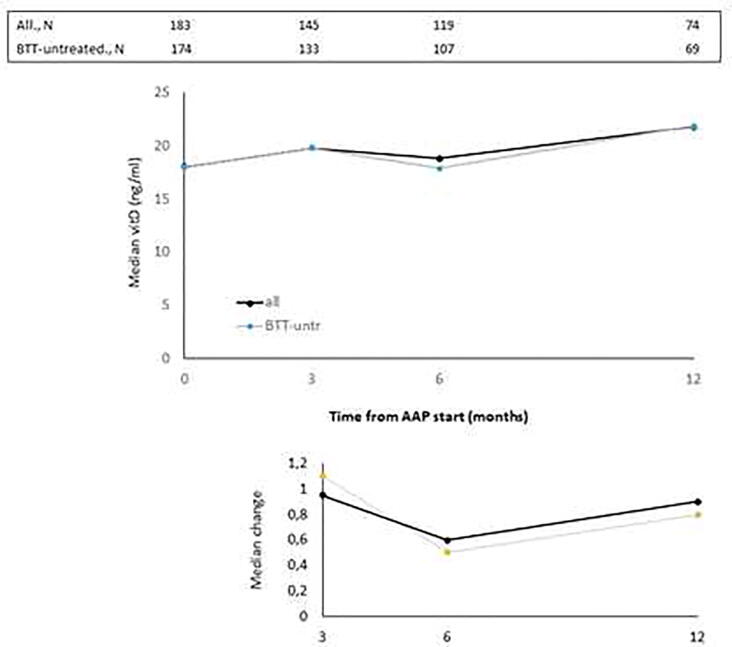
Evaluation of bone turnover biomarkers over time in the overall population and BTT-treated patients. Both the median levels (top panels) and the median change at 3, 6 and 12 months versus baseline (bottom panels) are reported for each biomarker. The Wilcoxon signed-rank test was used to compare the median change at month 3, 6 and 12 vs baseline for each biomarker (i.e. intra-patient change). The asterisks indicate statistical significance for the median change vs baseline.
Fig. 2
Fig. 2
Evaluation of bone turnover biomarkers over time in the overall population and BTT-treated patients. Both the median levels (top panels) and the median change at 3, 6 and 12 months versus baseline (bottom panels) are reported for each biomarker. The Wilcoxon signed-rank test was used to compare the median change at month 3, 6 and 12 vs baseline for each biomarker (i.e. intra-patient change). The asterisks indicate statistical significance for the median change vs baseline.
Fig. 3
Fig. 3
Evaluation of bone turnover biomarkers over time in the overall population and BTT-treated patients. Both the median levels (top panels) and the median change at 3, 6 and 12 months versus baseline (bottom panels) are reported for each biomarker. The Wilcoxon signed-rank test was used to compare the median change at month 3, 6 and 12 vs baseline for each biomarker (i.e. intra-patient change). The asterisks indicate statistical significance for the median change vs baseline.
Fig. 4
Fig. 4
Evaluation of bone turnover biomarkers over time in the overall population and BTT-treated patients. Both the median levels (top panels) and the median change at 3, 6 and 12 months versus baseline (bottom panels) are reported for each biomarker. The Wilcoxon signed-rank test was used to compare the median change at month 3, 6 and 12 vs baseline for each biomarker (i.e. intra-patient change). The asterisks indicate statistical significance for the median change vs baseline.
Fig. 5
Fig. 5
Evaluation of BALP levels over time in patients subgrouped by the presence of bone metastases. Top panel: median levels recorded; bottom panel: median intra-patient change at each time point vs baseline. The asterisk indicates statistical significance (P = 0.0234) reached at month 12 vs baseline in men with bone metastases only.
Fig. 6
Fig. 6
Evaluation of CTX levels over time in patients subgrouped by the presence of bone metastases. Top panel: median levels recorded; bottom panel: median intra-patient change at each time point vs baseline. The asterisk indicates statistical significance (P = 0.0072) reached at month 6 vs baseline in men with bone metastases only.

References

    1. Coates P. Bone turnover markers. Aust. Fam. Phys. 2013;42:285–287. - PubMed
    1. Gartrell B.A., Coleman R., Efstathiou E., Fizazi K., Logothetis C.J., Smith M.R., Sonpavde G., Sartor O., Saad F. Metastatic prostate cancer and the bone: significance and therapeutic options. Eur. Urol. 2015;68(5):850–858. doi: 10.1016/j.eururo.2015.06.039. - DOI - PubMed
    1. Keller E.T., Brown J. Prostate cancer bone metastases promote both osteolytic and osteoblastic activity. J. Cell. Biochem. 2004;91(4):718–729. doi: 10.1002/jcb.10662. - DOI - PubMed
    1. Gdowski A.S., Ranjan A., Vishwanatha J.K. Current concepts in bone metastasis, contemporary therapeutic strategies and ongoing clinical trials. J. Exp. Clin. Cancer Res. 2017;36(1) doi: 10.1186/s13046-017-0578-1. - DOI - PMC - PubMed
    1. Bubendorf L., Schöpfer A., Wagner U., Sauter G., Moch H., Willi N., Gasser T.C., Mihatsch M.J. Metastatic patterns of prostate cancer: an autopsy study of 1,589 patients. Hum. Pathol. 2000;31:578–583. - PubMed