


Analysis of Prognostic Factors of World Health Organization Grade Ⅲ Meningiomas
- PMID: 33425743
- PMCID: PMC7793968
- DOI: 10.3389/fonc.2020.593073
Analysis of Prognostic Factors of World Health Organization Grade Ⅲ Meningiomas
Abstract
Objective: WHO grade III meningiomas are highly aggressive and lethal. However, there is a paucity of clinical information because of a low incidence rate, and little is known for prognostic factors. The aim of this work is to analyze clinical characteristics and prognosis in patients diagnosed as WHO grade III meningiomas.
Methods: 36 patients with WHO grade III meningiomas were enrolled in this study. Data on gender, age, clinical presentation, preoperative Karnofsky Performance Status (KPS), histopathologic features, tumor size, location, radiologic findings, postoperative radiotherapy (RT), surgical treatment, and prognosis were retrospectively analyzed. Progression-free survival (PFS) and overall survival (OS) were evaluated using the Kaplan-Meier method. Univariate and multivariate analysis were conducted by the Cox regression model.
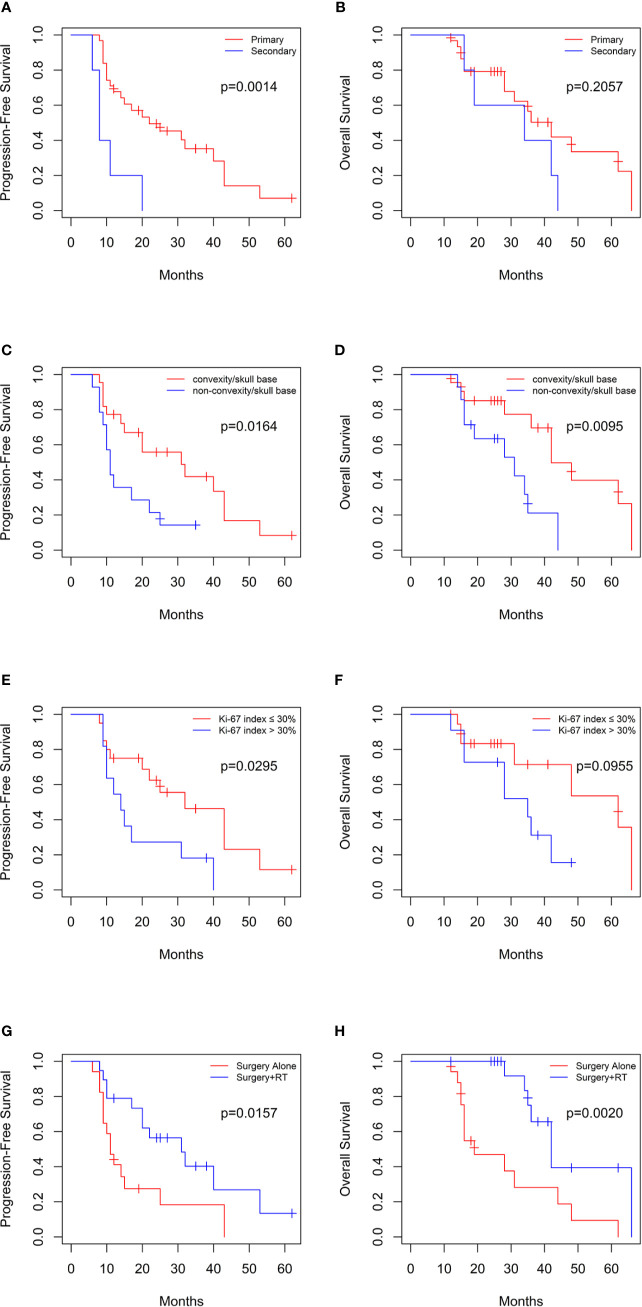
Results: Median PFS is 20 months and median OS is 36 months in 36 patients with WHO grade III meningiomas. Patients with secondary tumors which transformed from low grade meningomas had lower PFS (p=0.0014) compared with primary group. Multivariate analysis revealed that tumors location (PFS, p=0.016; OS, p=0.013), Ki-67 index (PFS, p=0.004; OS, p<0.001) and postoperative radiotherapy (PFS, p=0.006; OS, p<0.001) were associated with prognosis.
Conclusion: WHO grade III meningiomas which progressed from low grade meningiomas were more prone to have recurrences or progression. Tumors location and Ki-67 index can be employed to predict patient outcomes. Adjuvant radiotherapy after surgery can significantly improve patient prognosis.
Keywords: WHO; malignancy; meningioma; prognosis; recurrence.
Copyright © 2020 Tian, Liu, Zhao, Wang, Jiang, Shu and Lei.
Conflict of interest statement
The authors declare that the research was conducted in the absence of any commercial or financial relationships that could be construed as a potential conflict of interest.
Figures
References
-
- Biernat W. World Health Organization classification of tumors of the nervous system. Pol J Pathol (2000) 51(3):107–14. - PubMed
LinkOut - more resources
Full Text Sources
