


Comparison of Deaths Rates for COVID-19 across Europe During the First Wave of the COVID-19 Pandemic
- PMID: 33425843
- PMCID: PMC7793870
- DOI: 10.3389/fpubh.2020.620416
Comparison of Deaths Rates for COVID-19 across Europe During the First Wave of the COVID-19 Pandemic
Abstract
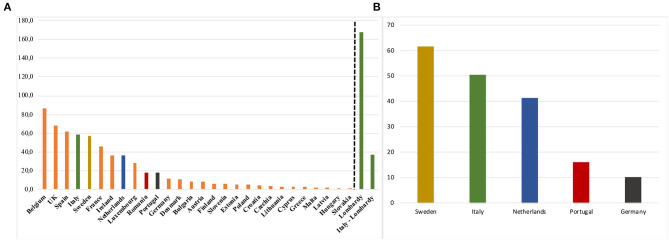
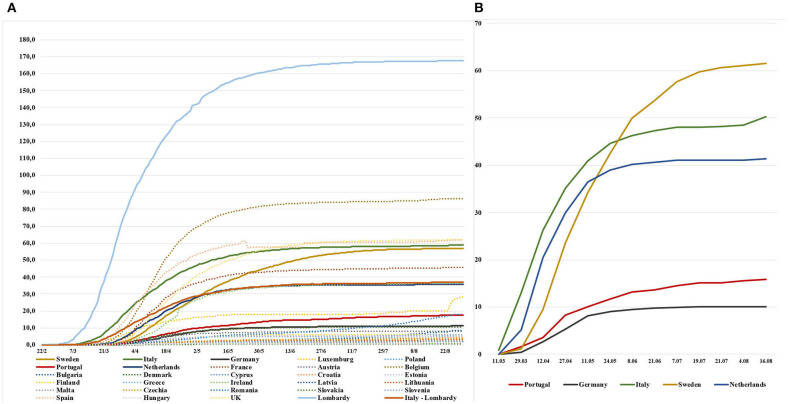
Background: Europe overall suffered greatly in the early stages of the COVID-19 pandemic but the impact of different countries varied. Italy was in the forefront, but there too there were differences, with the Lombardy region the epicentre of the pandemic. Methods: We report Crude Mortality Rates (CMRs) from deaths reported as due to COVID-19 and, in five countries where age-specific data are available, Standardized Mortality Rates (SMRs) in the European Union and United Kingdom. Results: As of 30th August 2020, Belgium was the country with the highest cumulative CMR (86.3/100,000), but the Lombardy region reached almost double this figure (167.6/100,000), far ahead of the corresponding figure for the rest of Italy at 37.0/100,000. SMRs could be calculated for five countries (Italy, Portugal, Sweden, Germany, and Netherlands). Among them, Sweden had the highest SMR (61.6/100,000). The corresponding figures for Italy, Netherlands, Portugal and Germany were 50.2, 41.4, 15.9, and 10.1 per 100,000, respectively. Conclusion: It is clear that countries within Europe have performed very differently in their responses to the COVID-19 pandemic, but the many limitations in the available data must be addressed before a definitive assessment of the reasons for these differences can be made.
Keywords: COVID-19; death rates; epidemics; pandemics; standardized mortality rate.
Copyright © 2020 Villani, McKee, Cascini, Ricciardi and Boccia.
Conflict of interest statement
The authors declare that the research was conducted in the absence of any commercial or financial relationships that could be construed as a potential conflict of interest.
Figures
References
-
- Vanoni M, McKee M, Bonell C, Semenza J, Stuckler D. Using volunteered geographic information to assess mobility in the COVID-19 pandemic context: cross-city time series analysis of 41 cities in 22 countries from March 2nd to 26th 2020. Global Health. (2020) 16:85. 10.1186/s12992-020-00598-9 - DOI - PMC - PubMed
-
- Karanikolos M, McKee M. How comparable is covid-19 mortality across countries? EuroHealth. (2020) 26:45–50. Available online at: https://analysis.covid19healthsystem.org/index.php/2020/06/04/how-compar...
-
- Kontis V, Bennett JE, Rashid T, Parks RM, Pearson-Stuttard J, Guillot M, et al. Magnitude, demographics and dynamics of the effect of the first wave of the COVID-19 pandemic on all-cause mortality in 21 industrialized countries. Nat Med. (2020). 10.1038/s41591-020-1112-0. [Epub ahead of print]. - DOI - PMC - PubMed
-
- ECDC COVID-19 situation update for the EU/EEA and the UK, as of 21st July 2020. Available online at: https://www.ecdc.europa.eu/en/cases-2019-ncov-eueea (accessed August 30, 2020).
Publication types
MeSH terms
LinkOut - more resources
Full Text Sources
Medical
Research Materials
