


A validated integrated clinical and molecular glioblastoma long-term survival-predictive nomogram
- PMID: 33426529
- PMCID: PMC7780842
- DOI: 10.1093/noajnl/vdaa146
A validated integrated clinical and molecular glioblastoma long-term survival-predictive nomogram
Abstract
Background: Glioblastoma (GBM) is the most common primary malignant brain tumor in adulthood. Despite multimodality treatments, including maximal safe resection followed by irradiation and chemotherapy, the median overall survival times range from 14 to 16 months. However, a small subset of GBM patients live beyond 5 years and are thus considered long-term survivors.
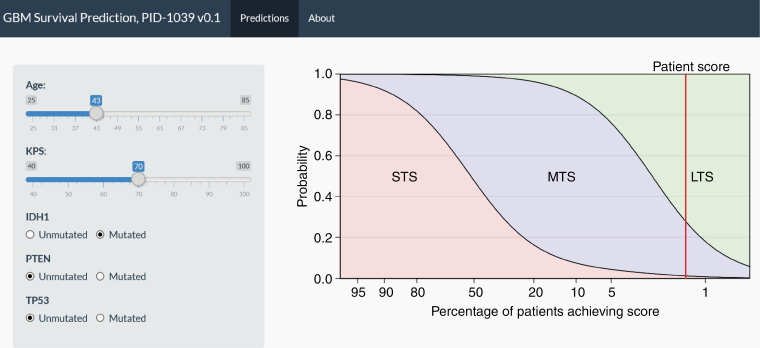
Methods: A retrospective analysis of the clinical, radiographic, and molecular features of patients with newly diagnosed primary GBM who underwent treatment at The University of Texas MD Anderson Cancer Center was conducted. Eighty patients had sufficient quantity and quality of tissue available for next-generation sequencing and immunohistochemical analysis. Factors associated with survival time were identified using proportional odds ordinal regression. We constructed a survival-predictive nomogram using a forward stepwise model that we subsequently validated using The Cancer Genome Atlas.
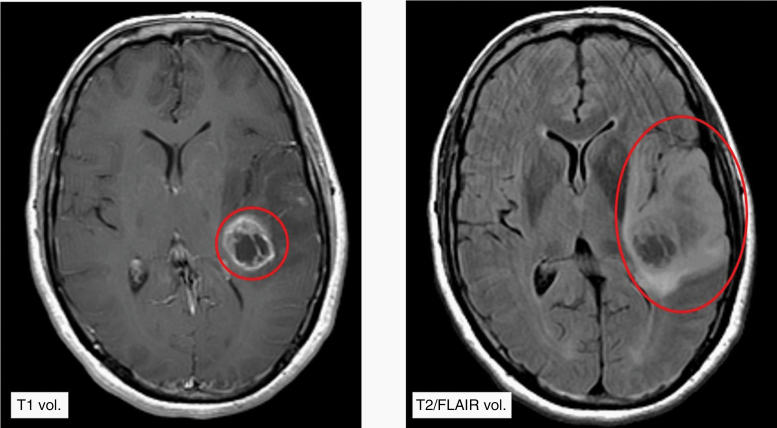
Results: Univariate analysis revealed 3 pivotal genetic alterations associated with GBM survival: both high tumor mutational burden (P = .0055) and PTEN mutations (P = .0235) negatively impacted survival, whereas IDH1 mutations positively impacted survival (P < .0001). Clinical factors significantly associated with GBM survival included age (P < .0001), preoperative Karnofsky Performance Scale score (P = .0001), sex (P = .0164), and clinical trial participation (P < .0001). Higher preoperative T1-enhancing volume (P = .0497) was associated with shorter survival. The ratio of TI-enhancing to nonenhancing disease (T1/T2 ratio) also significantly impacted survival (P = .0022).
Conclusions: Our newly devised long-term survival-predictive nomogram based on clinical and genomic data can be used to advise patients regarding their potential outcomes and account for confounding factors in nonrandomized clinical trials.
Keywords: glioblastoma; long-term survival; nomogram; outcome; prediction.
© The Author(s) 2020. Published by Oxford University Press, the Society for Neuro-Oncology and the European Association of Neuro-Oncology.
Figures
References
-
- Stupp R, Mason WP, van den Bent MJ, et al. ; European Organisation for Research and Treatment of Cancer Brain Tumor and Radiotherapy Groups ; National Cancer Institute of Canada Clinical Trials Group. Radiotherapy plus concomitant and adjuvant temozolomide for glioblastoma. N Engl J Med. 2005;352(10):987–996. - PubMed
-
- Chandler KL, Prados MD, Malec M, Wilson CB. Long-term survival in patients with glioblastoma multiforme. Neurosurgery. 1993;32(5):716–720; discussion 720. - PubMed
-
- Krex D, Klink B, Hartmann C, et al. ; German Glioma Network Long-term survival with glioblastoma multiforme. Brain. 2007;130(Pt 10):2596–2606. - PubMed
Grants and funding
LinkOut - more resources
Full Text Sources
Research Materials
Miscellaneous