


Age-Related Tau Burden and Cognitive Deficits Are Attenuated in KLOTHO KL-VS Heterozygotes
- PMID: 33427737
- PMCID: PMC9472657
- DOI: 10.3233/JAD-200944
Age-Related Tau Burden and Cognitive Deficits Are Attenuated in KLOTHO KL-VS Heterozygotes
Erratum in
-
Age-Related Tau Burden and Cognitive Deficits Are Attenuated in KLOTHO KL-VS Heterozygotes.J Alzheimers Dis. 2021;82(3):1369-1370. doi: 10.3233/JAD-219006. J Alzheimers Dis. 2021. PMID: 34250957 No abstract available.
Abstract
Background: Identification of new genetic variants that modify Alzheimer's disease (AD) risk will elucidate novel targets for curbing the disease progression or delaying symptom onset.
Objective: To examine whether the functionally advantageous KLOTHO gene KL-VS variant attenuates age-related alteration in cerebrospinal fluid (CSF) biomarkers or cognitive function in middle-aged and older adults enriched for AD risk.
Methods: Sample included non-demented adults (N = 225, mean age = 63±8, 68% women) from the Wisconsin Registry for Alzheimer's Prevention and the Wisconsin Alzheimer's Disease Research Center who were genotyped for KL-VS, underwent CSF sampling and had neuropsychological testing data available proximal to CSF draw. Covariate-adjusted multivariate regression examined relationships between age group (Younger versus Older; mean split at 63 years), AD biomarkers, and neuropsychological performance tapping memory and executive function, and whether these relationships differed between KL-VS non-carriers (KL-VSNC) and heterozygote (KL-VSHET).
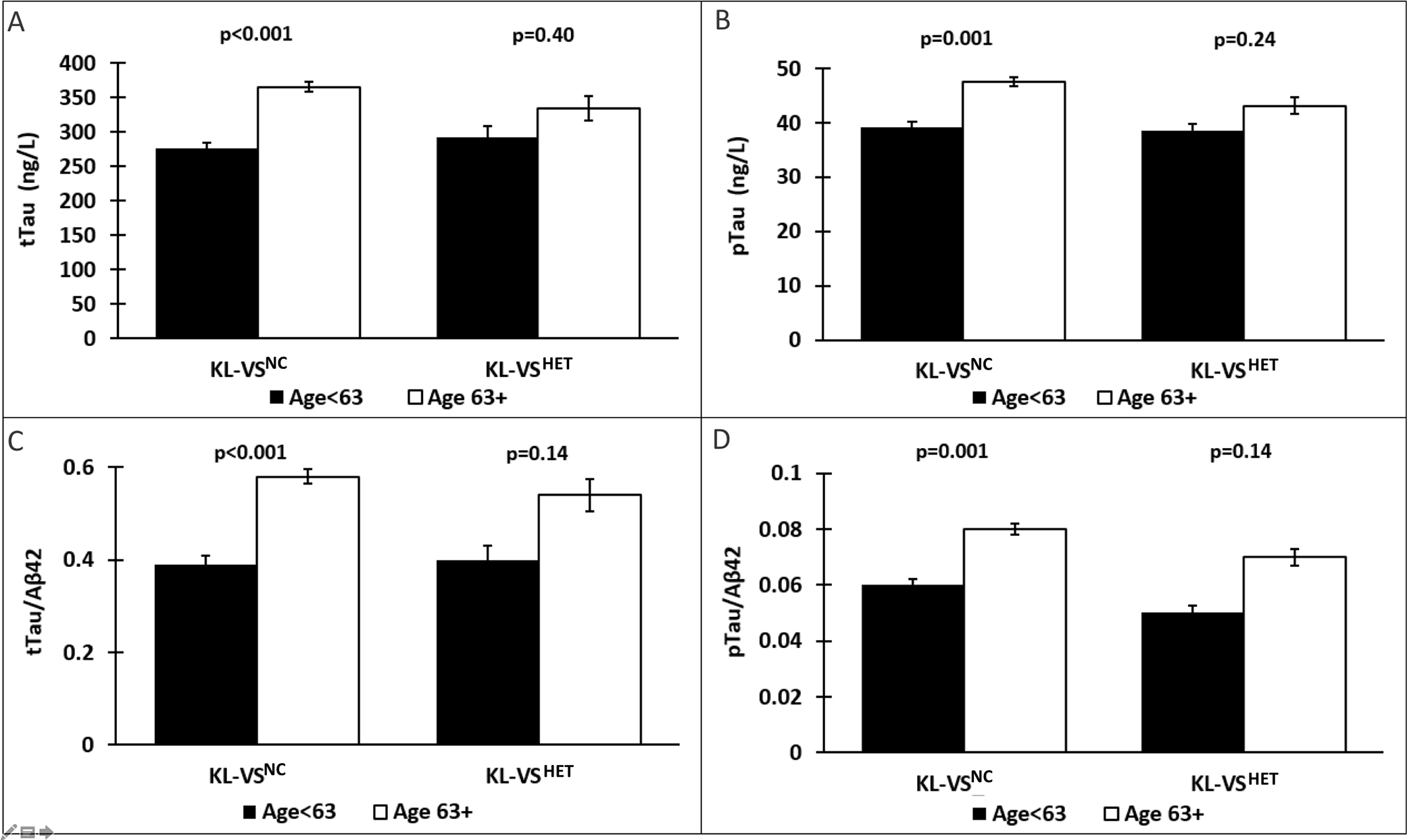
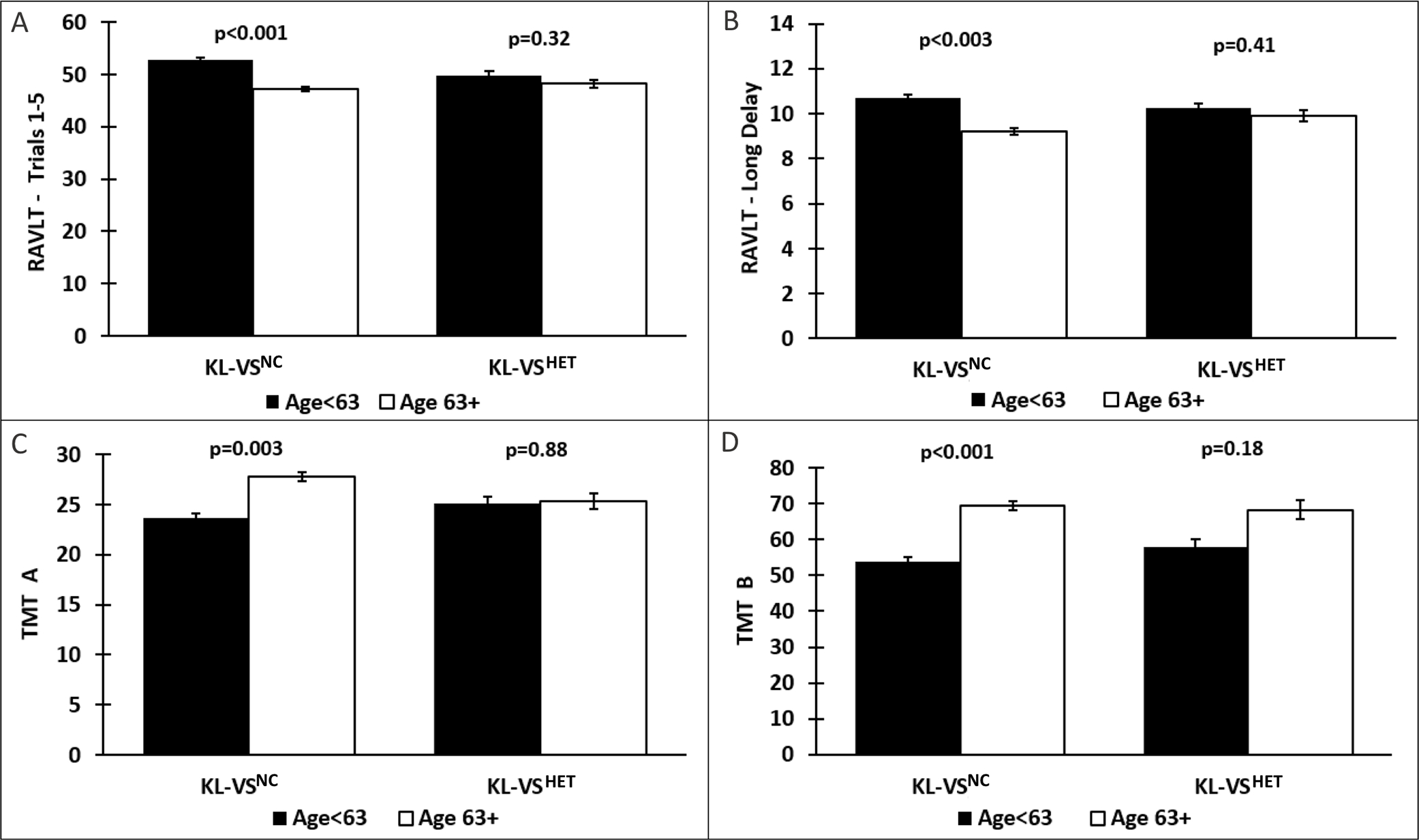
Results: In the pooled analyses, older age was associated with higher levels of total tau (tTau), phosphorylated tau (pTau), and their respective ratios to amyloid-β (Aβ)42 (ps ≤ 0.002), and with poorer performance on neuropsychological tests (ps ≤ 0.001). In the stratified analyses, KL-VSNC exhibited this age-related pattern of associations with CSF biomarkers (all ps ≤ 0.001), and memory and executive function (ps ≤ 0.003), which were attenuated in KL-VSHET (ps ≥ 0.14).
Conclusion: Worse memory and executive function, and higher tau burden with age were attenuated in carriers of a functionally advantageous KLOTHO variant. KL-VS heterozygosity seems to be protective against age-related cognitive and biomolecular alterations that confer risk for AD.
Keywords: Alzheimer’s disease; biomarkers; cerebrospinal fluid; executive function; memory.
Figures
References
-
- Hou Y, Dan X, Babbar M, Wei Y, Hasselbalch SG, Croteau DL, Bohr VA. Ageing as a risk factor for neurodegenerative disease. Nat Rev Neurol 2019;15:565–581. - PubMed
-
- Alzheimer’s Association. 2018 Alzheimer’s disease facts and figures. Alzheimers Dement 2018;14:367–429.
Publication types
MeSH terms
Substances
Grants and funding
LinkOut - more resources
Full Text Sources
Other Literature Sources
Medical
