


Coral growth, survivorship and return-on-effort within nurseries at high-value sites on the Great Barrier Reef
- PMID: 33428639
- PMCID: PMC7799815
- DOI: 10.1371/journal.pone.0244961
Coral growth, survivorship and return-on-effort within nurseries at high-value sites on the Great Barrier Reef
Abstract
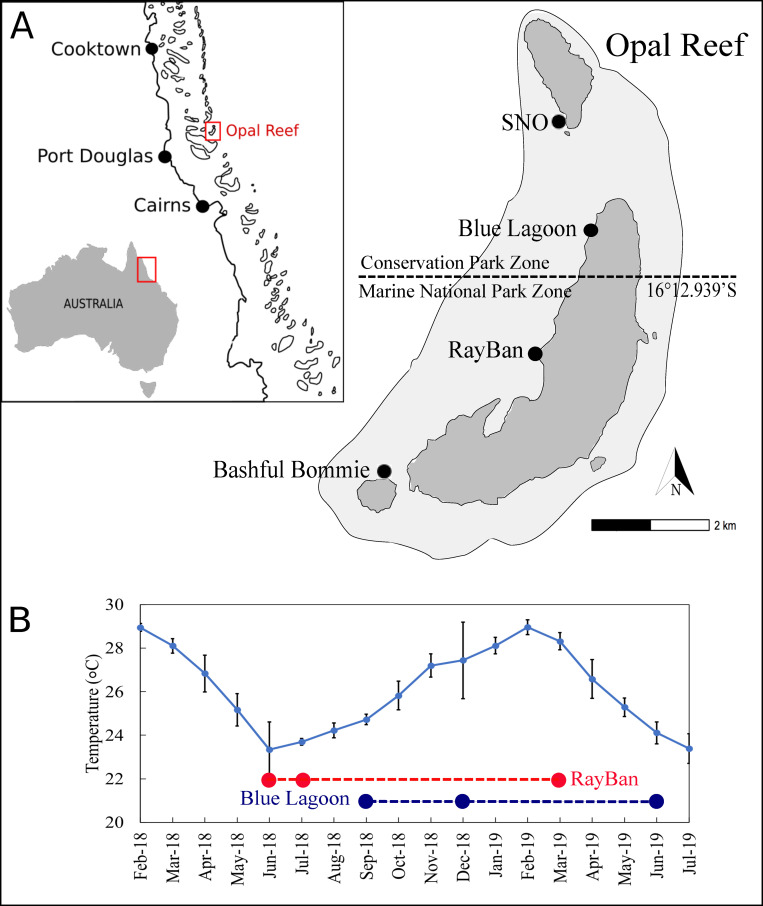
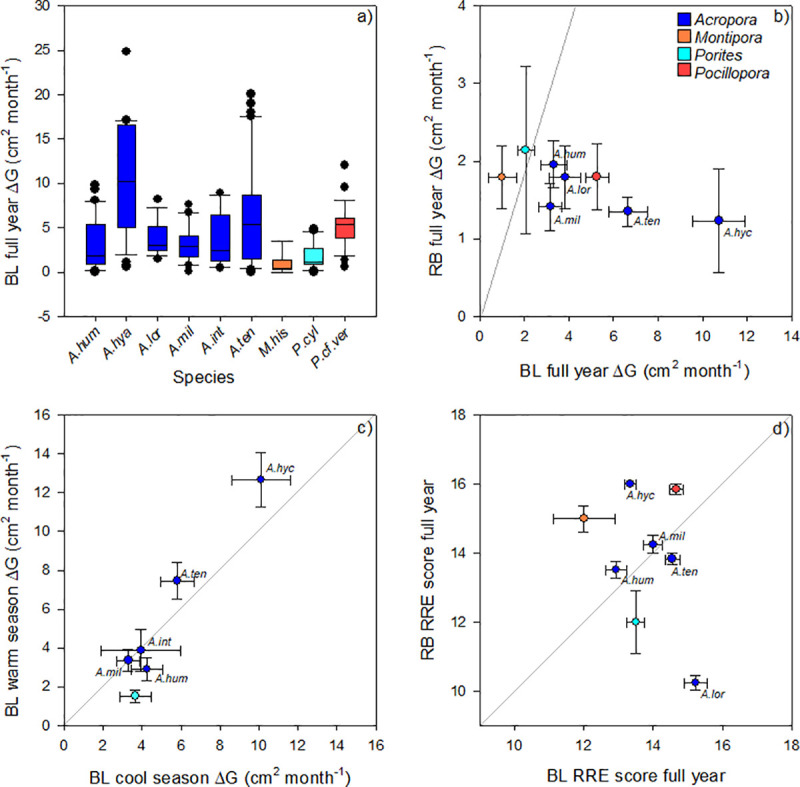
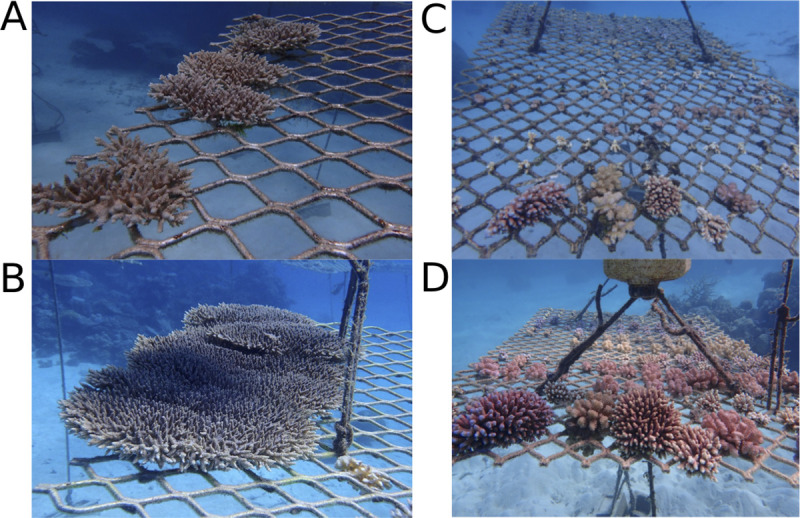
Coral reefs are deteriorating worldwide prompting reef managers and stakeholders to increasingly explore new management tools. Following back-to-back bleaching in 2016/2017, multi-taxa coral nurseries were established in 2018 for the first time on the Great Barrier Reef (GBR) to aid reef maintenance and restoration at a "high-value" location-Opal Reef-frequented by the tourism industry. Various coral species (n = 11) were propagated within shallow water (ca. 4-7m) platforms installed across two sites characterised by differing environmental exposure-one adjacent to a deep-water channel (Blue Lagoon) and one that was relatively sheltered (RayBan). Growth rates of coral fragments placed onto nurseries were highly variable across taxa but generally higher at Blue Lagoon (2.1-10.8 cm2 month-1 over 12 months) compared to RayBan (0.6-6.6 cm2 month-1 over 9 months). Growth at Blue Lagoon was largely independent of season, except for Acropora tenuis and Acropora hyacinthus, where growth rates were 15-20% higher for December 2018-July 2019 ("warm season") compared to August-December 2018 ("cool season"). Survivorship across all 2,536 nursery fragments was ca. 80-100%, with some species exhibiting higher survivorship at Blue Lagoon (Acropora loripes, Porites cylindrica) and others at RayBan (A. hyacinthus, Montipora hispida). Parallel measurements of growth and survivorship were used to determine relative return-on-effort (RRE) scores as an integrated metric of "success" accounting for life history trade-offs, complementing the mutually exclusive assessment of growth or survivorship. RRE scores within sites (across species) were largely driven by growth, whereas RRE scores between sites were largely driven by survivorship. The initial nursery phase of coral propagation therefore appears useful to supplement coral material naturally available for stewardship of frequently visited Great Barrier Reef tourism (high-value) sites, but further assessment is needed to evaluate how well the growth rates and survival for nursery grown corals translate once material is outplanted.
Conflict of interest statement
JE is co-owner and LH is an employee of Wavelength Reef Cruises. This does not alter our adherence to PLOS ONE policies on sharing data and materials. There are no patents, products in development or marketed products associated with this research to declare.
Figures
References
-
- Hudson JH, Diaz R. Damage survey and restoration of M/V Wellwood grounding site, Molasses Reef, Key Largo National Marine Sanctuary, Florida. In Proceedings of the Sixth International Coral Reef Symposium. 1988; (2): 231–236.
-
- Bohnsack JA, Sutherland DL. Artificial reef research: a review with recommendations for future priorities. Bulletin of Marine Science. 1985. July 1;37(1):11–39.
Publication types
MeSH terms
LinkOut - more resources
Full Text Sources
Other Literature Sources
