


Pharmacologic interventions for postoperative nausea and vomiting after thyroidectomy: A systematic review and network meta-analysis
- PMID: 33428643
- PMCID: PMC7799806
- DOI: 10.1371/journal.pone.0243865
Pharmacologic interventions for postoperative nausea and vomiting after thyroidectomy: A systematic review and network meta-analysis
Abstract
Objective: To determine the effectiveness of pharmacologic interventions for preventing postoperative nausea and vomiting (PONV) in patients undergoing thyroidectomy.
Design: Systematic review and network meta-analysis (NMA).
Data sources: MEDLINE, EMBASE, Cochrane Central Register of Controlled Trials, and Google Scholar.
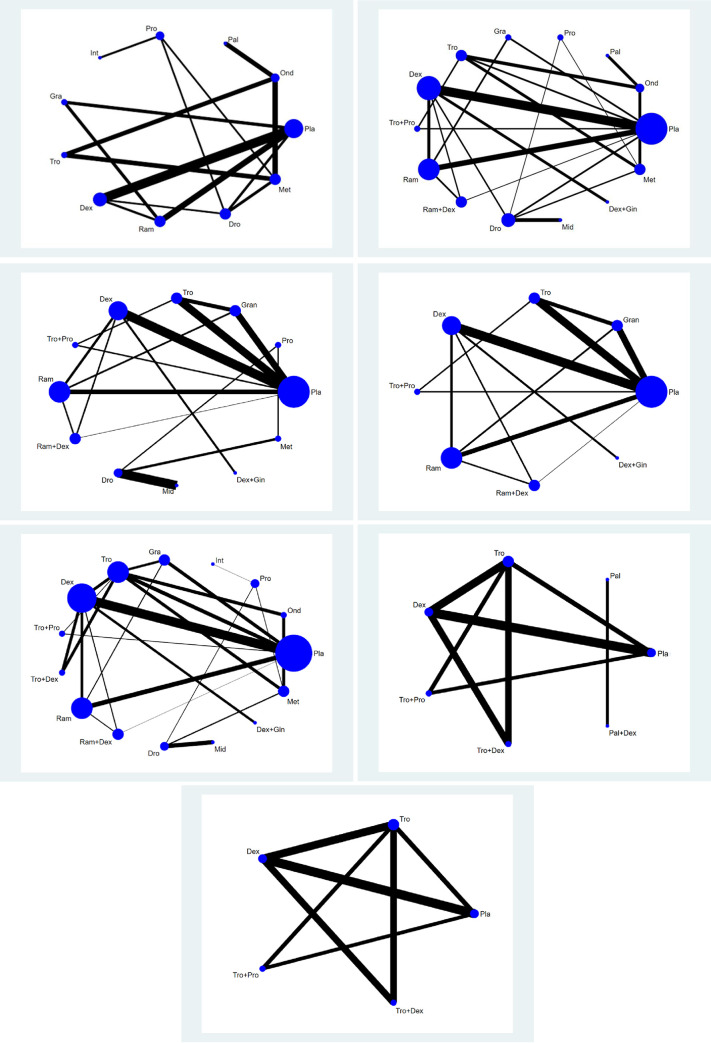
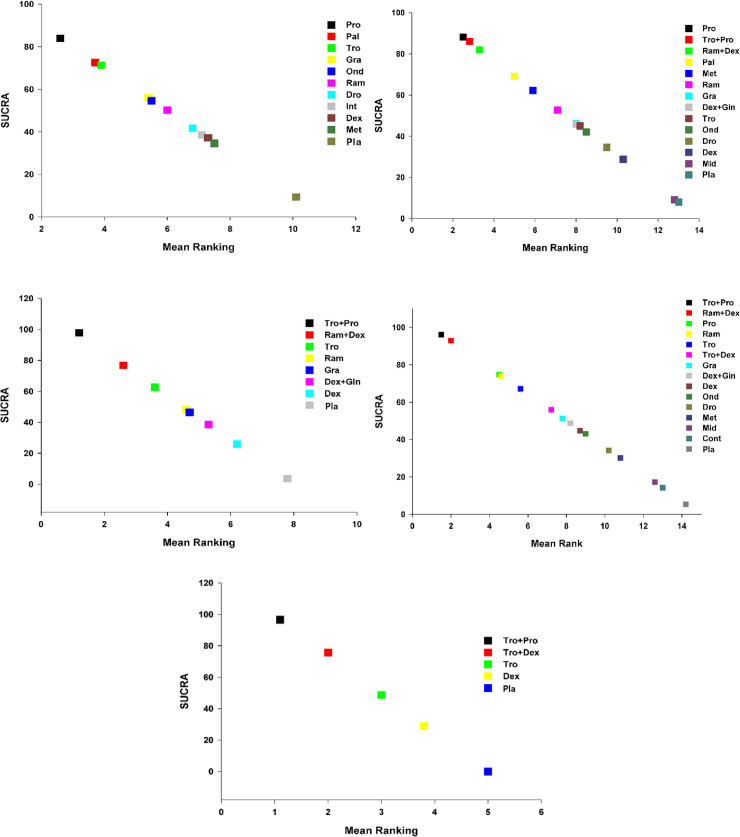
Eligibility criteria, participants, and interventions: Randomized clinical trials that investigated the efficacy of pharmacologic interventions in preventing PONV in patients undergoing thyroidectomy were included. The primary endpoints were the incidences of postoperative nausea and vomiting (PONV), postoperative nausea (PON), postoperative vomiting (POV), use of rescue antiemetics, and incidence of complete response in the overall postoperative phases. The secondary endpoints were the same parameters assessed in the early, middle, and late postoperative phases. The surface under the cumulative ranking curve (SUCRA) values and rankograms were used to present the hierarchy of pharmacologic interventions.
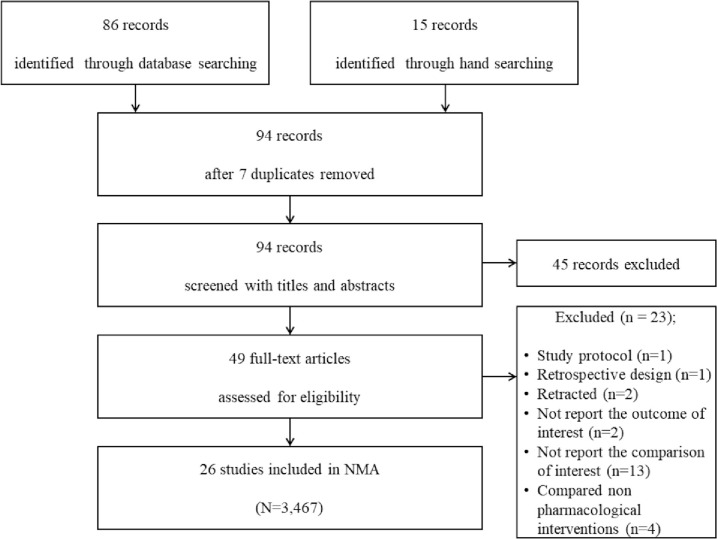
Results: Twenty-six studies (n = 3,467 patients) that investigated 17 different pharmacologic interventions were included. According to the SUCRA values, the incidence of PONV among the overall postoperative phases was lowest with propofol alone (16.1%), followed by palonosetron (27.5%), and with tropisetron (28.7%). The incidence of PON among the overall postoperative phases was lowest with propofol alone (11.8%), followed by tropisetron and propofol combination (14%), and ramosetron and dexamethasone combination (18.0%). The incidence of POV among the overall postoperative phases was lowest with tropisetron and propofol combination (2.2%), followed by ramosetron and dexamethasone combination (23.2%), and tropisetron alone (37.3%). The least usage of rescue antiemetics among the overall postoperative phases and the highest complete response was observed with tropisetron and propofol combination (3.9% and 96.6%, respectively).
Conclusion: Propofol and tropisetron alone and in combination, and the ramosetron and dexamethasone combination effectively prevented PONV, PON, POV in patients undergoing thyroidectomy, with some heterogeneity observed in this NMA of full-text reports. Their use minimized the need for rescue antiemetics and enhanced the complete response.
Trial registration number: CRD42018100002.
Conflict of interest statement
The authors have declared that no competing interests exist.
Figures
References
-
- Puhan MA, Schunemann HJ, Murad MH, Li T, Brignardello-Petersen R, Singh JA, et al. A GRADE Working Group approach for rating the quality of treatment effect estimates from network meta-analysis. Bmj. 2014;24(349). - PubMed
-
- Higgins J, Sterne J, Savović J, Page M, Hróbjartsson A, Boutron I, et al. A revised tool for assessing risk of bias in randomized trials. 2016. In: Cochrane Methods [Internet]. Cochrane Database of Systematic Reviews.
-
- Stroup DF, Berlin JA, Morton SC, Olkin I, Williamson GD, Rennie D, et al. Meta-analysis of observational studies in epidemiology: a proposal for reporting. Meta-analysis Of Observational Studies in Epidemiology (MOOSE) group. Jama. 2000;283(15):2008–12. Epub 2000/05/02. 10.1001/jama.283.15.2008 . - DOI - PubMed
Publication types
MeSH terms
Substances
LinkOut - more resources
Full Text Sources
Other Literature Sources
Miscellaneous
