


The efficacy and safety of prokinetics in critically ill adults receiving gastric feeding tubes: A systematic review and meta-analysis
- PMID: 33428672
- PMCID: PMC7799841
- DOI: 10.1371/journal.pone.0245317
The efficacy and safety of prokinetics in critically ill adults receiving gastric feeding tubes: A systematic review and meta-analysis
Abstract
Background: Intolerance to gastric feeding tubes is common among critically ill adults and may increase morbidity. Administration of prokinetics in the ICU is common. However, the efficacy and safety of prokinetics are unclear in critically ill adults with gastric feeding tubes. We conducted a systematic review to determine the efficacy and safety of prokinetics for improving gastric feeding tube tolerance in critically ill adults.
Methods: Randomized controlled trials (RCTs) were identified by systematically searching the Medline, Cochrane and Embase databases. Two independent reviewers extracted the relevant data and assessed the quality of the studies. We calculated pooled relative risks (RRs) for dichotomous outcomes and the mean differences (MDs) for continuous outcomes with the corresponding 95% confidence intervals (CIs). We assessed the risk of bias using the Cochrane risk-of-bias tool and used the Grading of Recommendations Assessment, Development, and Evaluation (GRADE) methodology to rate the quality of the evidence.
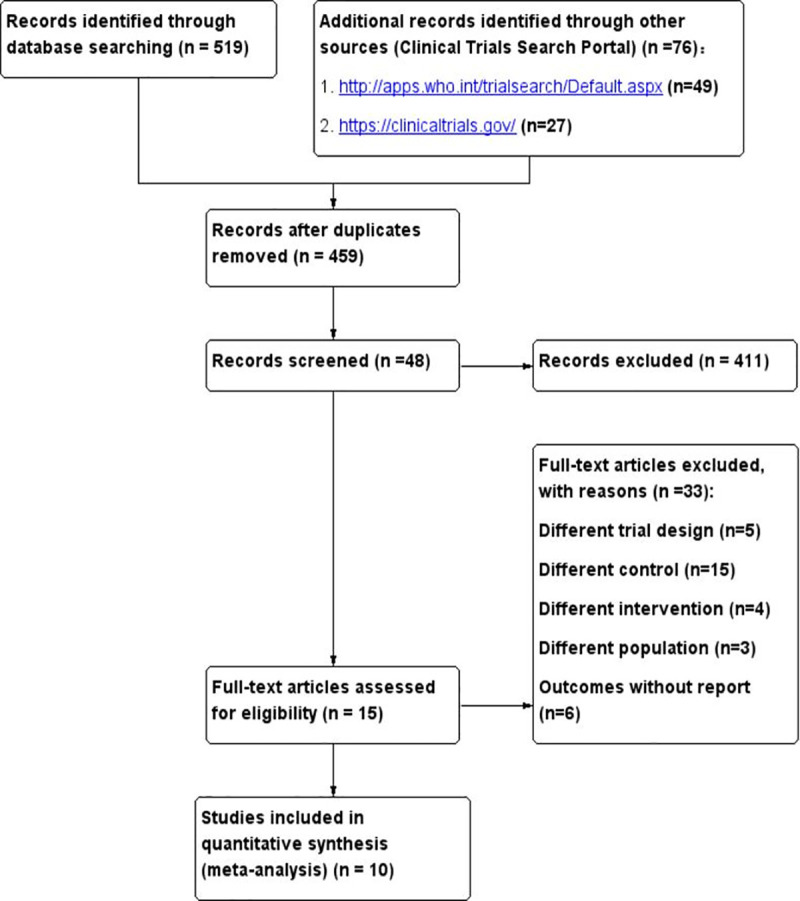
Results: Fifteen RCTs met the inclusion criteria. A total of 10 RCTs involving 846 participants were eligible for the quantitative analysis. Most studies (10 of 13, 76.92%) showed that prokinetics had beneficial effects on feeding intolerance in critically ill adults. In critically ill adults receiving gastric feeding, prokinetic agents may reduce the ICU length of stay (MD -2.03, 95% CI -3.96, -0.10; P = 0.04; low certainty) and the hospital length of stay (MD -3.21, 95% CI -5.35, -1.06; P = 0.003; low certainty). However, prokinetics failed to improve the outcomes of reported adverse events and all-cause mortality.
Conclusion: As a class of drugs, prokinetics may improve tolerance to gastric feeding to some extent in critically ill adults. However, the certainty of the evidence suggesting that prokinetics reduce the ICU or hospital length of stay is low. Prokinetics did not significantly decrease the risks of reported adverse events or all-cause mortality among critically ill adults.
Conflict of interest statement
The authors have declared that no competing interests exist.
Figures


References
-
- McClave SA, Taylor BE, Martindale RG, Warren MM, Johnson DR, Braunschweig C, et al. Guidelines for the Provision and Assessment of Nutrition Support Therapy in the Adult Critically Ill Patient: Society of Critical Care Medicine (SCCM) and American Society for Parenteral and Enteral Nutrition (A.S.P.E.N.). JPEN J Parenter Enteral Nutr. 2016;40(2):159–211. Epub 2016/01/17. 10.1177/0148607115621863 . - DOI - PubMed
Publication types
MeSH terms
Substances
LinkOut - more resources
Full Text Sources
Other Literature Sources
Medical
Research Materials
Miscellaneous
