


Rehabilitation training combined acupuncture for limb hemiplegia caused by cerebral infarction: A protocol for a systematic review of randomized controlled trial
- PMID: 33429730
- PMCID: PMC7793329
- DOI: 10.1097/MD.0000000000023474
Rehabilitation training combined acupuncture for limb hemiplegia caused by cerebral infarction: A protocol for a systematic review of randomized controlled trial
Abstract
Background: Previous studies have reported that rehabilitation training combined acupuncture (RTA) can be used for the treatment of limb hemiplegia (LH) caused by cerebral infarction (CI). However, its effectiveness is still unclear. In this systematic review study, we aim to evaluate the effectiveness and safety of RTA for LH following CI.
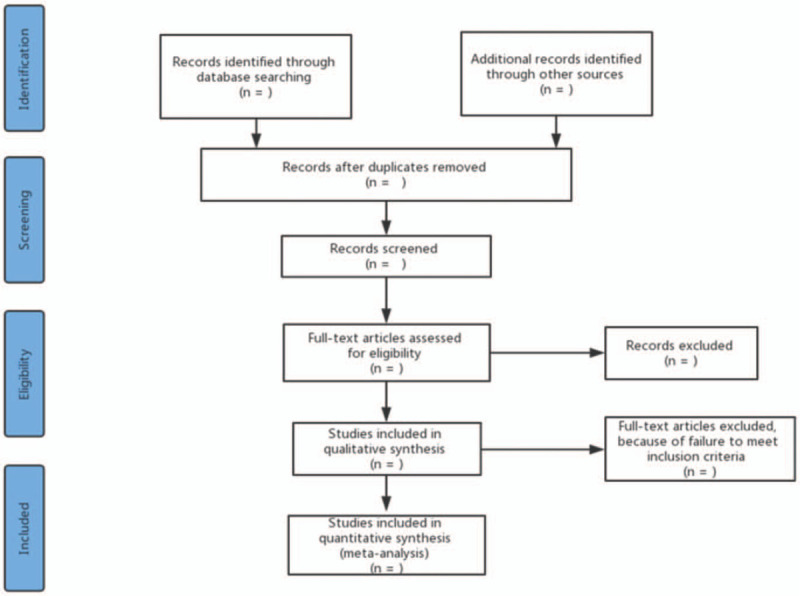
Methods: We will retrieve the databases of CENTRAL, EMBASE, MEDILINE, CINAHL, AMED, CBM, PUBMED, and CNKI from inception to June 1, 2020 with no language restrictions. The randomized controlled trials of RTA for evaluating effectiveness and safety in patients with LH following CI will be included. Cochrane risk of bias tool will be used to measure the methodological quality for all included studies. Two authors will independently select the studies, extract the data, and assess the methodological quality of included studies. A third author will be invited to discuss if any disagreements exist between 2 authors. We will perform heterogeneity assessment before carrying out meta-analysis. According to the heterogeneity, we select random effect model or fixed effect model for meta-analysis of the included cohort studies. Cochrane risk of bias tool will be used to determine the methodological quality for included studies. RevMan 5.3 software (Cochrane Community, London, UK) will be utilized to perform statistical analysis.
Results: This systematic review will assess the effectiveness and safety of RTA for LH caused by CI. The primary outcome includes limbs function, as measured by the Wolf Motor Function Test (WMFT) Assessment scale, or other associated scales. The secondary outcomes consist of muscle strength, muscle tone, quality of life, and any adverse events.
Conclusion: The findings of this study will summarize the current evidence of RTA for LH caused by CI, and may provide helpful evidence for the clinical treatment.
Dissemination and ethics: The findings of this study are expected to be published in peer-reviewed journals. It does not require ethical approval, because no individual data will be utilized in this study.
Systematic review registration: INPLASY202070114.
Copyright © 2021 the Author(s). Published by Wolters Kluwer Health, Inc.
Conflict of interest statement
The authors have no conflicts of interest to disclose.
Figures
References
-
- Sveinsson OA, Kjartansson O, Valdimarsson EM. HeilablóÐþurrÐ/heiladrep: FaraldsfræÐi, orsakir og einkenni [Cerebral ischemia/infarction—epidemiology, causes and symptoms]. Laeknabladid 2014;100:271–9. - PubMed
-
- Zhang SJ, Wu W, Zhai F, et al. Clinical study on nutritional risk screening in elderly patients with cerebrovascular diseases. Chin J Geriatr Heart Brain Vessel Dis 2013;15:500–2.
-
- Sveinsson ÓÁ, Kjartansson Ó, Valdimarsson EM. Heilablóđþurrđ/-drep—greining og međferđ [Cerebral ischemia/infarction—diagnosis and treatment]. Laeknabladid 2014;100:393–401. - PubMed
-
- Kwakkel G, Kollen BJ, Van der Grond J, et al. Probability of regaining dexterity in the flaccid upper limb: impact of severity of paresis and time since onset in acute stroke. Stroke 2003;34:2181–6. - PubMed
-
- Spieler JF, Lanoë JL, Amarenco P. Costs of stroke care according to handicap levels and stroke subtypes. Cerebrovasc Dis 2004;17:134–42. - PubMed
MeSH terms
LinkOut - more resources
Full Text Sources
Other Literature Sources
Medical
