


Antibody and Cell-Mediated Immune Responses Are Correlates of Protection against Influenza Infection in Vaccinated Older Adults
- PMID: 33430191
- PMCID: PMC7825602
- DOI: 10.3390/vaccines9010025
Antibody and Cell-Mediated Immune Responses Are Correlates of Protection against Influenza Infection in Vaccinated Older Adults
Abstract
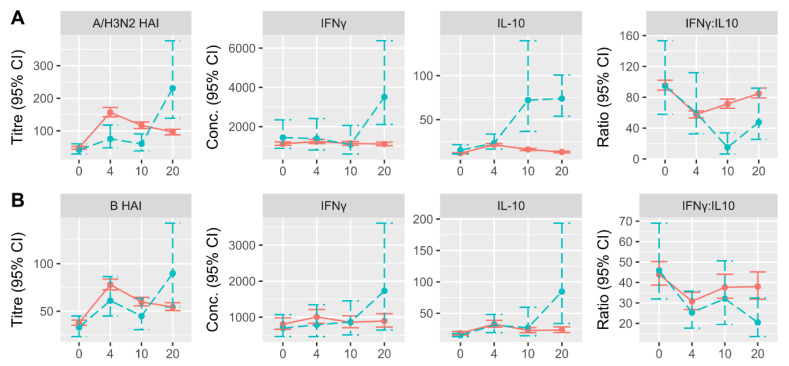
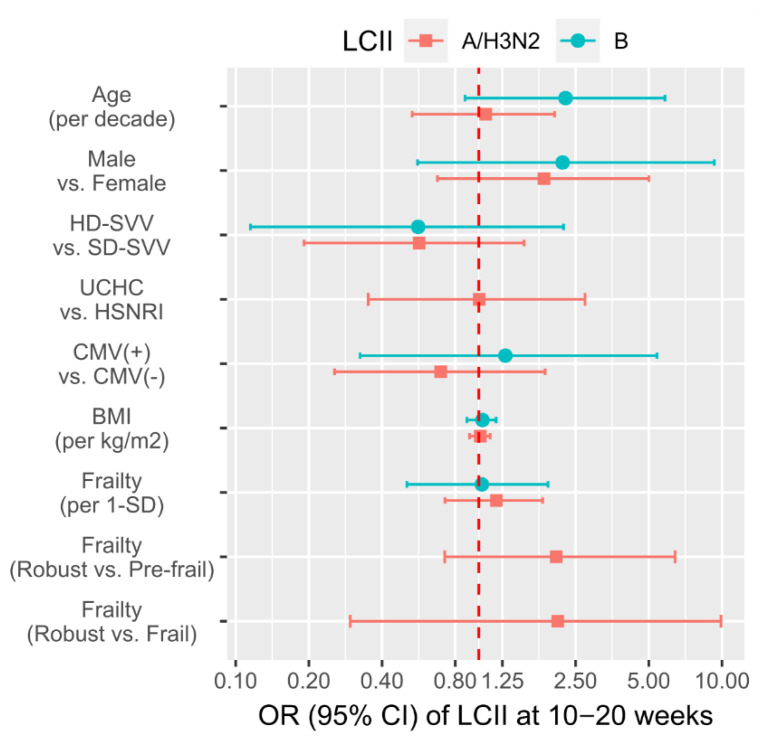
Despite efforts to design better vaccines for older adults, the risk for serious complications of influenza remains disproportionately high. Identifying correlates of vaccine effectiveness and understanding the heterogeneity of health outcomes in older adults are key to the vaccine development pipeline. We sought correlates of protection against laboratory-confirmed influenza illness (LCII) in a 4-year randomized trial of standard versus high-dose influenza vaccination of adults 65 years and older. To this end, we quantified serum hemagglutination-inhibition (HAI) titers and interferon-gamma (IFNγ) and interleukin-10 (IL-10) secretion by virus-challenged peripheral blood mononuclear cells. Of the 608 participants included, 26 developed either A/H3N2-(n = 17) or B-LCII (n = 9) at 10-20 weeks post-vaccination. Antibody titres for A/H3N2 at 4-weeks post-vaccination were significantly associated with protection against LCII, where every 1-standard deviation increase reduced the odds of A/H3N2-LCII by 53%. Although B-titres did not correlate with protection against B-LCII, the fold-increase in IFNγ:IL-10 ratios from pre- to 4-weeks post-vaccination was significantly associated with protection against B-LCII, where every 1-standard deviation increase reduced the odds by 71%. Our results suggest that both antibody and cell-mediated immune measures are valuable and potentially complementary correlates of protection against LCII in vaccinated older adults, although this may depend on the viral type causing infection.
Keywords: antibody; cell-mediated immunity; correlates of protection; influenza; older adults; vaccination.
Conflict of interest statement
J.E.M. reports payments to her institution for her participation in advisory, scientific, or data safety and monitoring boards from Sanofi, G.S.K., Pfizer, Merck, ResTORbio, and Medicago, and as a site lead clinical trials sponsored by VBI and Jansen, outside the submitted work. L.H. reports payments from Spring Discovery for her work in an advisory capacity. M.L. reports grant funding, in-kind supply of vaccines, or honoraria for participation in advisory boards, from Seqirus, Sanofi, Medicago, and Pfizer. M.K.A. reports payments from GSK (grant funding), Sanofi (grants, honoraria and consulting fees) and Pfizer (grants and honoraria), outside the submitted work. G.A.K. reports grants from the US National Institutes of Health and honoraria for participation in advisory boards from ResTORbio, Janssen and Spring Discovery. C.P.V. and G.P. report no conflicts of interest. The funders had no role in the design of the study, collection, analyses, or interpretation of data, the writing of the manuscript, or in the decision to publish the results.
Figures

References
-
- Troeger C.E., Blacker B.F., Khalil I.A., Zimsen S.R.M., Albertson S.B., Abate D., Abdela J., Adhikari T.B., Aghayan S.A., Agrawal S., et al. Mortality, morbidity, and hospitalisations due to influenza lower respiratory tract infections, 2017: An analysis for the Global Burden of Disease Study 2017. Lancet Respir. Med. 2019;7:69–89. doi: 10.1016/S2213-2600(18)30496-X. - DOI - PMC - PubMed
-
- CDC Weekly U.S. Influenza Surveillance Report (FluView) [(accessed on 5 May 2020)]; Available online: https://www.cdc.gov/flu/weekly/index.htm.
Grants and funding
LinkOut - more resources
Full Text Sources
Other Literature Sources
