Review
. 2021 Jan 7;10(1):92.
doi: 10.3390/cells10010092.

IL-1α Processing, Signaling and Its Role in Cancer Progression

Affiliations
Review

IL-1α Processing, Signaling and Its Role in Cancer Progression

Jing Wen Chiu et al. Cells. .

Abstract

Interleukin-1α (IL-1α) is a major alarmin cytokine which triggers and boosts the inflammatory responses. Since its discovery in the 1940s, the structure and bioactivity of IL-1α has been extensively studied and emerged as a vital regulator in inflammation and hematopoiesis. IL-1α is translated as a pro-form with minor bioactivity. The pro-IL-1α can be cleaved by several proteases to generate the N terminal and C terminal form of IL-1α. The C terminal form of IL-1α (mature form) has several folds higher bioactivity compared with its pro-form. IL-1α is a unique cytokine which could localize in the cytosol, membrane, nucleus, as well as being secreted out of the cell. However, the processing mechanism and physiological significance of these differentially localized IL-1α are still largely unknown. Accumulating evidence suggests IL-1α is involved in cancer pathogenesis. The role of IL-1α in cancer development is controversial as it exerts both pro- and anti-tumor roles in different cancer types. Here, we review the recent development in the processing and signaling of IL-1α and summarize the functions of IL-1α in cancer development.

Keywords: IL-1R; cancer; interleukin-1α; protease.


Conflict of interest statement

The authors declare no conflict of interest.

Figures
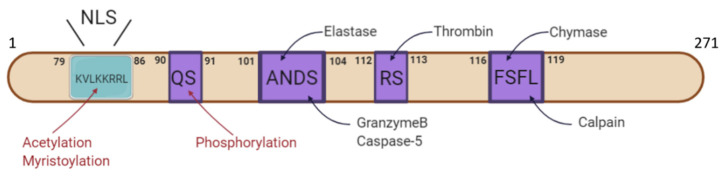
Figure 1
Figure 1
Overview of IL-1α structure. Human IL-1α consists of 271 amino acids including an nuclear localization signal (NLS) domain. IL-1α can be cleaved by various proteases, such as elastase, granzyme B, caspase-5, thrombin, chymase and calpain. IL-1α also undergoes post-translational modification, including acetylation, myristoylation as well as phosphorylation.
Figure 2
Figure 2
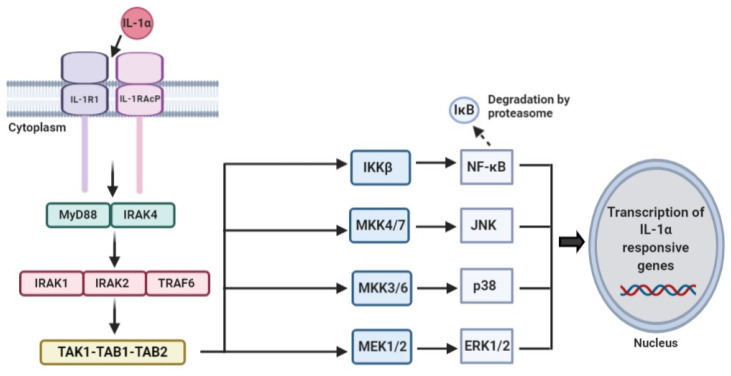
Overview of IL-1α signaling pathway. The binding of IL-1α to IL-1RI leads to dimerization of the receptor at the TIR domain and recruitment of IL-1RAcP. This IL-1α/IL-1RI/IL-1RAcP complex then recruits adaptor proteins MyD88 and IRAK for subsequent downstream signaling cascade. IRAK will phosphorylate IRAK1 and IRAK2 and recruit TRAF6 to form the IRAK1-IRAK2-TRAF6 complex; subsequently TRAF6 will associate with TAK1-TAB1-TAB2 to phosphorylate TAK1. Phosphorylated TAK1 will dissociate from the TRAF6-TAK1-TAB1-TAB2 complex to initiate the NF-κB and MAPK signaling pathways to regulate the downstream proinflammatory cytokines expressions, such as IL-6, TNF-α and cyclooxygenase 2. Abbreviations: IL-1RI, IL-1 receptor I; IL-1RAcP, interleukin-1 receptor accessory protein; MyD88, myeloid differentiation factor 88; IRAK, IL-1R-associated kinase; TRAF6, tumor necrosis factor–associated factor 6; TAK1, transforming growth factor-β-activated kinase 1; NF- κB, nuclear factor kappa-B; MAPK, Mitogen-activated protein kinase.
Figure 3
Figure 3
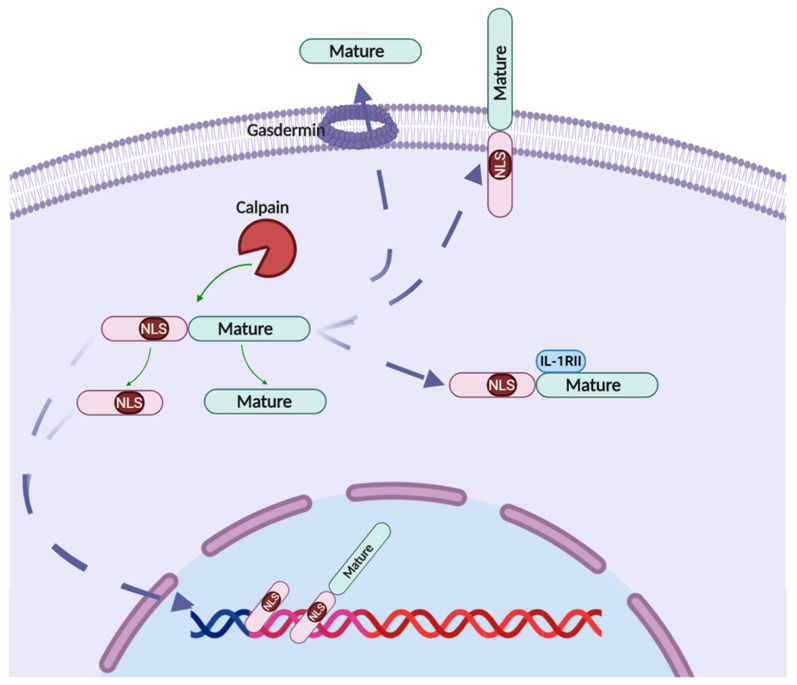
Overview of IL-1α cellular localization. IL-1α is translated as pro-peptide precursors form. (1) Pro-IL-1α contains a nuclear localization sequence (KVLKKRRL) in the N-terminal region which leads pro-IL-1α and propiece IL-1α translocation into the nucleus; (2) Pro-IL-1α can be cleaved by several proteases, such as calpain, into mature form. Mature IL-1α can be secreted out of cell possibly through gasdermin-formed pores; (3) Pro-IL-1α can be myristoylated and anchored to the cell membrane to form the membrane-bound IL-1α; (4) IL-1RII binds to Pro-IL-1α, shielding the NLS and proteases cleaved sits, thus retaining the Pro-IL-1α in the cytosol.

References

    1. Menkin V. Biology of inflammation; chemical mediators and cellular injury. Science. 1956;123:527–534. doi: 10.1126/science.123.3196.527. - DOI - PubMed
    1. Atkins E. Pathogenesis of fever. Physiol. Rev. 1960;40:580–646. doi: 10.1152/physrev.1960.40.3.580. - DOI - PubMed
    1. Dinarello C.A. The interleukin-1 family: 10 years of discovery. FASEB J. Off. Public Fed. Am. Soc. Exp. Biol. 1994;8:1314–1325. doi: 10.1096/fasebj.8.15.8001745. - DOI - PubMed
    1. Dinarello C.A., Goldin N.P., Wolff S.M. Demonstration and characterization of two distinct human leukocytic pyrogens. J. Exp. Med. 1974;139:1369–1381. doi: 10.1084/jem.139.6.1369. - DOI - PMC - PubMed
    1. Auron P.E., Webb A.C., Rosenwasser L.J., Mucci S.F., Rich A., Wolff S.M., Dinarello C.A. Nucleotide sequence of human monocyte interleukin 1 precursor cDNA. Proc. Natl. Acad. Sci. USA. 1984;81:7907–7911. doi: 10.1073/pnas.81.24.7907. - DOI - PubMed

Publication types

Substances

LinkOut - more resources