. 2021 Dec;36(1):147-153.
doi: 10.1080/14756366.2020.1850710.

Repurposing existing drugs: identification of SARS-CoV-2 3C-like protease inhibitors

Affiliations

Repurposing existing drugs: identification of SARS-CoV-2 3C-like protease inhibitors

Wei-Chung Chiou et al. J Enzyme Inhib Med Chem. 2021 Dec.

Abstract

Severe acute respiratory syndrome coronavirus 2 (SARS-CoV-2) is responsible for coronavirus disease 2019 (COVID-19). Since its emergence, the COVID-19 pandemic has not only distressed medical services but also caused economic upheavals, marking urgent the need for effective therapeutics. The experience of combating SARS-CoV and MERS-CoV has shown that inhibiting the 3-chymotrypsin-like protease (3CLpro) blocks the replication of the virus. Given the well-studied properties of FDA-approved drugs, identification of SARS-CoV-2 3CLpro inhibitors in an FDA-approved drug library would be of great therapeutic value. Here, we screened a library consisting of 774 FDA-approved drugs for potent SARS-CoV-2 3CLpro inhibitors, using an intramolecularly quenched fluorescence (IQF) peptide substrate. Ethacrynic acid, naproxen, allopurinol, butenafine hydrochloride, raloxifene hydrochloride, tranylcypromine hydrochloride, and saquinavir mesylate have been found to block the proteolytic activity of SARS-CoV-2 3CLpro. The inhibitory activity of these repurposing drugs against SARS-CoV-2 3CLpro highlights their therapeutic potential for treating COVID-19 and other Betacoronavirus infections.

Keywords: 3CLpro inhibitors; FRET; SARS-CoV-2 3CL protease; antiviral; repurposing drugs.


Conflict of interest statement

The authors declare no conflicts of interest.

Figures
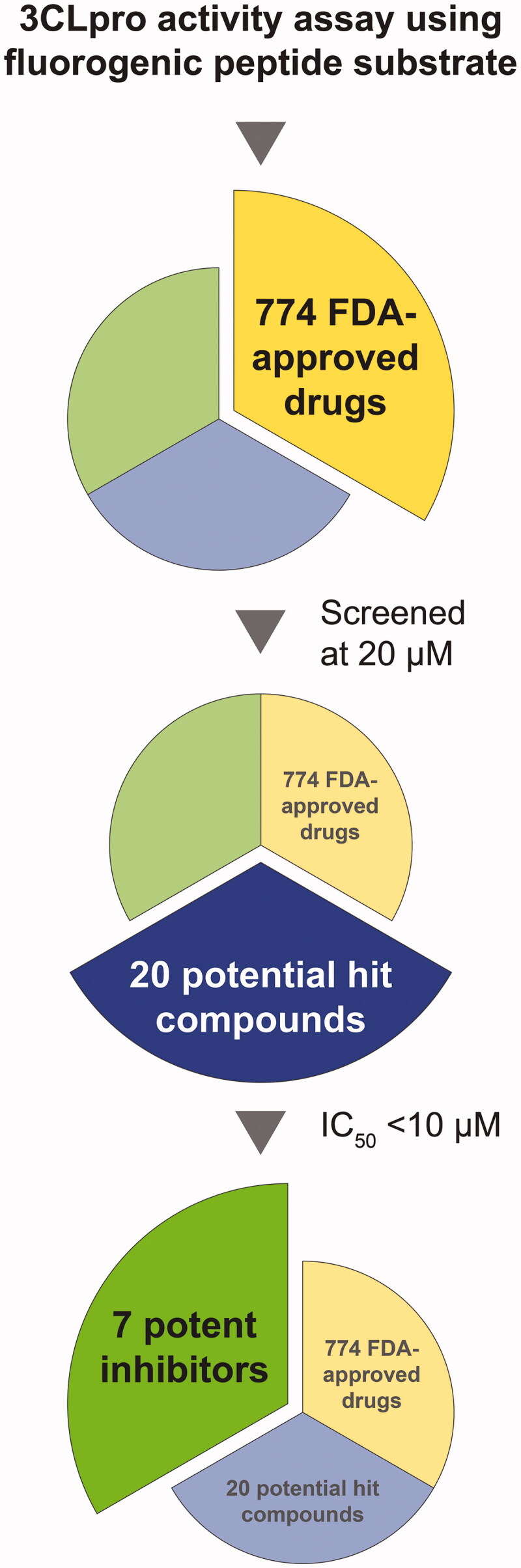
Figure 1.
Figure 1.
Flowchart of identification of SARS-CoV-2 3CLpro inhibitors in a library of 774 FDA-approved drugs. An initial screening was performed to evaluate the inhibition of SARS-CoV-2 3CLpro activity by FDA-approved drugs at 20 µM. Subsequently, IC50 characterisation was performed to pinpoint the more effective drugs. Twenty potential hit compounds were found, of which seven had a more pronounced effect in inhibiting SARS-CoV-2 3CLpro.
Figure 2.
Figure 2.
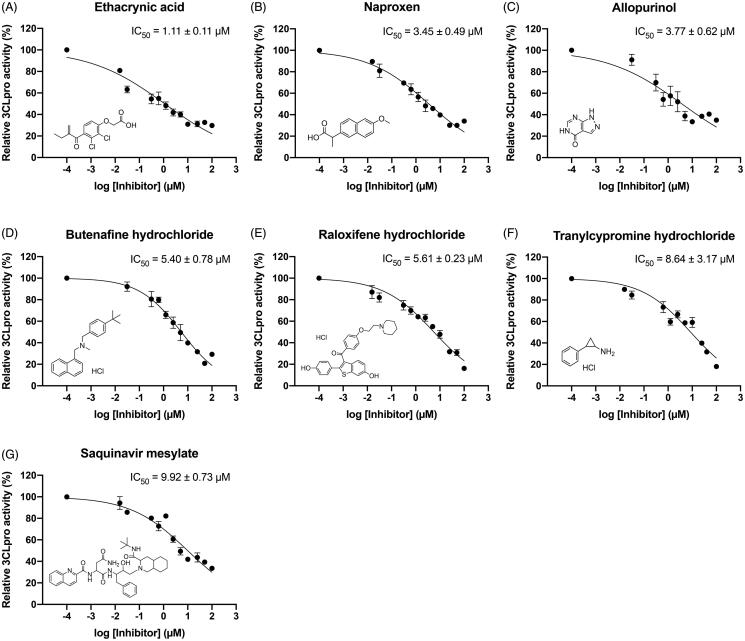
Dose-response curves of potent SARS-CoV-2 3CLpro inhibitors. The inhibitory activity of (A) Ethacrynic acid, (B) Naproxen, (C) Allopurinol, (D) Butenafine hydrochloride, (E) Raloxifene hydrochloride, (F) Tranylcypromine hydrochloride, and (G) Saquinavir mesylate against SARS-CoV-2 3CLpro are shown, along with a depiction of the chemical structure. Data (N = 3) are expressed as the mean ± SEM.
Figure 3.
Figure 3.
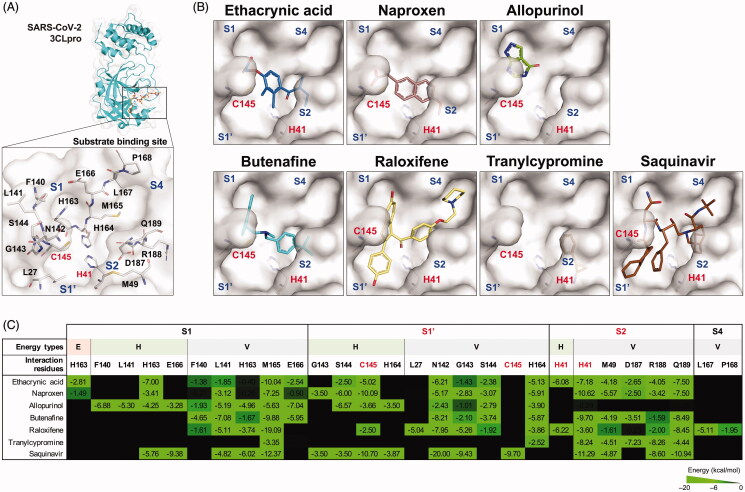
Interaction forces between the identified inhibitors and the substrate binding residues of SARS-CoV-2 3CLpro. (A) The substrate binding site of SARS-CoV-2 3CLpro. S1, S1’, S2 and S4 subsites are labelled in blue. Catalytic residues (red) H41 and C145, and other substrate binding residues (black) are labelled. (B) Molecular docking of seven SARS-CoV-2 3CLpro inhibitors. Substrate binding subsites (blue) and catalytic residues (red) H41 and C145 are labelled. (C) Interaction profiles of seven SARS-CoV-2 3CLpro inhibitors. The interaction energy (kcal/mol) positively correlates with the brightness of the colour (bright green). Catalytic residues H41 and C145 are labelled in red. E: electrostatic force (red fill); H: hydrogen binding force (green fill); V: van der Waals force (gray fill).

References

    1. King JS. Covid-19 and the need for health care reform. N Engl J Med 2020;382:e104. - PubMed
    1. Chen B, Tian EK, He B, et al. Overview of lethal human coronaviruses. Signal Transduct Target Ther 2020;5:89. - PMC - PubMed
    1. Berlin DA, Gulick RM, Martinez FJ.. Severe Covid-19. N Engl J Med 2020. - PubMed
    1. Ienca M, Vayena E.. On the responsible use of digital data to tackle the COVID-19 pandemic. Nat Med 2020;26:463–4. - PMC - PubMed
    1. Khailany RA, Safdar M, Ozaslan M.. Genomic characterization of a novel SARS-CoV-2. Gene Rep 2020;19:100682. ). - PMC - PubMed

MeSH terms