


Retrospective and prospective measures of post-traumatic growth reflect different processes: longitudinal evidence of greater decline than growth following a hematopoietic stem-cell transplantation
- PMID: 33430807
- PMCID: PMC7798346
- DOI: 10.1186/s12888-020-03007-y
Retrospective and prospective measures of post-traumatic growth reflect different processes: longitudinal evidence of greater decline than growth following a hematopoietic stem-cell transplantation
Abstract
Background: This prospective longitudinal study examined and compared two measures (prospective and retrospective ones) of post-traumatic growth (PTG) following Hematopoietic Stem-Cell Transplantation (HSCT) and their respective relationships with mental health and psychological disposition. We also tested the hypothesis that unwillingness to be in contact with distressing thoughts and feelings-i.e. experiential avoidance-would moderate the relationship between Post-Traumatic Stress Disorder (PTSD) and growth.
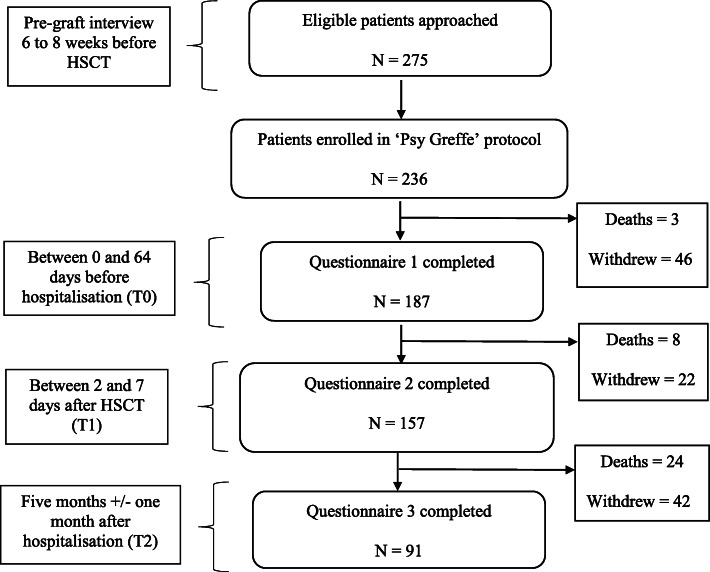
Methods: This study was carried out with 187 patients. Patients completed the Post-Traumatic Growth Inventory (PTGI) 5 months after HSCT and scales tapping into the five domains of PTGI during hospitalisation and 5 months after HSCT. Mental health and psychological disposition were also assessed prior to hospitalisation. A PTSD scale was administered at the five-month follow-up.
Results: Prospective and retrospective measures of PTG were weakly correlated. Bayesian pre/post-HSCT comparisons in the prospective measure of PTG revealed substantial to very strong decline in four of the five dimensions assessed. Overall, RCI indicated a reliable increase for 5.6% of patients and a reliable decrease for 40.8% of patients. Confirming that retrospective and prospective measures of PTG reflect different processes, they were not related to the same mental health and psychological disposition variables. Moreover, the hypothesis that acquiring positive outcomes from a potentially traumatic experience, such as HSCT, requires direct confrontation with the source of distress was supported in the case of the retrospective measure of growth but not in the case of the prospective measure growth.
Conclusions: Retrospective measures such as the PTGI do not appear to assess actual pre- to post-HSCT change. HSCT seems more linked to psychological decline than to growth.
Trial registration: ClinicalTrials.gov NCT03883672.
Keywords: Hematopoietic stem cell transplantation; Mental health; Post-traumatic growth; Post-traumatic stress disorder; Psychological disposition.
Conflict of interest statement
The authors declare that they have no competing interests.
References
-
- Linden W, Vodermaier A, MacKenzie R, Greig D. Anxiety and depression after cancer diagnosis: prevalence rates by cancer type, gender, and age. J Affect Disord. 2012;141(2–3):343–351. - PubMed
-
- Braamse AM, Gerrits MM, van Meijel B, Visser O, van Oppen P, Boenink AD, et al. Predictors of health-related quality of life in patients treated with auto-and Allo-SCT for hematological malignancies. Bone Marrow Transplant. 2012;47(6):757–769. - PubMed
Publication types
MeSH terms
Associated data
LinkOut - more resources
Full Text Sources
Other Literature Sources
Medical
