


The association between ambient temperature and mortality of the coronavirus disease 2019 (COVID-19) in Wuhan, China: a time-series analysis
- PMID: 33430851
- PMCID: PMC7797893
- DOI: 10.1186/s12889-020-10131-7
The association between ambient temperature and mortality of the coronavirus disease 2019 (COVID-19) in Wuhan, China: a time-series analysis
Abstract
Background: The COVID-19 has caused a sizeable global outbreak and has been declared as a public health emergency of international concern. Sufficient evidence shows that temperature has an essential link with respiratory infectious diseases. The objectives of this study were to describe the exposure-response relationship between ambient temperature, including extreme temperatures, and mortality of COVID-19.
Methods: The Poisson distributed lag non-linear model (DLNM) was constructed to evaluate the non-linear delayed effects of ambient temperature on death, by using the daily new death of COVID-19 and ambient temperature data from January 10 to March 31, 2020, in Wuhan, China.
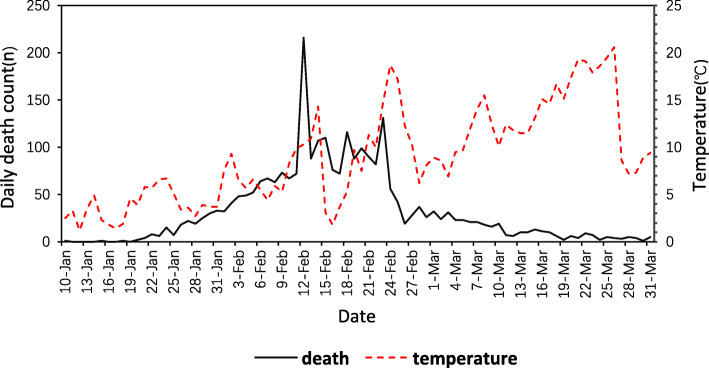
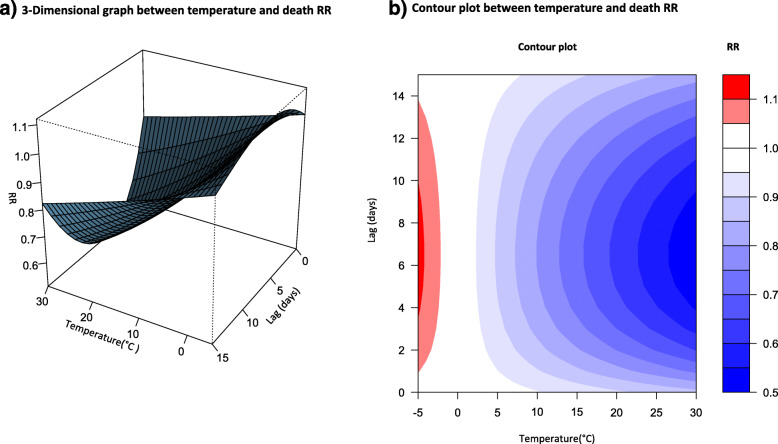
Results: During the period mentioned above, the average daily number of COVID-19 deaths was approximately 45.2. Poisson distributed lag non-linear model showed that there was a non-linear relationship (U-shape) between the effect of ambient temperature and mortality. With confounding factors controlled, the daily cumulative relative death risk decreased by 12.3% (95% CI [3.4, 20.4%]) for every 1.0 °C increase in temperature. Moreover, the delayed effects of the low temperature are acute and short-term, with the most considerable risk occurring in 5-7 days of exposure. The delayed effects of the high temperature appeared quickly, then decrease rapidly, and increased sharply 15 days of exposure, mainly manifested as acute and long-term effects. Sensitivity analysis results demonstrated that the results were robust.
Conclusions: The relationship between ambient temperature and COVID-19 mortality was non-linear. There was a negative correlation between the cumulative relative risk of death and temperature. Additionally, exposure to high and low temperatures had divergent impacts on mortality.
Keywords: Ambient temperature; COVID-19; Distributed lag non-linear model; Mortality; Negative correlation.
Conflict of interest statement
The author declares that he has no competing interests.
Figures



References
-
- WHO . Update 49—SARS case fatality ratio, incubation period. 2003.
MeSH terms
Grants and funding
LinkOut - more resources
Full Text Sources
Other Literature Sources
Medical
