


What is the impact of infrapopliteal endovascular intervention on free flap survival in diabetic foot reconstruction?
- PMID: 33430921
- PMCID: PMC7802144
- DOI: 10.1186/s13018-020-02173-9
What is the impact of infrapopliteal endovascular intervention on free flap survival in diabetic foot reconstruction?
Abstract
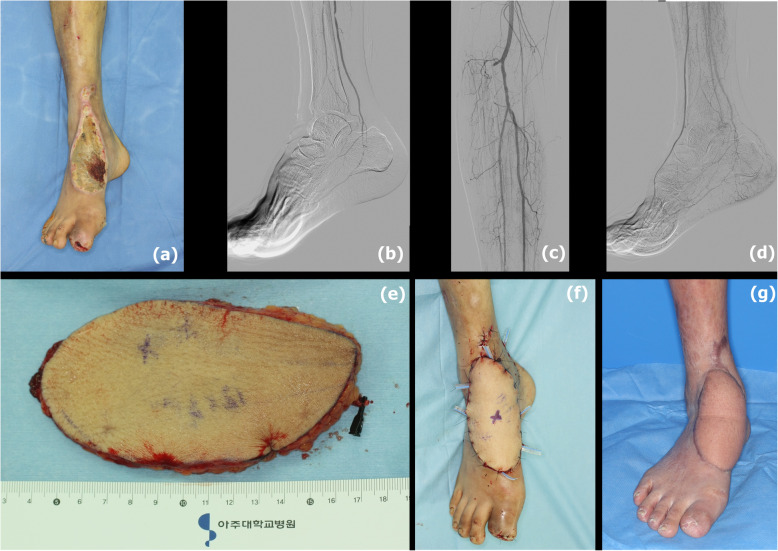
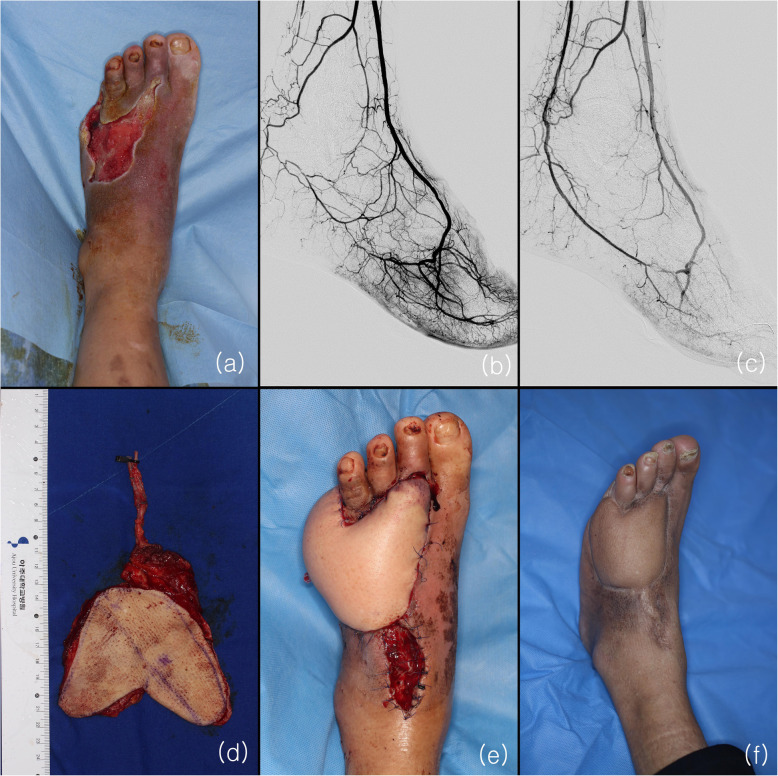
Background: The combination of endovascular intervention and microvascular free flap transfer has been effectively used for chronic ischemic wounds of lower limb. The aim of this study was to determine the influence of angioplasty on free flap survival in diabetic foot ulcer reconstruction.
Methods: A retrospective research was conducted for 46 diabetic patients with chronic ulcer of the foot. All patients underwent free flap reconstruction because of their non-healing wound with tendon or bone exposure. Patient's demography, clinical data related to vascular status, vascular intervention, and free flap transfer procedure were collected. Flap survival rate was compared between the group with severe arterial stenosis group and non-severe stenosis group. It was also compared among groups with different revascularization results.
Results: The average age of patients was 56.2 ± 10.8 years. There were 14 (30.4%) men and 32 (69.6%) women. Of 46 patients, 23 (50%) had severe infrapopliteal arterial stenosis. All 23 patients underwent endovascular intervention. Their final results of the pedal arch were type 1 in 13 patients, type 2A in 7 patients, type 2B in 2 patients, and type 3 in 1 patient. Total flap necrosis was found in 5 (10.9%) cases, marginal necrosis in 4 (8.7%) cases, and wound dehiscence in 4 (8.7%) cases. There was no significant difference in flap loss between severe arterial stenosis patients and non-severe arterial stenosis patients. In the severe arterial stenosis group, after endovascular intervention, patients with type 1 of pedal arch had a significantly lower rate of total flap necrosis than others. There was no association between the use of revascularized recipient artery and flap survival.
Conclusions: Our study revealed that the quality of pedal arch was crucial for free flap survival. Thus, PTA should aim to re-establish a complete pedal arch to increase wound healing rate and flap success.
Keywords: Diabetic foot; Endovascular intervention; Free flap; Percutaneous transluminal Angioplasty; Peripheral arterial disease.
Conflict of interest statement
The authors have no competing interests to disclose.
Figures
References
-
- Moulik PK, Mtonga R, Gill GV. Amputation and mortality in new-onset diabetic foot ulcers stratified by etiology. Diabetes Care. 2003;26(2):491–494. - PubMed
-
- Bordianu A, Bobirca F, Patrascu T. Skin grafting in the treatment of diabetic foot soft tissue defects. Chirurgia (Bucur) 2018;113(5):644–650. - PubMed
-
- Hong JP, Oh TS. An algorithm for limb salvage for diabetic foot ulcers. Clin Plast Surg. 2012;39(3):341–352. - PubMed
-
- Briggs SE, Banis JC, Jr, Kaebnick H, Silverberg B, Acland RD. Distal revascularization and microvascular free tissue transfer: an alternative to amputation in ischemic lesions of the lower extremity. J Vasc Surg. 1985;2(6):806–811. - PubMed
-
- Huang CC, Chang CH, Hsu H, Mark Chiu CH, Lin CM, Lee JT, et al. Endovascular revascularization and free tissue transfer for lower limb salvage. J Plast Reconstr Aesthet Surg. 2014;67(10):1407–1414. - PubMed
Publication types
MeSH terms
LinkOut - more resources
Full Text Sources
Other Literature Sources
Medical
