. 2021 Aug;69(2):280-287.
doi: 10.1016/j.jadohealth.2020.12.004. Epub 2021 Jan 9.

Resilience Factors in the Association Between Depressive Symptoms and Suicidality

Affiliations

Resilience Factors in the Association Between Depressive Symptoms and Suicidality

Jing Yu et al. J Adolesc Health. 2021 Aug.

Abstract

Purpose: To investigate whether life satisfaction and optimism might reduce the risk of suicidal thoughts and behaviors among adolescents with depressive symptoms.

Methods: Participants were 1,904 youth from the NEXT Generation Health Study, a national sample of U.S. adolescents, followed over 7 years from 2009/2010 to 2015/2016. Longitudinal latent profile analysis and logistic regressions were conducted.

Results: We identified three subgroups of adolescents with different patterns of depressive symptoms across the first six waves: "Low" (40%), "Mild" (42%), and "Moderate to Severe" (18%). The Moderate to Severe (OR = 14.47, 95% CI [6.61, 31.66]) and Mild (OR = 3.90, 95% CI [2.22, 6.86]) depression profiles had significantly higher odds of developing suicidality than the Low depression profile. Both life satisfaction and optimism moderated the association between depressive symptom profile and suicidality. The difference in suicidality risk between the Mild and Low depression profiles was significantly attenuated at high versus low levels of life satisfaction, with a difference of -.08, 95% CI [-.14, -.03]. In addition, the difference in suicidality risk between the Moderate to Severe and Low depression profiles was attenuated at high versus low levels of optimism, with a difference of -.11, 95% CI [-.21, -.01].

Conclusions: For adolescents transitioning to young adulthood, resilience factors such as life satisfaction and optimism may buffer against suicidality risk in the face of mild or moderate to severe depressive symptoms.

Trial registration: ClinicalTrials.gov NCT01031160.

Keywords: Depression; Life satisfaction; Optimism; Resilience factor; Risk factor; Suicidal ideation; Suicide attempt; Suicide plan.


Conflict of interest statement

There are no potential conflicts of interest associated with this article.

Figures
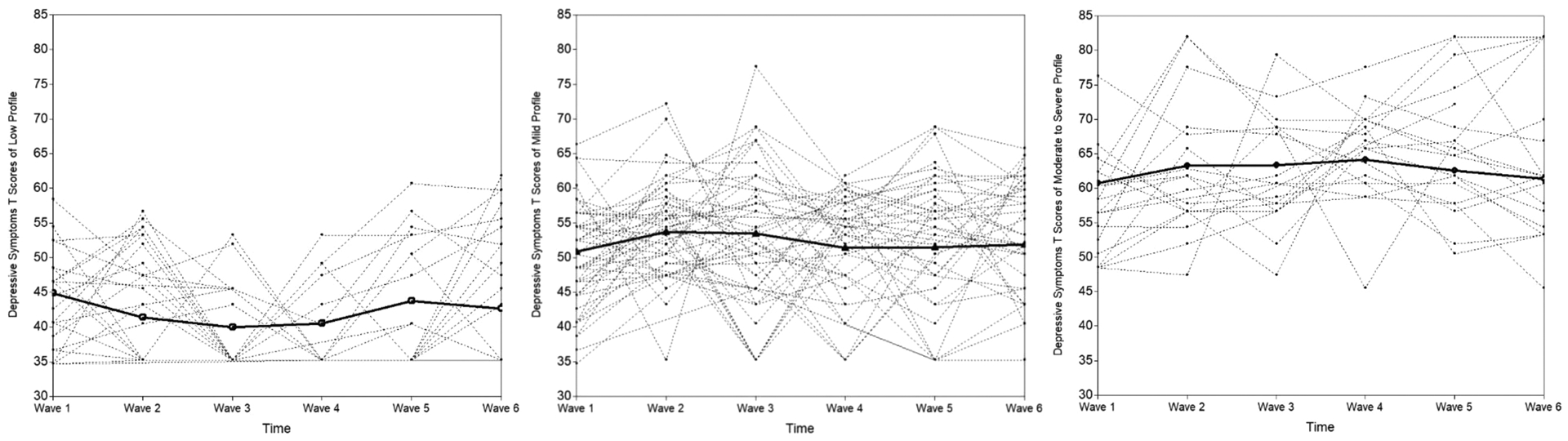
Figure 1.
Figure 1.
Longitudinal profiles of adolescents’ depressive symptoms from Wave 1 to Wave 6. Note: The plot was based on 100 randomly selected individuals, specifically, about 30 individuals in the Low depression profile (1a), 47 individuals in the Mild depression profile (1b), and 23 individuals in the Moderate to Severe depression profile (1c).
Figure 2.
Figure 2.
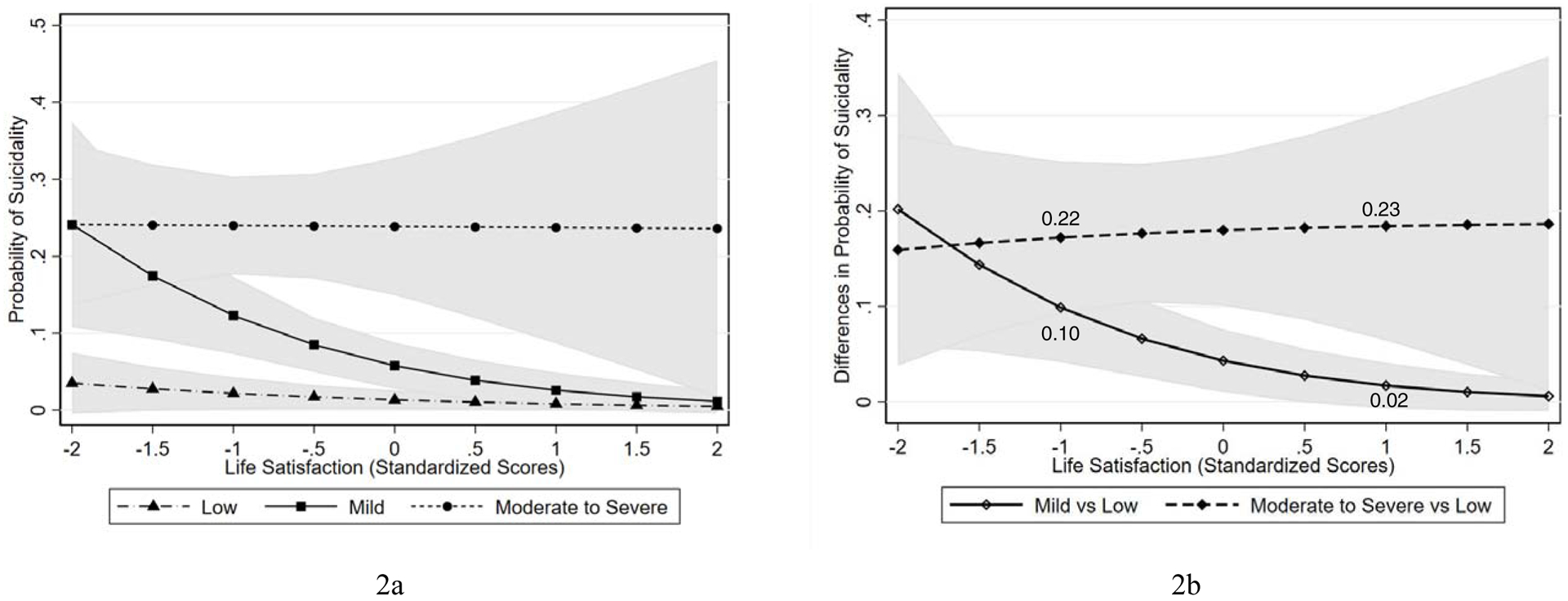
Risk of suicidality across depressive symptom profiles at different levels of life satisfaction Note: Results of the logistic regression analysis, converted into probabilities, were used to evaluate the buffering effect of life satisfaction in the association between depressive symptom profile and risk of suicidality. Figure 2a shows that the risk of suicidality in the Mild depression profile decreased as the level of life satisfaction increased, whereas the suicidality risk of the Moderate to Severe and Low depression profiles did not change appreciably as the level of life satisfaction increased. Figure 2b shows that differences in the suicidality risk between the Mild and Low depression profiles decreased (i.e., a stronger buffering effect) as the level of life satisfaction increased, whereas risk differences between the Moderate to Severe and Low depression profiles did not change much as the level of life satisfaction increased.
Figure 3.
Figure 3.
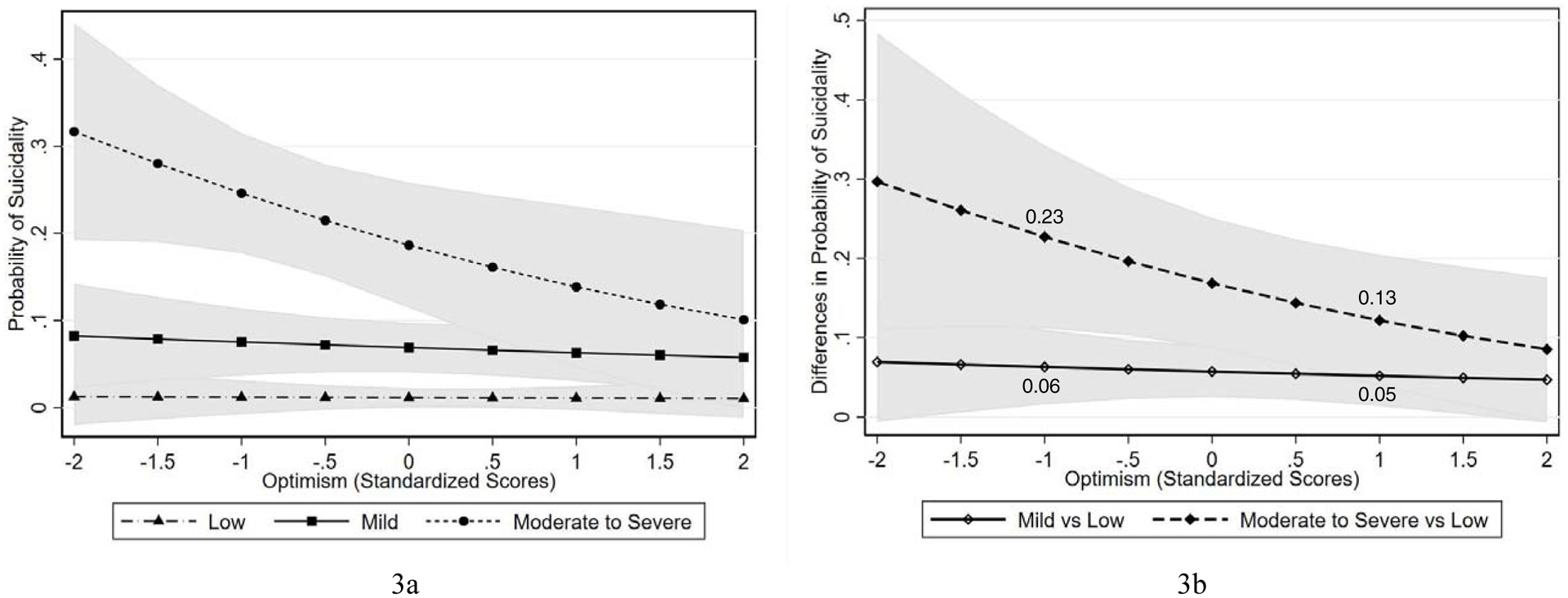
Risk of suicidality across depressive symptom profiles at different levels of optimism Note: Results of the logistic regression analysis, converted into probabilities, were used to evaluate the buffering effect of optimism in the association between depressive symptom profile and risk of suicidality. Figure 3a shows that risk of suicidality of the Moderate to Severe depression profile decreased as the level of optimism increased, whereas the suicidality risk of the Mild and Low depression profiles did not change much as the level of optimism increased. Figure 3b shows that differences in the suicidality risk between the Moderate to Severe and Low depression profiles decreased (i.e., a stronger buffering effect) as the level of optimism increased, whereas risk differences between the Mild and Low depression profiles did not change much as the level of optimism increased.

References

    1. Organization WH. Suicide in the world: global health estimates. World Health Organization; 2019. Available at: https://apps.who.int/iris/handle/10665/326948
    1. Hirsch JK, Visser PL, Chang EC, et al. Race and ethnic differences in hope and hopelessness as moderators of the association between depressive symptoms and suicidal behavior. J Am Coll Health 2012;60:115–125. DOI: 10.1080/07448481.2011.567402 - DOI - PubMed
    1. Shain B. Suicide and suicide attempts in adolescents. Pediatr 2016;138. DOI: 10.1542/peds.2016-1420 - DOI - PubMed
    1. Shore L, Toumbourou JW, Lewis AJ, et al. Review: Longitudinal trajectories of child and adolescent depressive symptoms and their predictors - a systematic review and meta-analysis. Child Adolesc Ment Health 2018;23:107–120. DOI: 10.1111/camh.12220 - DOI - PubMed
    1. Kerr DC, Reinke WM, Eddy JM. Trajectories of depressive symptoms and externalizing behaviors across adolescence: associations with histories of suicide attempt and ideation in early adulthood. Suicide Life Threat Behav 2013;43:50–66. DOI: 10.1111/j.1943-278X.2012.00127.x - DOI - PubMed

Publication types

Associated data