


No buzz for bees: Media coverage of pollinator decline
- PMID: 33431567
- PMCID: PMC7812767
- DOI: 10.1073/pnas.2002552117
No buzz for bees: Media coverage of pollinator decline
Abstract
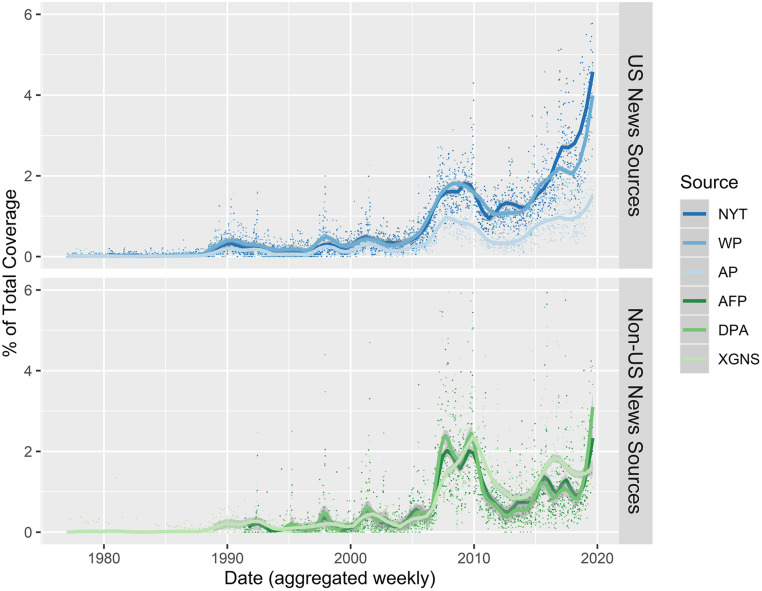
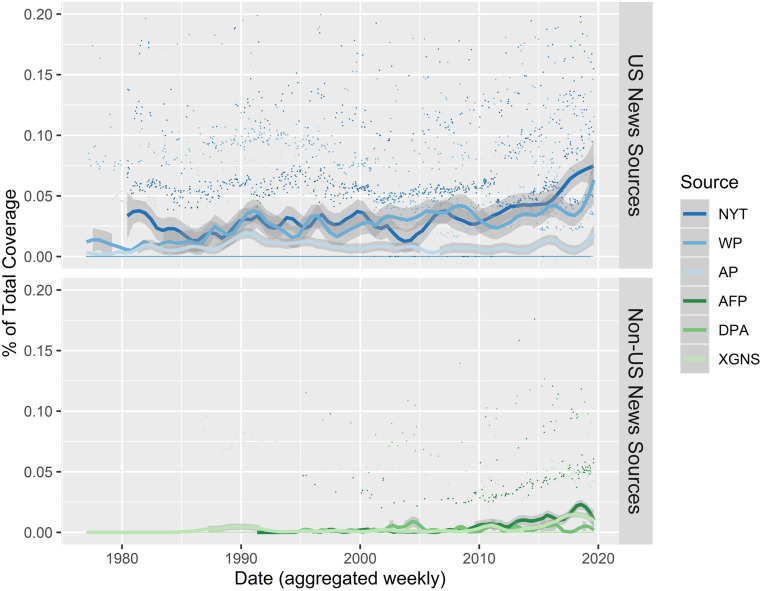
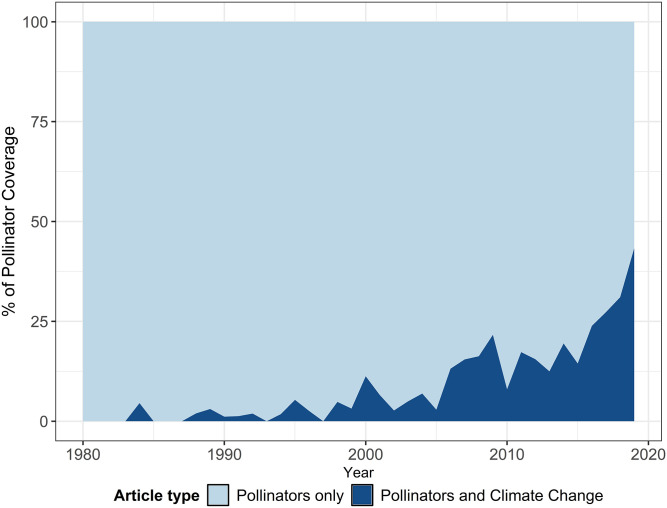
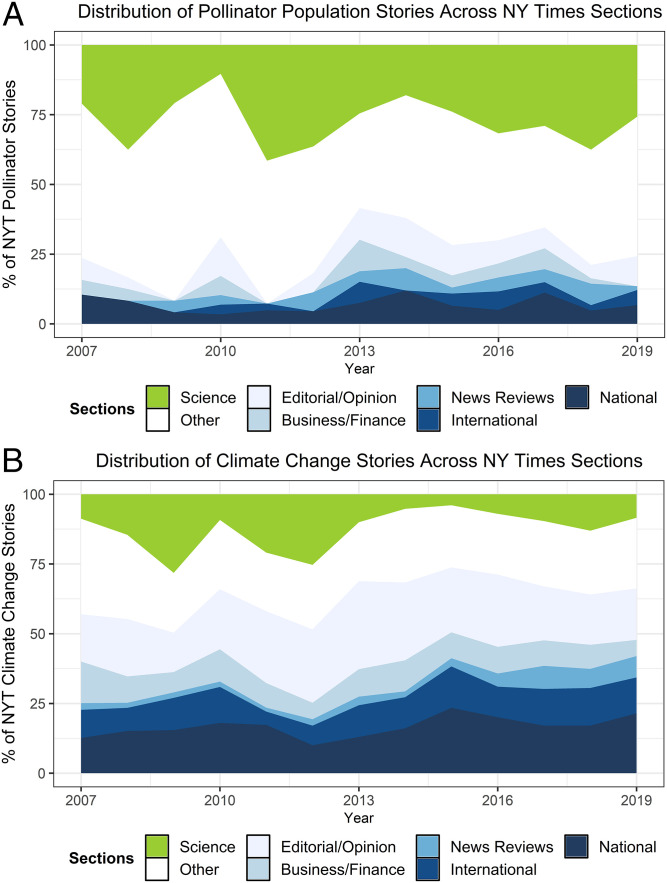
Although widespread declines in insect biomass and diversity are increasing concerns within the scientific community, it remains unclear whether attention to pollinator declines has also increased within information sources serving the general public. Examining patterns of journalistic attention to the pollinator population crisis can also inform efforts to raise awareness about the importance of declines of insect species providing ecosystem services beyond pollination. We used the Global News Index developed by the Cline Center for Advanced Social Research at the University of Illinois at Urbana-Champaign to track news attention to pollinator topics in nearly 25 million news items published by two American national newspapers and four international wire services over the past four decades. We found vanishingly low levels of attention to pollinator population topics relative to coverage of climate change, which we use as a comparison topic. In the most recent subset of ∼10 million stories published from 2007 to 2019, 1.39% (137,086 stories) refer to climate change/global warming while only 0.02% (1,780) refer to pollinator populations in all contexts, and just 0.007% (679) refer to pollinator declines. Substantial increases in news attention were detectable only in US national newspapers. We also find that, while climate change stories appear primarily in newspaper "front sections," pollinator population stories remain largely marginalized in "science" and "back section" reports. At the same time, news reports about pollinator populations increasingly link the issue to climate change, which might ultimately help raise public awareness to effect needed policy changes.
Keywords: insect decline; news attention; text data.
Conflict of interest statement
The authors declare no competing interest.
Figures
References
-
- Wagner D. L., Insect declines in the anthropocene. Annu. Rev. Entomol. 65, 457–480 (2020). - PubMed
-
- van Klink R., et al. , Meta-analysis reveals declines in terrestrial but increases in freshwater insect abundances. Science 368, 417–420 (2020). - PubMed
-
- Holland W. J., The Moth Book: A Popular Guide to a Knowledge of the Moths of North America (Doubleday, Page & Co., New York, 1903).
-
- Pyle R. M., “The origins and history of insect conservation in the United States” in Insect Conservation: Past, Present and Prospects, New T. R., Ed. (Springer Netherlands, Dordrecht, 2012), pp. 157–170.
-
- Carson R., Silent Spring (Houghton Mifflin, New York, 1962).
MeSH terms
LinkOut - more resources
Full Text Sources
Other Literature Sources
Miscellaneous
