Review
. 2021 May 3;13(5):a039917.
doi: 10.1101/cshperspect.a039917.

Noncanonical Auxin Signaling

Affiliations
Review

Noncanonical Auxin Signaling

Heather Marie McLaughlin et al. Cold Spring Harb Perspect Biol. .

Abstract

Auxin influences all aspects of plant growth and development and exerts its function at scales ranging from the subcellular to the whole-organism level. A canonical mechanism for auxin signaling has been elucidated, which is based on derepression of downstream genes via ubiquitin-mediated degradation of transcriptional repressors. While the combinatorial nature of this canonical pathway provides great potential for specificity in the auxin response, alternative noncanonical signaling pathways required to mediate certain processes have been identified. One such pathway affects gene regulation in a manner that is reminiscent of mechanisms employed in animal hormone signaling, while another triggers transcriptional changes through auxin perception at the plasma membrane and the stabilization of transcriptional repressors. In some cases, the exact perception mechanisms and the nature of the receptors involved are yet to be revealed. In this review, we describe and discuss current knowledge on noncanonical auxin signaling and highlight unresolved questions surrounding auxin biology.


Figures

Figure 1.
Figure 1.
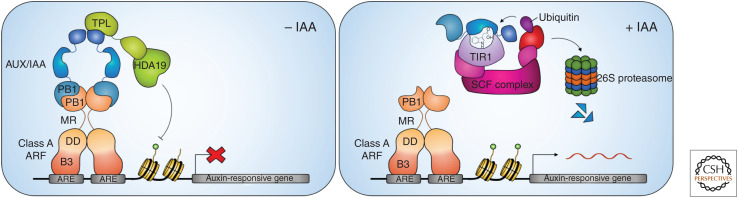
The canonical auxin signaling pathway. In the absence of auxin, AUXIN RESPONSE FACTORS (ARFs) are bound by Aux/IAA repressor proteins, which recruit transcriptional corepressors and prevent the expression of auxin-responsive genes. Auxin increases the affinity between the TIR1/AFB auxin receptor complex and Aux/IAAs, which are subsequently ubiquitinated and degraded. ARFs are then free to activate the expression of auxin-responsive genes. (ARE) Auxin-responsive element, (B3) B3 DNA-binding domain, (DD) dimerization domain, (MR) middle region, (PB1) Phox and Bem1 domain.
Figure 2.
Figure 2.
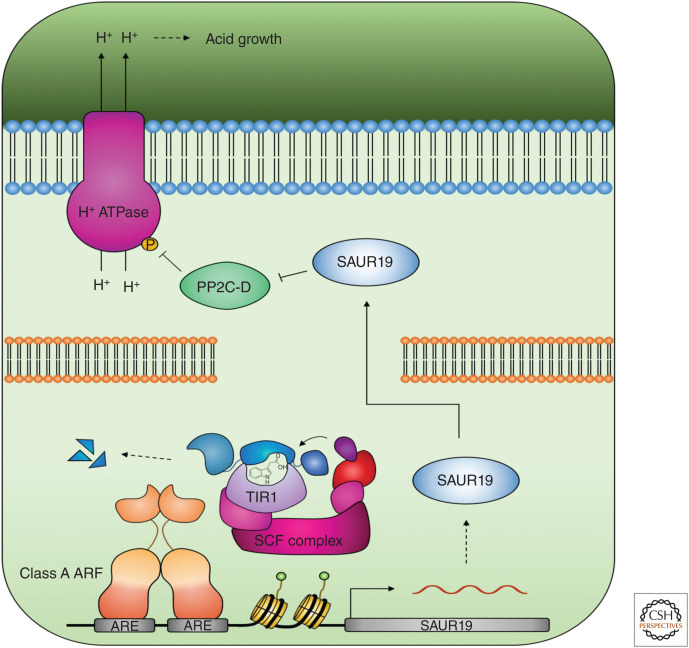
Auxin triggers the up-regulation of SAUR19 through the canonical signaling pathway. SAUR19 inhibits PP2C-D activity leading to the phosphorylation and activation of H+-ATPases, the acidification of the apoplast, and acid growth.
Figure 3.
Figure 3.
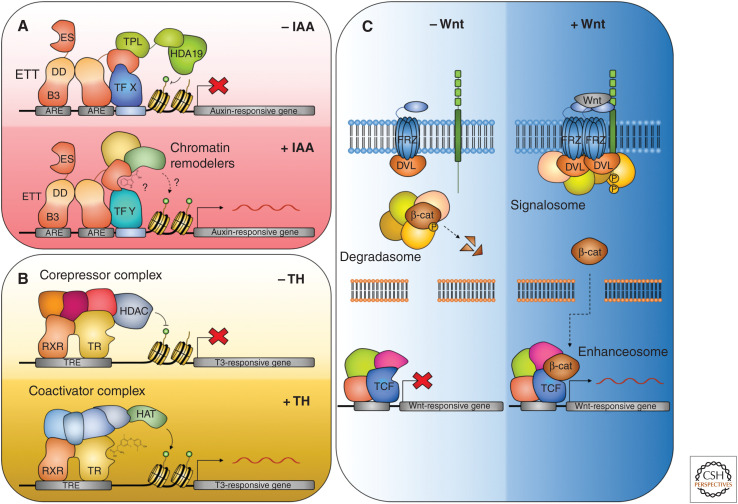
Ligand-mediated switch in the activity of transcription factor complexes. (A) The ETT-mediated auxin signaling pathway. In the absence of auxin, ETT recruits the corepressor TOPLESS (TPL) to target loci. TPL, in turn, recruits HDA19, which deacetylates histones and represses target gene expression. Auxin binds to ETT directly through the ETT-specific (ES) domain and triggers the dissociation of the repressive complex. Histone acetylation occurs, potentially through the recruitment of coactivators by ETT, and target genes are derepressed. (B) Thyroid hormone (TH) signaling pathway. In the absence of TH, the DNA-bound thyroid hormone receptor (THR) is associated with corepressors and histone deacetylases (HDACs), which repress target gene expression. In the presence of TH, the corepressors are exchanged for coactivators, and histone acetyltransferases (HATs) are recruited, activating target genes. (C) Wnt/β-catenin signaling. In the absence of Wnt, β-catenin is degraded by the degradasome. When the Wnt ligand binds to the Frizzled (FRZ) receptor, degradasome components are recruited to the plasma membrane by the active receptors, leading to the formation of the signalosome, and the accumulation of β-catenin. β-Catenin enters the nucleus and associates with the TCF transcription factor and other components of the enhanceosome, the Groucho corepressors dissociate, and Wnt-responsive genes are expressed.
Figure 4.
Figure 4.
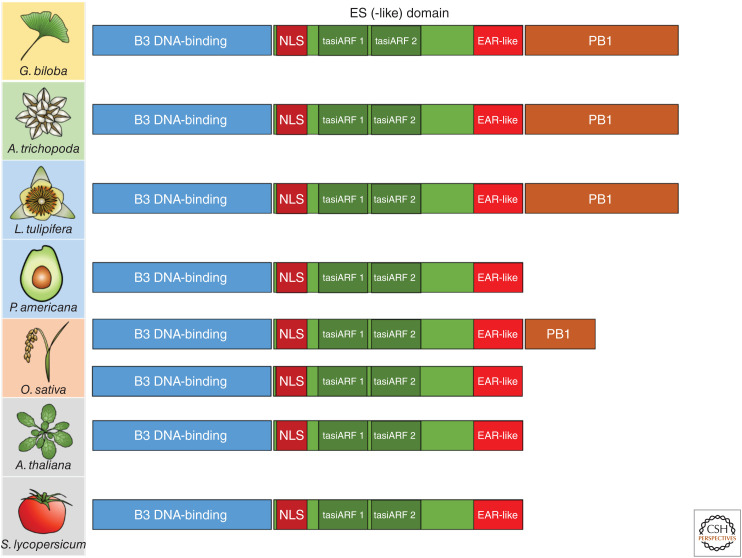
ETT domains and their conservation across the seed plants. ETT in the eudicot Arabidopsis thaliana and Solanum lycopersicum contains a highly conserved B3 DNA-binding domain, a nuclear localization signal (NLS), two tasi-ARF-binding sites, and an EAR-like TPL-interacting domain. The ARF3/4-like ortholog of the gymnosperm Ginkgo biloba and the ETT of the basal angiosperm Amborella trichopoda share these domains but also contain a full-length PB1 domain. Within the magnoliids, the PB1 domain is retained in the Liriodendron tulipifera ortholog but has been lost in the Persea americana ortholog. The monocot Oryza sativa has two clades of ETT paralogs with either a partial or total loss of the PB1 domain.
Figure 5.
Figure 5.
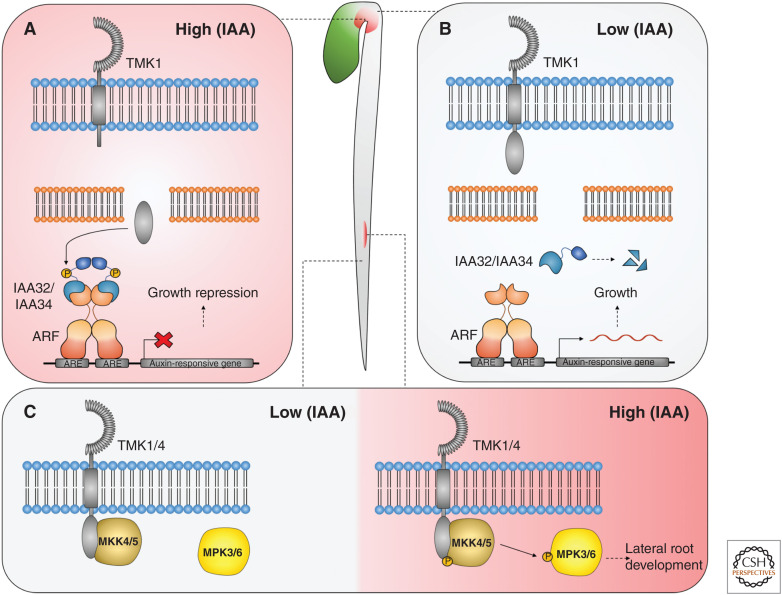
Trans-Membrane Kinase 1 (TMK1)-mediated auxin signaling during apical hook maintenance and lateral root emergence. (A) Relatively high auxin concentrations at the concave side of the apical hook activate the cleavage of the TMK1 carboxyl terminus. (B) At the convex side of the apical hook, relatively low auxin concentrations promote growth due to the destabilization of IAA32/34. The carboxyl-terminus of TMK1 is translocated to the nucleus, where it phosphorylates and stabilizes IAA32/34 to repress gene expression and inhibit growth. (C) Under high auxin conditions, TMK1 phosphorylates MKK4/5, triggering the downstream phosphorylation of MPK3/6 to regulate lateral root emergence.

References

    1. Abbas M, Alabadí D, Blázquez MA. 2013. Differential growth at the apical hook: all roads lead to auxin. Front Plant Sci 4: 441. 10.3389/fpls.2013.00441 - DOI - PMC - PubMed
    1. Adamowski M, Li L, Friml J. 2019. Reorientation of cortical microtubule arrays in the hypocotyl of Arabidopsis thaliana is induced by the cell growth process and independent of auxin signaling. Int J Mol Sci 20: 3337. 10.3390/ijms20133337 - DOI - PMC - PubMed
    1. Arsuffi G, Braybrook SA. 2018. Acid growth: an ongoing trip. J Exp Botany 69: 137–146. 10.1093/jxb/erx390 - DOI - PubMed
    1. Bergfeld R, Speth V, Schopfer P. 1988. Reorientation of microfibrils and microtubules at the outer epidermal wall of maize coleoptiles during auxin-mediated growth. Bot Acta 101: 57–67. 10.1111/j.1438-8677.1988.tb00012.x - DOI
    1. Berleth T, Jürgens G. 1993. The role of the monopteros gene in organizing the basal body region of the Arabidopsis embryo. Development 118: 575–587.

Publication types

MeSH terms

LinkOut - more resources