. 2021 Jan 11;11(1):340.
doi: 10.1038/s41598-020-79350-7.

Antagomir-mediated suppression of microRNA-134 reduces kainic acid-induced seizures in immature mice

Affiliations

Antagomir-mediated suppression of microRNA-134 reduces kainic acid-induced seizures in immature mice

Aoife Campbell et al. Sci Rep. .

Abstract

MicroRNAs are short non-coding RNAs that negatively regulate protein levels and perform important roles in establishing and maintaining neuronal network function. Previous studies in adult rodents have detected upregulation of microRNA-134 after prolonged seizures (status epilepticus) and demonstrated that silencing microRNA-134 using antisense oligonucleotides, termed antagomirs, has potent and long-lasting seizure-suppressive effects. Here we investigated whether targeting microRNA-134 can reduce or delay acute seizures in the immature brain. Status epilepticus was induced in 21 day-old (P21) male mice by systemic injection of 5 mg/kg kainic acid. This triggered prolonged electrographic seizures and select bilateral neuronal death within the CA3 subfield of the hippocampus. Expression of microRNA-134 and functional loading to Argonaute-2 was not significantly changed in the hippocampus after seizures in the model. Nevertheless, when levels of microRNA-134 were reduced by prior intracerebroventricular injection of an antagomir, kainic acid-induced seizures were delayed and less severe and mice displayed reduced neuronal death in the hippocampus. These studies demonstrate targeting microRNA-134 may have therapeutic applications for the treatment of seizures in children.


Conflict of interest statement

The Royal College of Surgeons in Ireland (DH) holds a patent for the inhibition of microRNA-134 for the treatment of seizure-related disorders and other neurologic injuries (US 9,803,200 B2). JW, MAJ and MTM are employees of Hoffman-La Roche Ltd. All other authors have no competing interests.

Figures
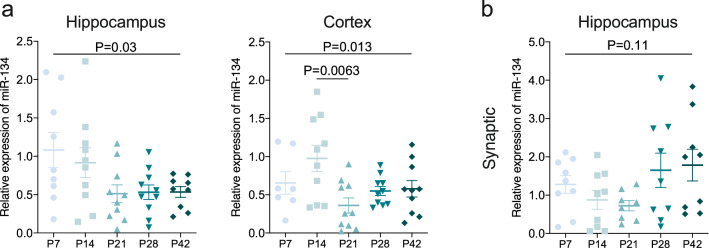
Figure 1
Figure 1
Expression of miR-134 in naïve brain over the developmental period P7-P42. (a) Overall miR-134 levels in naïve hippocampus and neocortex following standard RNA extraction (N = 10/group), overall change of levels of miR-134 over developmental period following standard RNA extraction with a significant decrease in cortex between P14 and P21. (b) Synaptic miR-134 levels in hippocampus. Two hippocampi were pooled to make up each experimental number (N = 9 per group for hippocampus), no change in levels of miR-134 following synaptic enrichment.
Figure 2
Figure 2
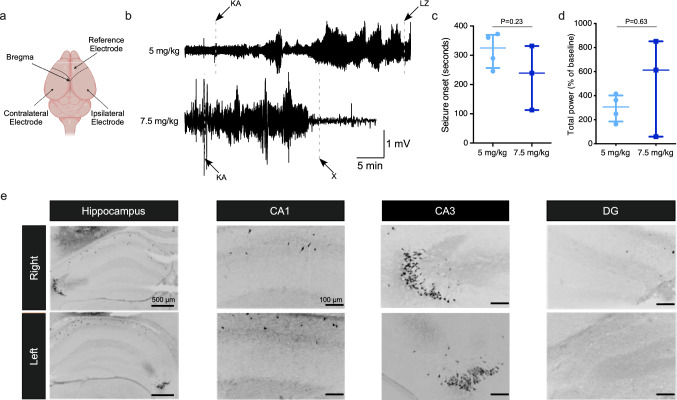
KA dose selection for the induction of seizures in P21 mice. (a) Schematic of electrode placement in P21 mouse brain. (b) Representative EEG traces for mice injected with 5 or 7.5 mg/kg KA (KA—KA injection, LZ—lorazepam injection, X—mouse died). (c) Graph shows no difference in onset to first electrographic seizure after the IP injection of 5 (N = 4) or 7.5 (N = 3) mg/kg of KA. (d) Graph shows no difference in % of increase in EEG total power, relative to baseline, recorded over the 30 min after KA injection. (e) Representative images of FJB staining show neuronal death at 24 h post SE (5 mg/kg KA) in the right and left hippocampi of a P21 mouse.
Figure 3
Figure 3
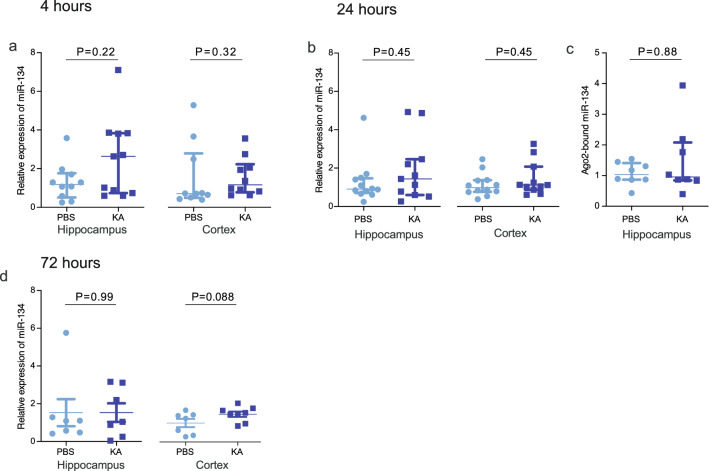
Systemic KA does not alter miR-134 expression in P21 mice. Graphs show real-time quantitative PCR analysis of miR-134 expression in hippocampal and cortical lysates at different time points after systemic KA injection, with counts normalised to RNU6B. (a) Overall miR-134 expression at 4 h (N = 10–11/group). (b) Overall miR-134 expression at 24 h (N = 11–12/group). (c) Ago2-bound (functionally engaged) miR-134 in hippocampus at 24 h (N = 8/group). (d) miR-134 expression at 72 h (N = 7/group).
Figure 4
Figure 4
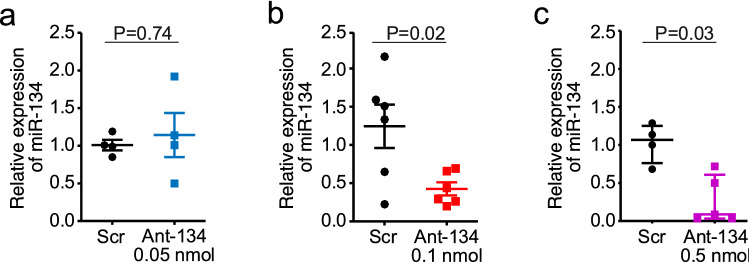
Ant-134 silences miR-134 in the hippocampus of naïve mice. (a) Relative expression of miR-134 following ICV injection of Scr/Ant-134 (0.05 nmol), (N = 4/group). (b) Relative expression of miR-134 following ICV injection of Scr/Ant-134 (0.1 nmol), (N = 6 [Scr] or N = 6 [Ant-134]. (c) Relative expression of miR-134 following ICV injection of Scr/Ant-134 (0.5 nmol), (N = 4 [Scr] or N = 5 [Ant-134]).
Figure 5
Figure 5
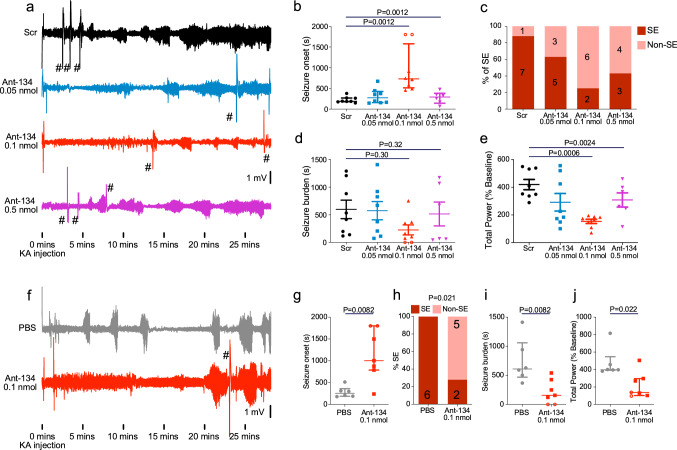
Protective effects of Ant-134 on SE severity in P21 mice. (a) Representative EEG traces from mice pre-treated with 0.05, 0.1 or 0.5 nmol Ant-134 in 2 µL PBS, or scramble control (Scr). Traces shown begin at the time of KA injection. (b) Dose-dependent effects of Ant-134 on seizure severity (N = 8 per group [Scr,0.05 nmol,0.1 nmol] or N = 5 [0.5 nmol]). 0.1 nmol Ant-134 increased time to seizure onset after KA injection. (c) There is a dose-dependent effect of Ant-134 on the percentage of mice experiencing SE following KA injection. There was no difference in seizure burden between groups and (d), however, there was a significant reduction in total EEG power in mice which received 0.1 nmol Ant-134 (e). (f) We performed a second set of experiments to validate the use of 0.1 nmol Ant-134 (N = 7, PBS N = 6). Representative traces start at the time of KA injection and show EEG recorded from mice pre-treated with 0.1 nmol Ant-134, or PBS control. (g) 0.1 nmol Ant-134 delayed seizure onset, reduced the percentage of mice experiencing full SE (h), reduced seizure burden, and reduced total EEG power (j). #—Artefacts caused by injections in other mice recorded simultaneously. Open circles represent mice which did not experience any seizure activity. Seizure onset was assigned a maximum value of 1800s for statistical purposes.
Figure 6
Figure 6
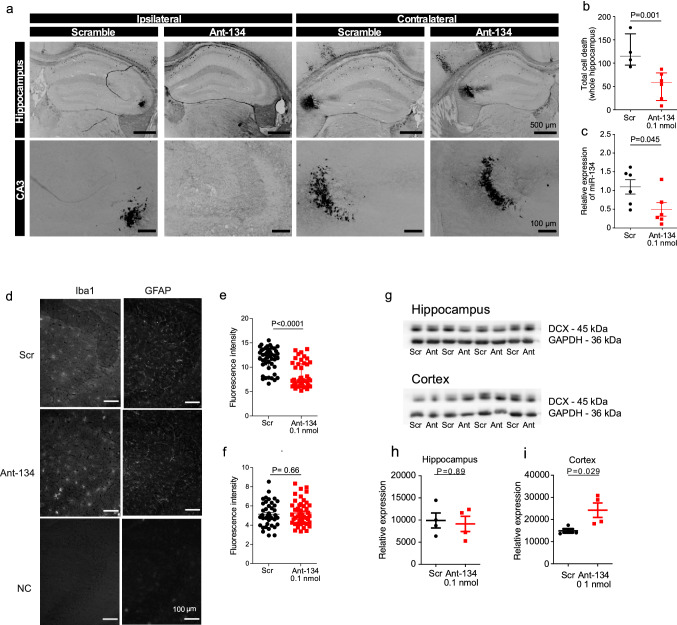
Ant-134 has protective effects in the hippocampus and de-represses cortical DCX. (a) Representative FJB-stained images show neuronal death in the hippocampus 24 h after SE ipsi- and contralateral to pre-treatment with 0.1 nmol Ant-134 or scramble control (Scr). (b) The number of FJB-stained cells was reduced in mice pre-treated with Ant-134 (N = 6) compared with scramble control (N = 4). (c) Partial knockdown of miR-134 levels (54.8%) was retained 24 h after SE in the hippocampus of mice that were pre-treated with 0.1 nmol Ant-134 (N = 6) or Scr (N = 6). (d) Representative immunohistochemistry staining with Iba1 and GFAP in the CA3 of the hippocampus after SE. (e) The number of activated microglia was decreased in mice pre-treated with Ant-134 (N = 3) compared with scramble control (N = 3). (f) There was no difference in the number of astrocytes in mice pre-treated with Ant-134 (N = 3) and scrambled control (N = 3). (g) Western blot showing DCX expression in hippocampus and cortex at 24 h after KA-induced seizures of mice pre-treated with Scr/Ant-134 (0.1 nmol). Full-length blot can be found in Supplementary Fig. S3a. (h) Densitometry analysis of DCX in the hippocampus. GAPDH was used as the loading control, (N = 4/group). (i) Densitometry of DCX in the cortex. GAPDH was used as the loading control (N = 4/group).

References

    1. Hauser WA. The prevalence and incidence of convulsive disorders in children. Epilepsia. 1994;35(Suppl 2):S1–6. doi: 10.1111/j.1528-1157.1994.tb05932.x. - DOI - PubMed
    1. Chin RFM, et al. Incidence, cause, and short-term outcome of convulsive status epilepticus in childhood: prospective population-based study. The Lancet. 2006;368:222–229. doi: 10.1016/S0140-6736(06)69043-0. - DOI - PubMed
    1. Raspall-Chaure M, Chin RFM, Neville BG, Bedford H, Scott RC. The epidemiology of convulsive status epilepticus in children: a critical review. Epilepsia. 2007;48:1652–1663. doi: 10.1111/j.1528-1167.2007.01175.x. - DOI - PubMed
    1. Singh RK, Gaillard WD. Status epilepticus in children. Curr. Neurol. Neurosci. Rep. 2009;9:137–144. doi: 10.1007/s11910-009-0022-9. - DOI - PubMed
    1. Maytal J, Shinnar S, Moshé SL, Alvarez LA. Low morbidity and mortality of status epilepticus in children. Pediatrics. 1989;83:323–331. - PubMed

Publication types