


Flattening the curves: on-off lock-down strategies for COVID-19 with an application to Brazil
- PMID: 33432282
- PMCID: PMC7787424
- DOI: 10.1186/s13362-020-00098-w
Flattening the curves: on-off lock-down strategies for COVID-19 with an application to Brazil
Abstract
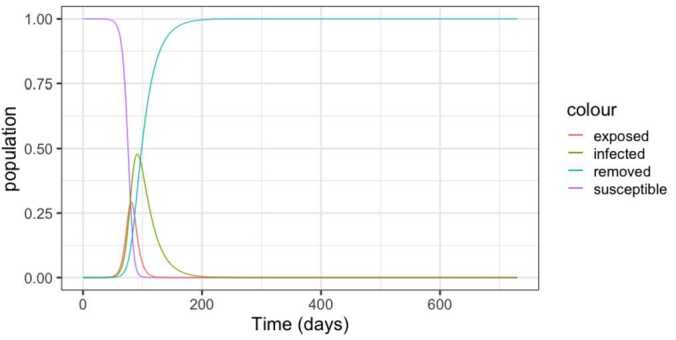
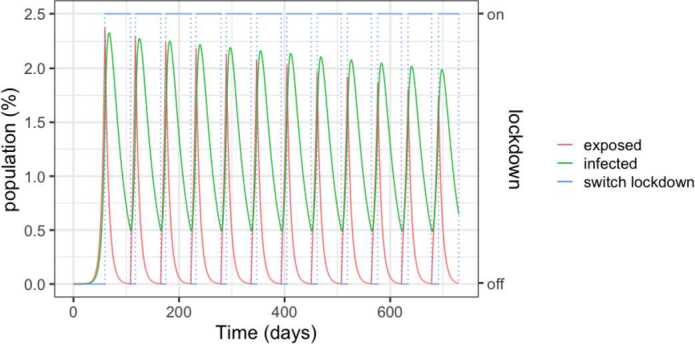
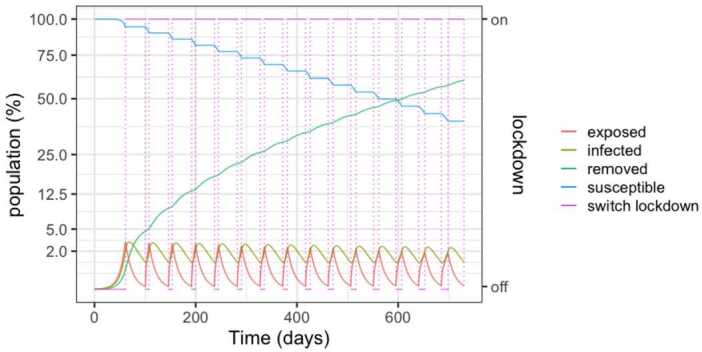
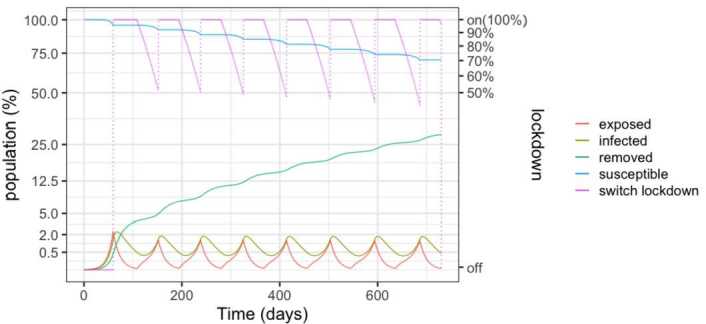
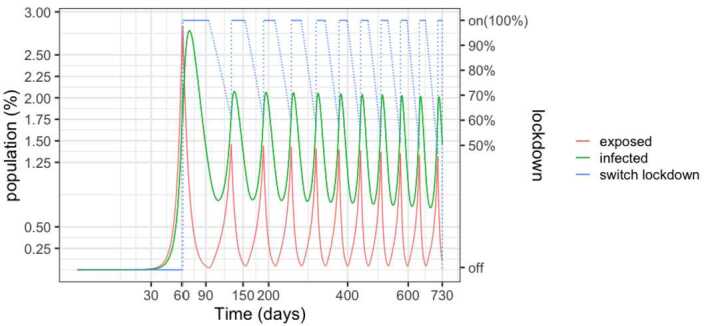
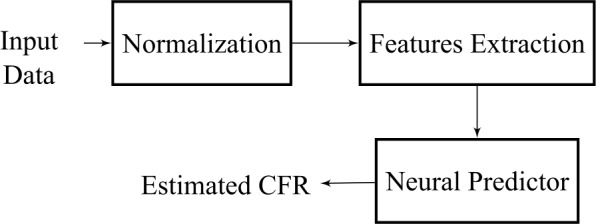
The current COVID-19 pandemic is affecting different countries in different ways. The assortment of reporting techniques alongside other issues, such as underreporting and budgetary constraints, makes predicting the spread and lethality of the virus a challenging task. This work attempts to gain a better understanding of how COVID-19 will affect one of the least studied countries, namely Brazil. Currently, several Brazilian states are in a state of lock-down. However, there is political pressure for this type of measures to be lifted. This work considers the impact that such a termination would have on how the virus evolves locally. This was done by extending the SEIR model with an on / off strategy. Given the simplicity of SEIR we also attempted to gain more insight by developing a neural regressor. We chose to employ features that current clinical studies have pinpointed has having a connection to the lethality of COVID-19. We discuss how this data can be processed in order to obtain a robust assessment.
Supplementary information: The online version contains supplementary material available at 10.1186/s13362-020-00098-w.
Keywords: COVID-19; Coronavirus; Lockdown; Neural network; Quarantine; Seir models.
© The Author(s) 2021.
Conflict of interest statement
Competing interestsThe authors declare that they have no competing interests.
Figures





References
-
- Rodriguez-Morales AJ, Cardona-Ospina JA, Gutiérrez-Ocampo E, Villamizar-Peña R, Holguin-Rivera Y, Escalera-Antezana JP, Alvarado-Arnez LE, Bonilla-Aldana DK, Franco-Paredes C, Henao-Martinez AF, Paniz-Mondolfi A, Lagos-Grisales GJ, Ramírez-Vallejo E, Suárez JA, Zambrano LI, Villamil-Gómez WE, Balbin-Ramon GJ, Rabaan AA, Harapan H, Dhama K, Nishiura H, Kataoka H, Ahmad T, Sah R. Clinical, laboratory and imaging features of COVID-19: a systematic review and meta-analysis. Trav Med Infect Dis. 2020;34:101623. doi: 10.1016/j.tmaid.2020.101623. - DOI - PMC - PubMed
-
- Coronavirus disease 2019 (COVID-19): situation report—51. (March 2020).
-
- Novel coronavirus (2019-ncov) situation report—1 (January 2020).
-
- Ferguson N, Laydon D, Nedjati Gilani G, Imai N, Ainslie K, Baguelin M, Bhatia S, Boonyasiri A, Cucunuba Perez Z, Cuomo-Dannenburg G, Dighe A, Dorigatti I, Fu H, Gaythorpe K, Green W, Hamlet A, Hinsley W, Okell L, Van Elsland S, Thompson H, Verity R, Volz E, Wang H, Wang Y, Walker P, Winskill P, Whittaker C, Donnelly C, Riley S, Ghani A. Report 9: impact of non-pharmaceutical interventions (npis) to reduce COVID-19 mortality and healthcare demand. Tech. rep., Imperial College London (03 2020). 10.25561/77482.
-
- Flaxman S, Mishra S, Gandy A, Unwin H, Coupland H, Mellan T, Zhu H, Berah T, Eaton J, Perez Guzman P, Schmit N, Cilloni L, Ainslie K, Baguelin M, Blake I, Boonyasiri A, Boyd O, Cattarino L, Ciavarella C, Cooper L, Cucunuba Perez Z, Cuomo-Dannenburg G, Dighe A, Djaafara A, Dorigatti I, Van Elsland S, Fitzjohn R, Fu H, Gaythorpe K, Geidelberg L, Grassly N, Green W, Hallett T, Hamlet A, Hinsley W, Jeffrey B, Jorgensen D, Knock E, Laydon D, Nedjati Gilani G, Nouvellet P, Parag K, Siveroni I, Thompson H, Verity R, Volz E, Walters C, Wang H, Wang Y, Watson O, Winskill P, Xi X, Whittaker C, Walker P, Ghani A, Donnelly C, Riley S, Okell L, Vollmer M, Ferguson N, Bhatt S. Report 13: estimating the number of infections and the impact of non-pharmaceutical interventions on COVID-19 in 11 European countries. Tech. rep., Imperial College London (03 2020). 10.25561/77731.
LinkOut - more resources
Full Text Sources
Other Literature Sources