Molecular Identification of Parasites Causing Cutaneous Leishmaniasis in Panama
- PMID: 33432903
- PMCID: PMC8045627
- DOI: 10.4269/ajtmh.20-1336
Molecular Identification of Parasites Causing Cutaneous Leishmaniasis in Panama
Abstract
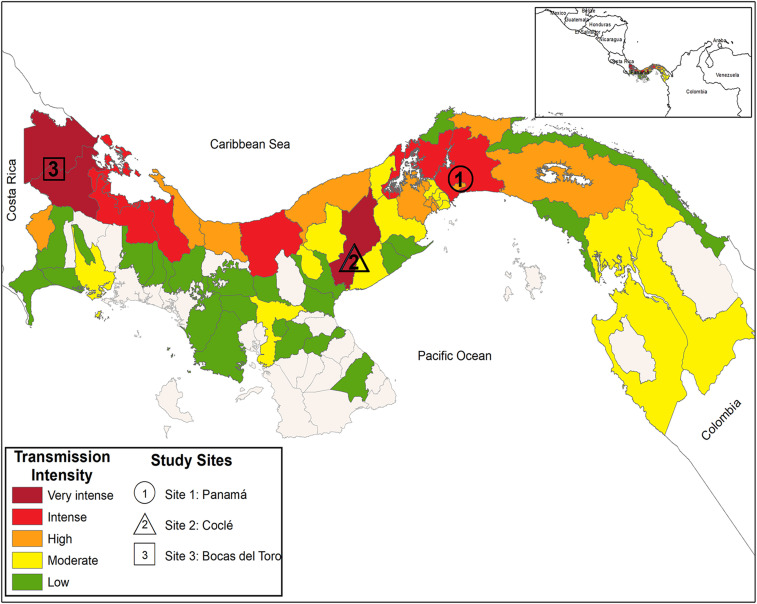
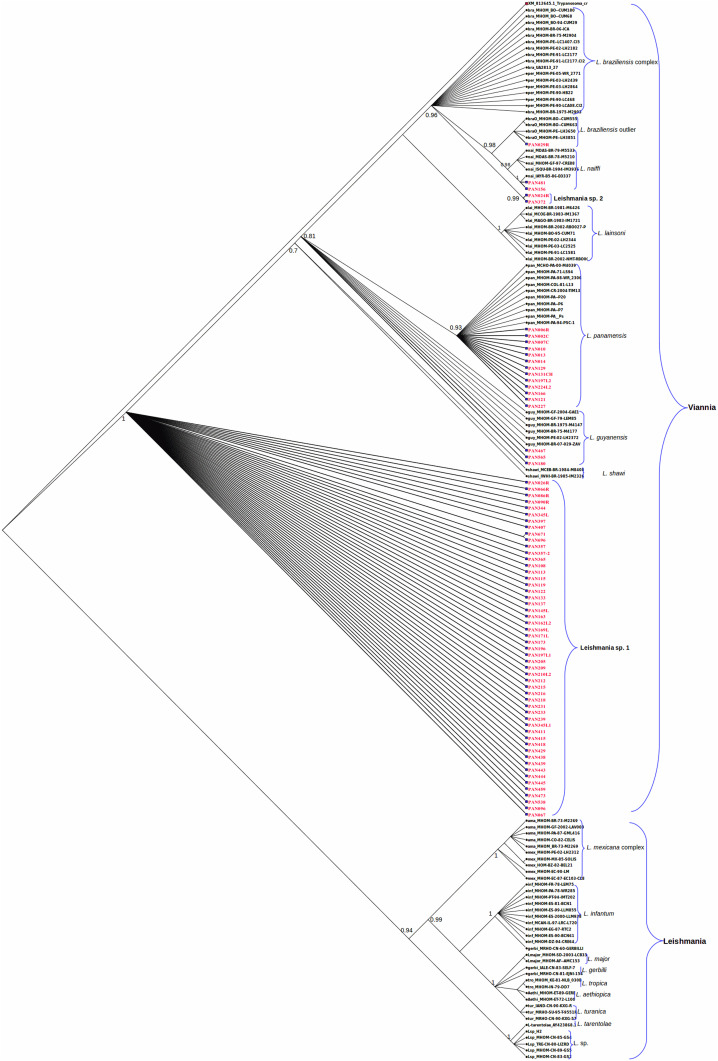
Isolates from 475 cutaneous leishmaniasis (CL) patients from three endemic regions were studied by three typing techniques. The molecular analysis from lesion scrapings based on hsp70 PCR-restriction fragment length polymorphism (RFLP) showed that 78.1% (371/475) restriction patterns corresponded to Leishmania (Viannia) panamensis, 19% (90/475) to Leishmania (Viannia) guyanensis, and 3.0% (14/475) to Leishmania (Viannia) braziliensis. Promastigotes isolated by culture from lesions of 228 patients (48.0%, 228/475) were identified by multi-locus enzyme electrophoresis. Of them, 95.2% (217/228) were typified as L. (V.) panamensis, 1.3% (3/228) as L. (V.) guyanensis, 2.2% (5/228) as L. (V.) braziliensis, and 1.3% (3/228) as hybrids (L. [V.] braziliensis/L. [V.] panamensis). However, a partial sequencing analysis of the hsp70 gene from 77 selected samples showed 16.9% (13/77) typified as L. (V.) panamensis, 68.8% (53/77) as Leishmania (V.) sp., 1, 3.9% (3/77) as L. (V.) guyanensis, 1.3% (1/77) as L. (V.) braziliensis outlier, 2.6% (2/77) as Leishmania (Viannia) naiffi, 2.6% as (2/77) Leishmania (V.) sp., and 2 and 3.9% (3/77) hybrid isolates of L. (V.) braziliensis/L. (V.) guyanensis. These results confirm L. (V.) panamensis as the predominant species and cause of CL lesions in Panama and that L. (V.) guyanensis, L. (V.) braziliensis, and L. (V.) naiffi are circulating to a lower degree. Furthermore, the determination of parasite isolates belonging to atypical clusters and hybrid isolates suggests the circulation of genetic variants with important implications for the epidemiology and clinical follow-up of CL in Panama. No evidence of the existence of parasites of the Leishmania (Leishmania) mexicana complex in Panamanian territory was found in this study.
Figures
References
-
- Bailey MS, Lockwood DNJ, 2007. Cutaneous leishmaniasis. Clin Dermatol 2: 203–211. - PubMed
-
- Leon LL, Machado GM, Barral A, de Carvalho-Paes LE, Grimaldi Júnior G, 1992. Antigenic differences among Leishmania amazonensis isolates and their relationship with distinct clinical forms of the disease. Mem Inst Oswaldo Cruz 87: 229–234. - PubMed
-
- Passos VM, Fernandes O, Lacerda PA, Volpini AC, Gontijo CM, Degrave W, Romanha AJ, 1999. Leishmania (Viannia) braziliensis is the predominant species infecting patients with American cutaneous leishmaniasis in the State of Minas Gerais, Southeast Brazil. Acta Trop 72: 251–258. - PubMed
-
- Berman J, 2006. Visceral leishmaniasis in the New World and Africa. Indian J Med Res 123: 289–294. - PubMed
Publication types
MeSH terms
Substances
LinkOut - more resources
Full Text Sources
Other Literature Sources