


Predictors of working days lost due to sickness absence and disability pension
- PMID: 33433695
- PMCID: PMC8238732
- DOI: 10.1007/s00420-020-01630-6
Predictors of working days lost due to sickness absence and disability pension
Abstract
Objective: To identify social and health-related predictors of the number of days lost due to sickness absence (SA) and disability pension (DP) among initially 55-year-old public-sector workers.
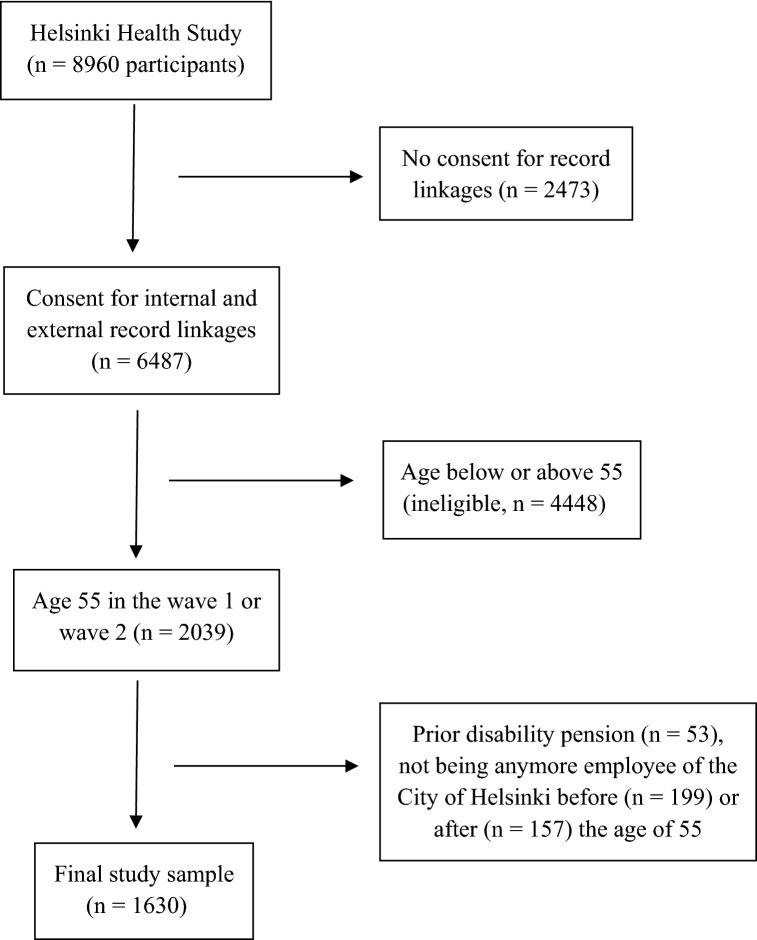
Methods: The data from the Finnish Helsinki Health Study included participants aged 55 years at the baseline (in 2000-2002, N = 1630, 81% women), and were enriched with register-based information on SA and DP. The cumulative number of calendar days lost due to SA ≥ 1 day or DP between ages 55 and 65 was calculated. Negative binomial regression model was used to identify the predictors of days lost.
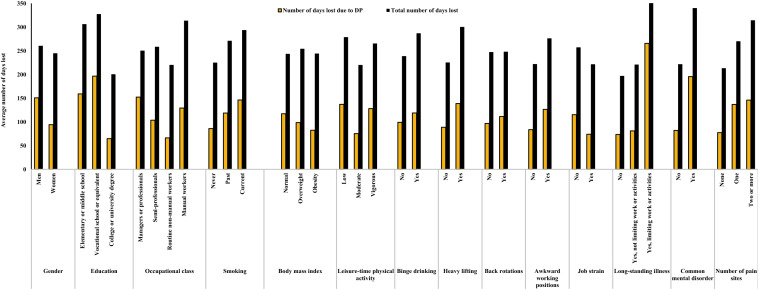
Results: The average calendar days lost was 316 days (about 220 working days) during a 10-year follow-up, and 44% were due to SA and 56% due to DP. Smoking [incidence rate ratio (IRR) = 1.19, 95% CI 1.01-1.40 for past and IRR = 1.30, CI 1.07-1.58 for current], binge drinking (IRR = 1.22, CI 1.02-1.46), lifting or pulling/pushing heavy loads (IRR = 1.35, CI 1.10-1.65), awkward working positions (IRR = 1.24, CI 1.01-1.53), long-standing illness limiting work or daily activities (IRR = 2.32, CI 1.93-2.79), common mental disorder (IRR = 1.52, CI 1.30-1.79), and multisite pain (IRR = 1.50, CI 1.23-1.84) increased the number of days lost, while high level of education (IRR = 0.66, CI 0.52-0.82) and moderate level of leisure-time physical activity (IRR = 0.80, CI 0.67-0.94) reduced the number of days lost.
Conclusions: Modifiable lifestyle risk factors, workload factors, common mental disorder, and multisite pain substantially increase the number of days lost. However, the findings of this study could be generalized to female workers in the public sector. Future research should also consider shorter SA spells in estimating working years lost and working life expectancy.
Keywords: Chronic disease; Healthy lifestyle; Life expectancy; Occupations; Sick leave; Work engagement; Workload.
Conflict of interest statement
The authors declare that they have no conflicts of interest.
Figures
References
-
- Ainsworth BE, Haskell WL, Herrmann SD, Meckes N, Bassett DR, Jr, Tudor-Locke C, Greer JL, Vezina J, Whitt-Glover MC, Leon AS. 2011 Compendium of Physical Activities: a second update of codes and MET values. Med Sci Sports Exerc. 2011;43(8):1575–1581. doi: 10.1249/MSS.0b013e31821ece12. - DOI - PubMed
-
- Aittomäki A. Social-class inequalities in ill health—the contribution of physical workload. Helsinki: University of Helsinki; 2008.
-
- Canivet C, Choi B, Karasek R, Moghaddassi M, Staland-Nyman C, Ostergren PO. Can high psychological job demands, low decision latitude, and high job strain predict disability pensions? A 12-year follow-up of middle-aged Swedish workers. Int Arch Occup Environ Health. 2013;86(3):307–319. doi: 10.1007/s00420-012-0766-4. - DOI - PubMed
MeSH terms
LinkOut - more resources
Full Text Sources
Other Literature Sources
Miscellaneous
