


Sex modulates the association of radial artery augmentation index with renal function decline in individuals without chronic kidney disease
- PMID: 33433788
- PMCID: PMC8599233
- DOI: 10.1007/s11255-020-02776-5
Sex modulates the association of radial artery augmentation index with renal function decline in individuals without chronic kidney disease
Abstract
Purpose: An increase in arterial stiffness is associated with rapid renal function decline (RFD) in patients with chronic kidney disease (CKD). The aim of this study was to investigate whether the radial augmentation index (rAI), a surrogate marker of arterial stiffness, affects RFD in individuals without CKD.
Methods: A total of 3165 Chinese participants from an atherosclerosis cohort with estimated glomerular filtration rates (eGFR) of ≥ 60 mL/min/1.73 m2 were included in this study. The baseline rAI normalized to a heart rate of 75 beats/min (rAIp75) was obtained using an arterial applanation tonometry probe. The eGFRs at both baseline and follow-up were calculated using the equation derived from the Chronic Kidney Disease Epidemiology Collaboration. The association of the rAIp75 with RFD (defined as a drop in the eGFR category accompanied by a ≥ 25% drop in eGFR from baseline or a sustained decline in eGFR of > 5 mL/min/1.73 m2/year) was evaluated using the multivariate regression model.
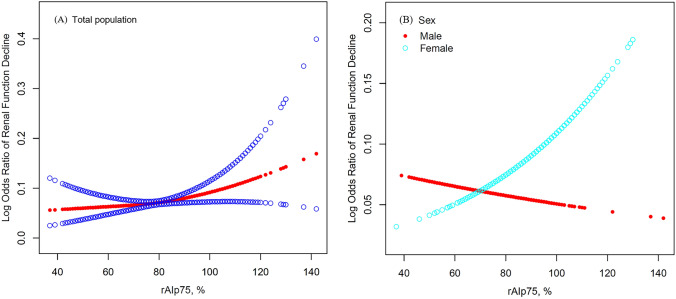
Results: During the 2.35-year follow-up, the incidence of RFD was 7.30%. The rAIp75 had no statistically independent association with RFD after adjustment for possible confounders (adjusted odds ratio = 1.12, 95% confidence interval: 0.99-1.27, p = 0.074). When stratified according to sex, the rAIp75 was significantly associated with RFD in women, but not in men (adjusted odds ratio and 95% confidence interval: 1.23[1.06-1.43], p = 0.007 for women, 0.94[0.76-1.16], p = 0.542 for men; p for interaction = 0.038).
Conclusion: The rAI might help screen for those at high risk of early rapid RFD in women without CKD.
Keywords: Arterial stiffness; Radial augmentation index; Renal function decline; Sex.
© 2021. The Author(s).
Conflict of interest statement
The authors declare that there is no conflict of interest.
Figures
References
MeSH terms
Grants and funding
- BMU20110177/the University of Michigan - Peking University Health Science Centre (UMHS-PUHSC) Joint Institute for Translational and Clinical Research and the Fundamental Research Funds for the Central Universities
- BMU20160530/the University of Michigan - Peking University Health Science Centre (UMHS-PUHSC) Joint Institute for Translational and Clinical Research and the Fundamental Research Funds for the Central Universities
- 2017YFC1307704/the National Key Research and Development Program of China
LinkOut - more resources
Full Text Sources
Other Literature Sources
Research Materials
Miscellaneous
