


The contributions of focused attention and open monitoring in mindfulness-based cognitive therapy for affective disturbances: A 3-armed randomized dismantling trial
- PMID: 33434227
- PMCID: PMC7802967
- DOI: 10.1371/journal.pone.0244838
The contributions of focused attention and open monitoring in mindfulness-based cognitive therapy for affective disturbances: A 3-armed randomized dismantling trial
Abstract
Objective: Mindfulness-based cognitive therapy (MBCT) includes a combination of focused attention (FA) and open monitoring (OM) meditation practices. The aim of this study was to assess both short- and long-term between- and within-group differences in affective disturbance among FA, OM and their combination (MBCT) in the context of a randomized controlled trial.
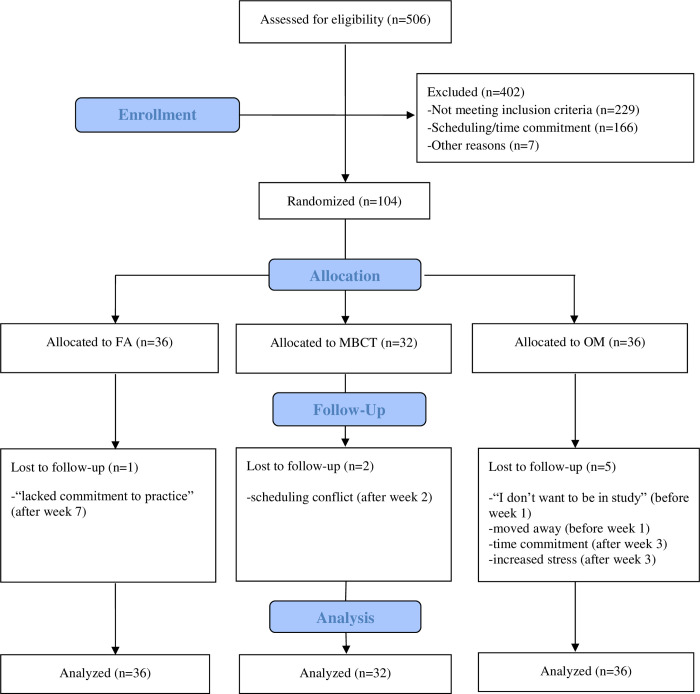
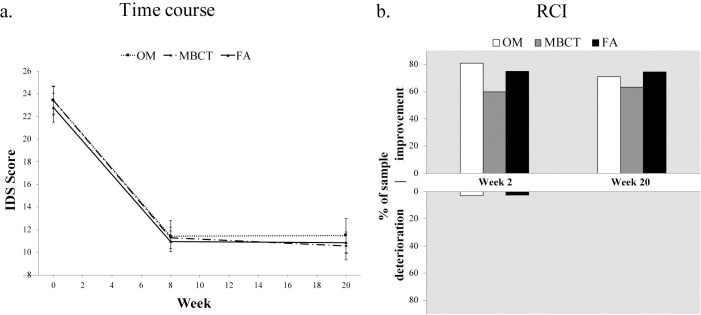
Method: One hundred and four participants with mild to severe depression and anxiety were randomized into one of three 8-week interventions: MBCT (n = 32), FA (n = 36) and OM (n = 36). Outcome measures included the Inventory of Depressive Symptomatology (IDS), and the Depression Anxiety Stress Scales (DASS). Mixed effects regression models were used to assess differential treatment effects during treatment, post-treatment (8 weeks) and long-term (20 weeks). The Reliable Change Index (RCI) was used to translate statistical findings into clinically meaningful improvements or deteriorations.
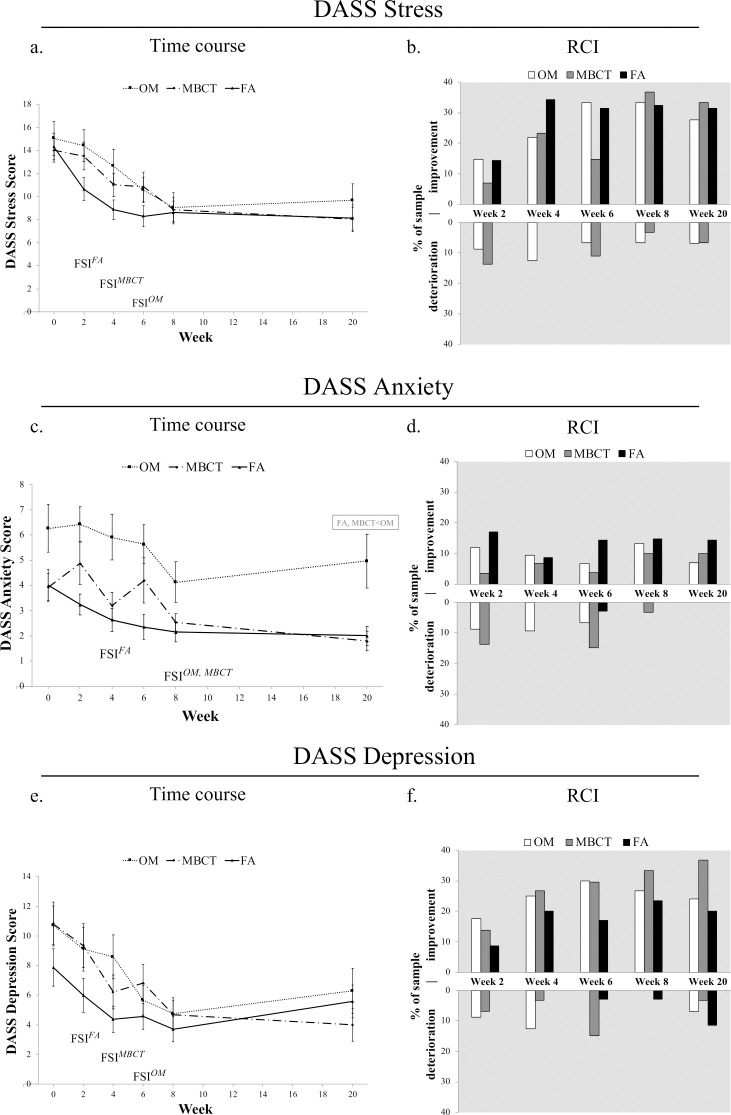
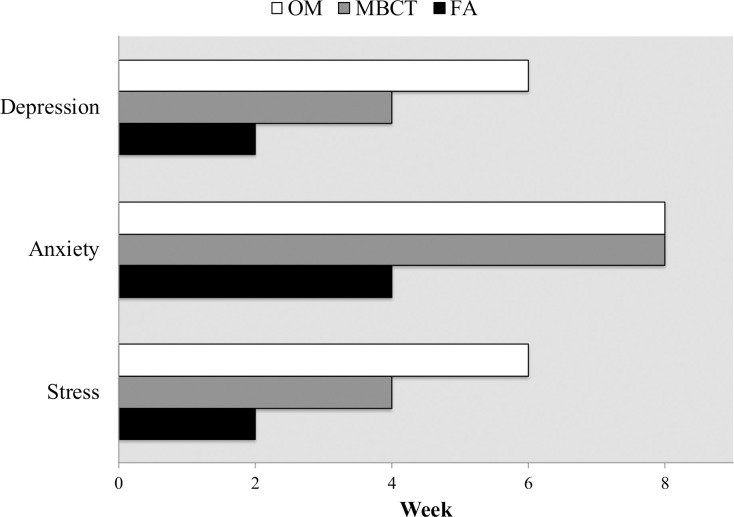
Results: All treatments demonstrated medium to large improvements (ds = 0.42-1.65) for almost all outcomes. While all treatments were largely comparable in their effects at post-treatment (week 8), the treatments showed meaningful differences in rapidity of response and pattern of deteriorations. FA showed the fastest rate of improvement and the fewest deteriorations on stress, anxiety and depression during treatment, but a loss of treatment-related gains and lasting deteriorations in depression at week 20. OM showed the slowest rate of improvement and lost treatment-related gains for anxiety, resulting in higher anxiety in OM at week 20 than MBCT (d = 0.40) and FA (d = 0.36), though these differences did not reach statistical significance after correcting for multiple comparisons (p's = .06). MBCT and OM showed deteriorations in stress, anxiety and depression at multiple timepoints during treatment, with lasting deteriorations in stress and depression. MBCT showed the most favorable pattern for long-term treatment of depression.
Conclusions: FA, OM and MBCT show different patterns of response for different dimensions of affective disturbance.
Trial registration: This trial is registered at (v NCT01831362); www.clinicaltrials.gov.
Conflict of interest statement
The authors have read the journal’s policy and have the following competing interests: WBB is a MBSR and MBCT teacher and has received financial compensation for this role, and is also nominally affiliated with the Mindfulness Center at Brown University which generates income by offering mindfulness classes to the public. WBB is the founder of Cheetah House, a RI non-profit organization that provides information about meditation-related difficulties, individual consultations, and support groups, as well as educational trainings to meditation teachers, clinicians, educators and mindfulness providers. This interest has been disclosed to and is being managed by Brown University, in accordance with its Conflict of Interest and Conflict of Commitment policies. This does not alter our adherence to PLOS ONE policies on sharing data and materials.
Figures
References
-
- Segal ZV, Williams JM, Teasdale JD. Mindfulness-based cognitive therapy for depression: a new approach to preventing relapse. London: Guilford; 2002.
Publication types
MeSH terms
Associated data
Grants and funding
LinkOut - more resources
Full Text Sources
Other Literature Sources
Medical
